
How to Start an Interview Podcast and Book Guests


To start an interview podcast, pick a format narrow enough that one type of guest always fits, line up your first three guests before you record, and book from a cold pitch instead of waiting for an audience. Then treat the interview as a skill: research the guest, ask for stories, and use follow-ups and silence so it never collapses into a Q&A list.
The gear matters less than you think. The two things that actually decide whether your show is worth listening to are who you get in the chair and what you do once they are there. Both are learnable, and neither requires a following. Below is the guest-pipeline manual: the pitch template that earns yeses from people who have never heard of you, the pre-interview doc you fill out before every recording, and the four in-conversation moves that turn a list of questions into a conversation.
First, the format decision, because it controls everything downstream.
What format should an interview podcast use?
Pick the narrowest format where one kind of guest always fits. A "people in [your field]" show is too broad to pitch; "operators who scaled a service business past $1M" is specific enough that a stranger reads the invite and immediately knows whether they belong. The narrower the lane, the easier the booking, the sharper the questions, and the more an episode travels to the right listeners.
Three format patterns work for a new interview show, and they differ mainly in how you find guests:
- The expertise show. One guest per episode, dug into a single domain. Easiest to research and pitch because the relevance is obvious, the same logic that runs a business podcast that wins clients.
- The story show. The guest is interesting for what happened to them, not their title. Harder to source (you find them through articles, not LinkedIn searches), but the episodes carry further because a story beats a resume.
- The recurring-guest or panel show. A small rotating cast you book once and reuse. Lower booking load per episode, at the cost of the variety that makes a feed worth subscribing to.
Whatever you pick, write a one-sentence guest definition and keep it in front of you. Every "should I book this person?" decision routes through that sentence. A show that books anyone interesting becomes a show about nothing, and listeners can't tell who it's for.
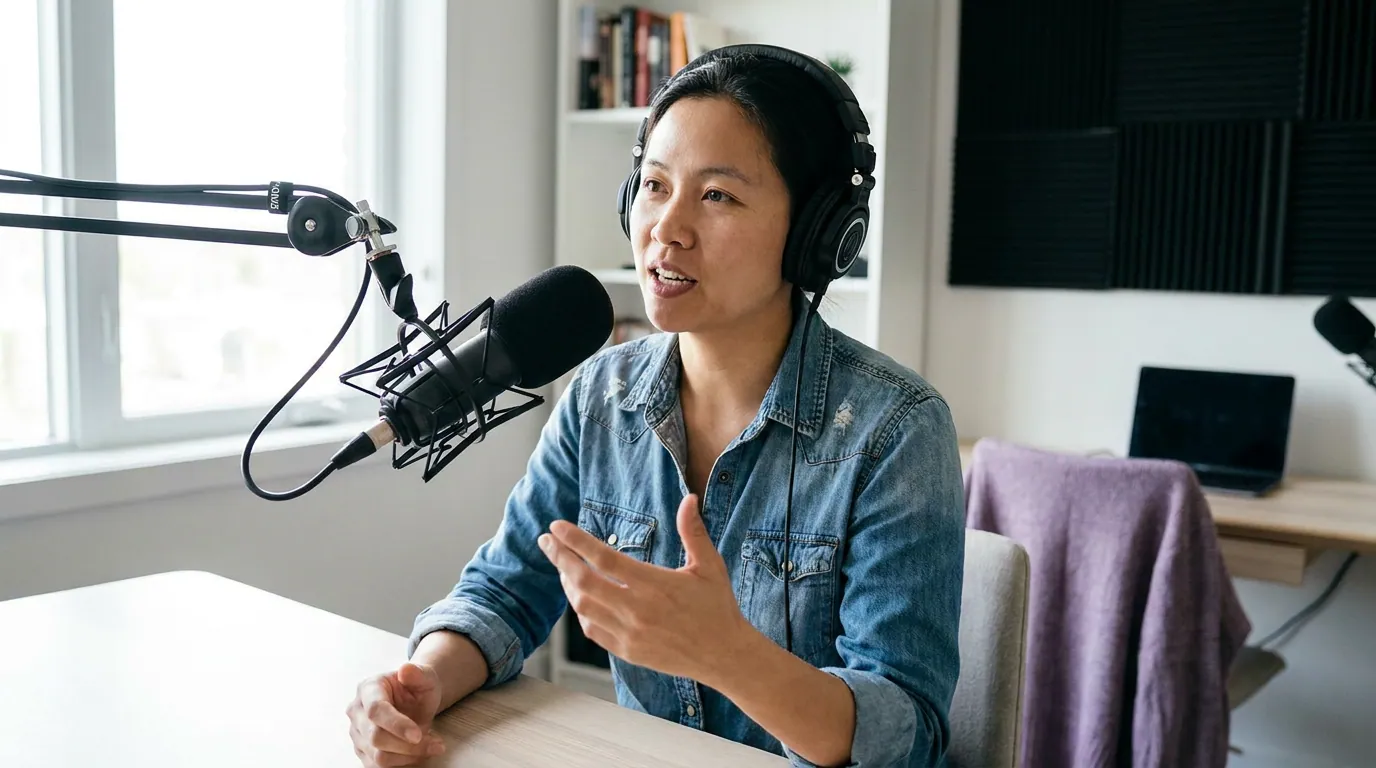
Why your guest pipeline is the whole game
An interview show fails in a specific way: you run out of guests, miss a week, miss two, and quietly stop. The data on podcast survival is blunt. Nearly half of all podcasts never get past their first three episodes (Command Linux, 2024), and the strongest predictor of survival is simply publishing consistently. For an interview show, the thing that breaks consistency is almost never editing. It is the scramble to find, chase, and confirm a guest before the next slot.
The fix is to never book one guest at a time. Run a small pipeline with five stages, sourced, invited, replied, booked, recorded, and keep at least three guests at the "sourced" stage and one "booked" two weeks out at all times. When the pipeline is full, a no-show or a quiet inbox never forces you to skip a week. This is the operational side of booking, and it is worth setting up properly; the deep version lives in how to book podcast guests. Here, the focus is the harder part: getting strangers to say yes in the first place.
How do you book guests before you have an audience?
Pitch a specific person a specific reason to talk, and ask for almost nothing. The yes comes from the angle, not your download count. A cold pitch that names the exact episode only this guest could record, explains why you chose them, and asks one tiny first step will out-convert a generic "would you come on my podcast?" by a wide margin, even with zero past episodes.
New hosts assume nobody will say yes without an audience. The opposite is closer to true: people who'd never go on a big show will say yes to a thoughtful invite from a small one, because the conversation sounds built for them. Your disadvantage in reach is offset by the one advantage a small show has, you can make every guest feel singularly chosen.
The four-part cold pitch
A pitch that lands has four parts and fits in five sentences. Anything longer reads like a press release and gets archived.
Here is the template, filled in for a hypothetical guest. Steal the structure, not the words.
Subject: 30 minutes on how you took support response time from 2 days to 2 hours? Hi Dana, I read your write-up on rebuilding the support queue at Helpwise, and the part where you killed the shared inbox stuck with me. I host [Show name], a show for early support leaders trying to scale without hiring. I'd love to have you walk through exactly how you made that switch, the messy middle, not just the result. We're a young show, but the conversations are tight and we cut the best moments into short clips you're welcome to reshare. Would you be open to a 30-minute recording in the next few weeks? If yes, I'll send times.
Notice what is missing: no flattery padding, no "huge fan," no apology for the size of the show beyond one honest line, no twelve-paragraph bio. The ask is a single word, "open?", because every additional decision you put in the first email costs you replies.
Two rules make this work at volume. Send fewer, better pitches. Ten researched emails beat a hundred templated ones, and the researched ones don't burn the relationship if the answer is no. And follow up exactly twice, spaced about a week apart, then stop. A short "still keen if the timing works" nudge recovers a real share of yeses from people who simply missed the first email; a third and fourth chase reads as desperate and torches the contact. Where to find these people in the first place, and how to manage the chase without it eating your week, is covered in how to find podcast guests.

The pre-interview research-and-question doc
Before every recording, fill one page. It holds three things: what you know about the guest, the single thread you want the conversation to follow, and the questions, ordered, not alphabetized. This page is the difference between an interview that goes somewhere and forty minutes of "so tell me about yourself."
Build the doc in this order:
- The thread (one sentence). What is the one thing a listener should walk away understanding? Write it first. Every question either serves the thread or gets cut. Without it you produce a tour of the guest's resume, which nobody finishes.
- The five-minute research pass. Read or skim the two or three things the guest is best known for, a talk, an article, a launch. Note one specific detail you can reference. That detail is your why-them line and your best opening question. Five focused minutes gets you that; save the hour-long deep read for guests big enough to warrant it. The full method is laid out in how to research a podcast guest.
- The questions, ordered. Write eight to ten, knowing you'll use six. Order them so the easy, warm-up questions come first and the one question you most want answered sits about two-thirds in, after rapport but before fatigue. Never save the best question for last; energy drops at the end.
The single biggest upgrade to your questions is grammatical. Ask for stories, not opinions. "What do you think about remote hiring?" gets a tidy paragraph the guest has said before. "Tell me about the worst remote hire you made and what you missed" gets a story nobody has heard, specific, surprising, and clippable. Lead with "tell me about the time," "walk me through," and "what happened when." The full set of question patterns that pull stories out of people is in how to ask good podcast interview questions.
One more line for the doc: write your out questions, two backup prompts you can drop in if a thread dies. "What's a belief in your field you've changed your mind about?" rescues almost any stall. Knowing they exist means you never freeze when the room goes quiet for the wrong reason.
The in-conversation moves that beat a Q&A list
A reader-of-questions and an interviewer do the same prep and produce completely different episodes. The interviewer treats the question list as a map, not a script, and uses four moves in the moment. Master these and the show stops sounding like a survey.
Follow up on the most interesting word. When a guest says "it was a disaster" and moves on, you stop them: "Wait, 'disaster.' What actually happened?" The best material is almost always one question deeper than the answer they gave. New hosts rush to the next scripted question and walk straight past the gold. Listen for the word that doesn't fit the polished story, and pull on it.
Use silence on purpose. When a guest gives a short, clipped answer, resist filling the gap. Wait two seconds, long enough to feel awkward. People are wired to fill silence, and what they add is usually the honest, unrehearsed part they skipped the first time. Silence is the single most underused interviewer tool, and the only one that costs nothing. The full case for it is in our piece on using silence on purpose in interviews.
Steer without yanking. When an answer wanders off the thread, don't interrupt flatly. Bridge: "That actually connects to something I wanted to ask, can we go back to the moment you decided to quit?" The bridge validates what they said and redirects in one breath, so the guest never feels cut off. A good interview drifts and gets gently pulled back a dozen times; a Q&A list never drifts at all, which is exactly why it's lifeless.
Drop questions out loud and freely. If the conversation makes question four irrelevant or already answered, skip it. Clinging to your list because you wrote it is how an interview dies. Your job is the best conversation available in the time you have, not full coverage of a document.

Common mistakes that sink new interview shows
- Booking before you've defined the guest. Without the one-sentence guest definition, you book anyone available and the feed becomes incoherent. Listeners can't tell who the show is for, so nobody subscribes. Define first, then source.
- Reading questions instead of listening. If you're staring at the next question while the guest is mid-answer, you'll miss the follow-up that makes the episode. Look at the question list only between answers, never during.
- Over-talking. A new host nervously fills space, finishes the guest's thought, or one-ups their story. The ratio to aim for is roughly 20% you, 80% them. The guest is the reason anyone pressed play.
- No right-of-reply to a no. When a guest declines, a warm "totally understand, door's open if your timing changes" keeps the relationship. Hosts who go cold or guilt-trip burn a contact they'll want in a year.
- Letting episodes die on the feed. An interview is an hour of content you spent weeks booking. Cutting it into a handful of short clips is what gets it discovered, and what proves to the next guest the show is worth their time. Social clips and recommendations now drive podcast discovery more than friends and family do: 57% of listeners say they rely on social media for podcast recommendations, the first time it surpassed personal referrals (InsideRadio, 2025).
The gear question, answered quickly
You need far less than the gear forums suggest. For a remote interview show, which most new ones are, a clean USB mic per host, headphones to kill echo, and a quiet room beat any expensive rig recorded badly. The honest framing: the gap between a $150 and a $1,500 setup is smaller than the gap between bad mic technique in a noisy room and good technique in a treated one.
Our best podcast mics by budget tier breaks down the $50 to $500+ tiers, and the best podcast mic under $100 covers what's genuinely good cheaply. Don't let gear research become the thing you do instead of booking guests.