
How to Start a Fantasy Sports Podcast


To start a fantasy sports podcast, build the show around two deadlines, not one team: the draft, your season-launch event, and the weekly start/sit deadline at kickoff, when your advice expires. Pick a format that delivers a usable decision every episode, publish before lineups lock, and decide how you'll handle sportsbook and DFS money before a single ad arrives.
A fantasy show is a different animal from a general sports show, and treating it like one is the first mistake. A team show reacts to games. A fantasy show makes a promise: tell me who to start, who to drop, who to grab off waivers, and tell me before it's too late to act. That promise sets a brutal production cadence, demands a data spine, and pulls in a specific kind of money (sportsbooks and daily fantasy operators) that carries disclosure rules a generic sports podcast never touches. Below is the system: the season calendar built on the draft and the waiver wire, the production week that ends at kickoff, three repeatable data-driven segment formats, and how to take gambling sponsorship without misleading your audience or the FTC.
Sports is one of the top US podcast genres (Statista top genres), and by revenue it is the fastest-growing of them, a projected 29.5% CAGR through 2030, against 27.0% for podcasting overall (Grand View Research, sports podcasting). Fantasy sits inside the most action-driven part of that lane: an audience that doesn't just listen, it acts on what you say every week. That engagement is your advantage. The catch is that the same audience leaves the moment your advice arrives late or wrong.
What makes a fantasy podcast different from a regular sports podcast?
A fantasy podcast gives the listener a decision they will act on this week, not just commentary they enjoy. That single difference rewrites everything: your episodes must publish before the lineup lock, every segment needs a clear takeaway ("start him, sit her"), and the money comes from sportsbooks and daily-fantasy apps, which brings disclosure rules a team-reaction show never faces.
A team fan-cast can post its game reaction the next morning and still be useful, the emotion holds. Fantasy advice does not hold. A start/sit take published after kickoff is worthless, no matter how good it was. That is the core constraint, and it is why a fantasy show is built backward from a deadline. If you are weighing this against a broader team show, our guide to starting a single-team sports podcast covers the schedule-driven model; this guide is for the version where your audience needs an answer before the clock starts.
The upside of that constraint is loyalty. A listener who set their lineup based on your call and won will be back next week. Usefulness, delivered on time, is the most durable retention mechanic in podcasting, far stronger than entertainment alone.

The draft-and-waiver season calendar
Map your sport's fantasy year once and attach an episode type to each beat. Unlike a team show built on the game schedule, a fantasy calendar is built on manager actions, when your listeners draft, set lineups, work the waiver wire, and make trades. Those are the only dates that matter, and they refill every season.
Three things to set up the first time you build it:
- Draft week is your single biggest day of the year. It is the fantasy equivalent of a team show's trade deadline, the most-searched, highest-stakes moment, when even casual managers seek advice. Plan your final rankings, a draft-strategy episode, and a live mock weeks ahead. This is the one window where new listeners arrive in bulk.
- The off-season is recruitment, not rest. Dynasty leagues, rookie scouting, and "way-too-early" rankings keep the most committed managers engaged through the dead months. A show that vanishes after the playoffs restarts from a cold audience every draft season.
- Keep a slow-week filler list. Bye weeks, blowout-heavy slates, and lulls happen. A running list of "fix my team" mailbags, scoring-format explainers, and process episodes means a quiet week never becomes a skipped one.
This matters because publishing consistency is the #1 predictor of a podcast surviving, and roughly 47% of podcasts stop at three episodes or fewer (podcast failure-rate analysis, drawing on the Amplifi/Podcast Index dataset). A fantasy calendar is unusually demanding, but it is also unusually self-refilling, because the next waiver deadline is always coming.
The fantasy production week (and the deadline you can't miss)
Here is the part that separates fantasy from every other sports format: your week is a countdown to kickoff. Everything publishes against a hard lock, and the most valuable episode, start/sit, is also the most time-sensitive. Build the week backward from that deadline and it becomes routine; build it forward and you will miss the lock and lose trust.
The waiver-wire episode (early week). After Sunday and Monday games resolve, managers race to claim free agents before the waiver deadline. Publish this Tuesday or Wednesday with a ranked list of pickups, a clear priority order, and a suggested bid amount for auction-waiver leagues. Concrete and ranked, not "keep an eye on these guys," but "here is who to claim, in order, and what to spend."
The matchup preview (mid-week). Thursday through Saturday, look ahead: which players have great matchups, which face a tough defense, who is trending up. This is where your data spine shows. Keep it tight and skimmable, because listeners are scanning for names that affect their roster.
The start/sit episode (just before kickoff). The flagship, and the deadline. Saturday night or Sunday morning, you deliver the close calls, the two flex players a manager is torn between, the risky boom-or-bust start. This is the episode people set their lineups by, so it must publish before the lock. The discipline here is editing speed: record late with the freshest injury news, then turn it around fast. A scrappy episode that lands at 10am beats a polished one that lands at 1:05pm.
The takeaway that should govern your whole setup: protect the start/sit deadline above all else. Everything in your gear and editing choices should serve fast turnaround on that one episode. This is the opposite priority from a business podcast that wins clients, where polish and authority matter more than speed, different genre, opposite tradeoff.

Three data-driven segment formats that record fast
Fantasy listeners want decisions backed by something, not just vibes. But you do not need a proprietary model, you need a consistent, transparent process. Lock three repeatable segment formats and a normal week practically produces itself. The trick is that each one ends in an action, not an observation.
- The ranked list. Your bread and butter: top 12 running backs to start, top 8 waiver pickups, top 5 sits. Always ranked, always finite. A ranked list forces a decision and makes you accountable, which is exactly what builds trust. State your reasoning in one line per name, matchup, recent target share, injury context, and move on.
- The head-to-head call. "Player A or Player B at flex this week?" Pick a few close decisions your listeners actually face, state the data both ways, then commit to one. Committing is the point. Wishy-washy "it depends" answers are why people stop listening to fantasy shows. Give the caveat, then give the answer.
- The data spotlight. One number, explained, that should change a decision: a player's snap-count trend, red-zone touches, or an opponent's defensive rank against a position. This is where you show your work and teach the audience to think, which turns casual listeners into loyal ones. Keep it to one stat per spotlight so it lands.
Cite your sources out loud. If your snap-count number comes from a public stats site, say so, "per the public play-by-play data." Transparency about where your numbers come from is both honest and a credibility builder, the same sourcing discipline any serious show lives by. Never present a stat as your own proprietary model when it is a public figure you looked up.
How do you handle sportsbook and DFS sponsorships and gambling disclosures?
If a sportsbook or daily-fantasy app pays you, in cash, free credits, or affiliate commissions, you must disclose that connection clearly and conspicuously in the same episode, in the same format the endorsement appears in. An audio ad needs an audio disclosure; a YouTube on-screen plug needs an on-screen one. Each episode is treated as its own ad with its own disclosure, and "clear and conspicuous" means difficult to miss and easy to understand (FTC Endorsement Guides Q&A).
This is the money that finds fantasy podcasts first, and it carries rules a team-reaction show rarely deals with. The good news: the rules are simple once you map them. The FTC's standard is that any "material connection", payment, free product, or affiliate commission, that could affect how much weight a listener gives your recommendation must be disclosed, near the recommendation, every time (FTC Endorsement Guides Q&A).
The practical rules, in order:
- Disclose in the episode, not just the show notes. A disclosure buried in the description or a footer link fails the standard if listeners can miss it. The FTC is explicit that for audio and video, the disclosure has to be in the audio or on screen, viewers and listeners skip the text (FTC Endorsement Guides Q&A).
- Use plain words. "This episode is sponsored by [book]" or "paid link" works. "Affiliate link" is weaker because some listeners do not know what it means, and the FTC has said as much.
- Disclose every episode. One disclosure does not carry across a season, you cannot assume a listener heard a previous episode. Each one is its own ad.
- Never imply guaranteed winnings. Do not call a bet a "lock" or promise profit. Add responsible-gambling and age (21+ in most US states) messaging, and follow any specific language a sportsbook requires in its affiliate agreement. State-level gambling-advertising rules can layer on top of the FTC's, so check your jurisdiction.
This is not legal advice, if you sign a real sportsbook affiliate deal, read the agreement and consider a media lawyer. But disclosing clearly, in the episode, in plain words, every time, keeps you on the right side of the rule and keeps your audience trusting you. Hidden gambling money is exactly the kind of thing that destroys a fantasy show's credibility, and credibility is the entire product.
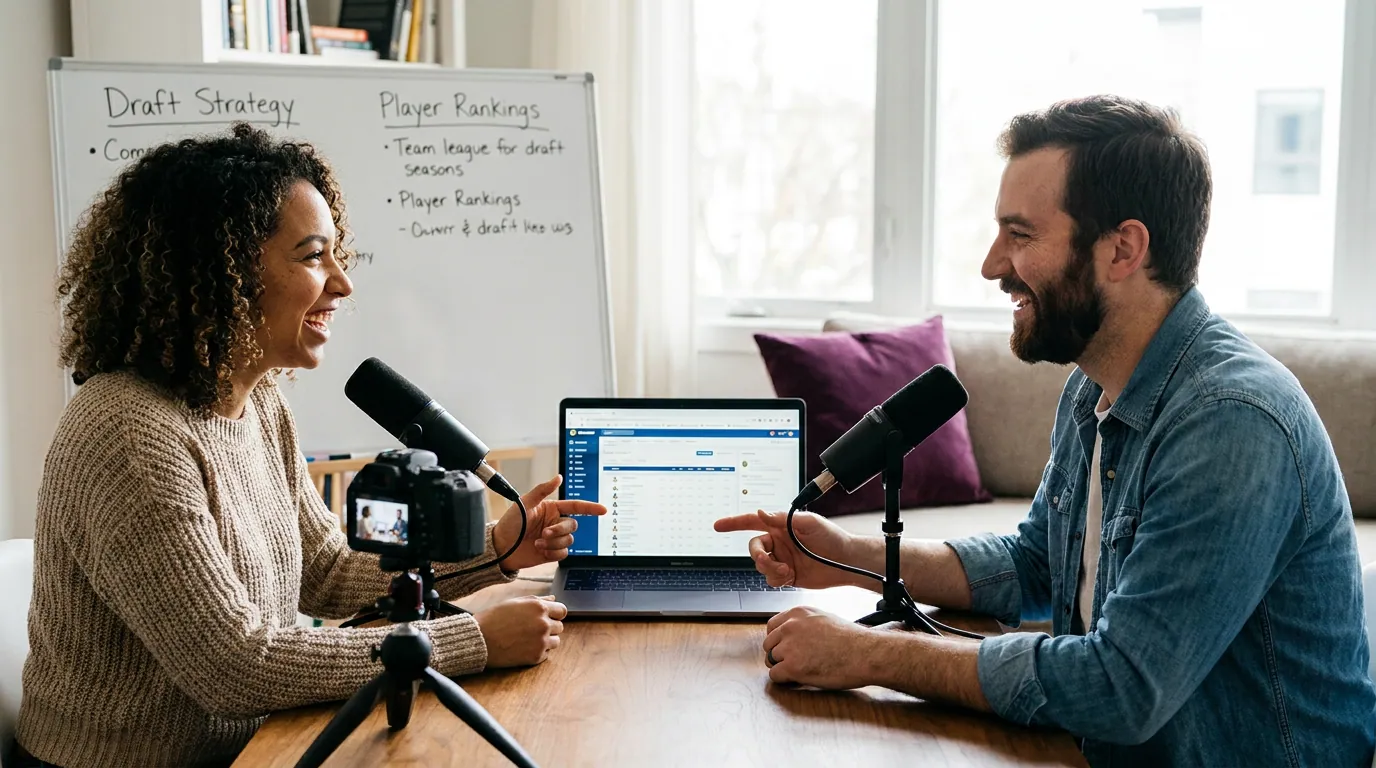
What gear does a fantasy sports podcast actually need?
Less than you fear, and the priority is speed over polish. The gap between a $150 and a $1,500 setup is smaller than the gap between bad mic technique in a noisy room and good technique in a treated one (editorial framing from our gear guides). For a fantasy show, fast turnaround on the start/sit episode matters more than studio sound, so favor a simple, reliable rig you can record and edit quickly.
| Tier | What it covers | Good for |
|---|---|---|
| ~$70–150 (one mic) | A solid USB or hybrid mic, basic headphones | A solo host or a remote co-host |
| ~$150–350 (two mics) | Two mics, an interface or hybrid setup, headphones | The classic two-host fantasy show |
| ~$500+ (video rig) | The above plus a webcam/camera and simple lights | A YouTube show with a draft board on screen |
Cost-tier ranges from Ausha's gear cost analysis. For specific picks, our best podcast mics by budget tier guide and a strong option under $100 cover everything a starting fantasy show needs. One fantasy-specific note: if you record video with stats on screen, plan your screen layout so a stat table is readable, and rehearse pulling numbers up fast, fumbling for a spreadsheet on air kills the pace of a data show. The chemistry-and-format point a comedy podcast with friends relies on applies here too: two voices that play off each other carry a show more than any microphone does.
Why clips matter more for a fantasy show than almost any genre
Fantasy advice is built to be clipped: every bold call is a self-contained, timely take with a clear claim ("start this guy, trust me"). Clips drive an estimated 20–40% of new audience for video shows and can raise reach 2–5× (Podcast Studio Glasgow). For a fantasy show, the highest-performing clip is usually a 30-to-60-second start/sit call with a strong opinion and a name on screen, the riskier and more specific, the better it travels.
A practical workflow: after each waiver and start/sit episode, pull two or three of your boldest 30-to-60-second calls, add captions, and post them while the advice is still actionable, before lineups lock. Timing is the multiplier in fantasy, exactly as it is in the full episode: a great call clipped and posted Saturday night reaches managers still deciding; the same clip Monday is a receipt, not advice. The same "create once, distribute everywhere" logic a fitness podcast uses to demonstrate value applies, tuned to the kickoff clock. One honest caveat: virality without strategy is empty engagement, and views are not subscribers, make clips that prove you are useful and pull people back to the full lineup advice, not just clips that chase plays.
Frequently asked questions
Do I need to be a fantasy expert to start a fantasy sports podcast?
No, but you need a transparent, consistent process. The most durable fantasy shows are run by sharp, well-prepared managers, not insiders. Pick a clear method, public stats, matchup analysis, your own rankings, explain your reasoning out loud, and be accountable for your calls. Honesty about where your numbers come from matters more than credentials, and committing to a decision matters more than being right every week.
How often should a fantasy sports podcast publish?
During the season, build the cadence around manager actions: a waiver-wire episode early in the week, a matchup preview mid-week, and a start/sit episode before kickoff. Even one reliable start/sit episode that always lands before the lineup lock beats three episodes published whenever. Consistency is the #1 survival factor, roughly 47% of podcasts stop at three episodes or fewer (failure-rate analysis), and the kickoff deadline is the one you can never miss.
Can I take money from sportsbooks or daily fantasy apps?
Yes, and many fantasy shows do. The rule is disclosure: any payment, free credits, or affiliate commission must be revealed clearly and conspicuously in the episode itself, in audio for an audio ad, on screen for a video plug, and in every episode it appears in, not just the show notes (FTC Endorsement Guides). Use plain words like "sponsored by" or "paid link," never imply guaranteed winnings, and add responsible-gambling and age messaging. Check your state's gambling-ad rules, which can add requirements.
What's the best format for a fantasy football podcast specifically?
A weekly three-part rhythm works for most leagues: a waiver-wire pickups episode after the week's games, a matchup preview mid-week, and a start/sit episode just before kickoff. Inside each, use ranked lists, head-to-head "start A or B" calls, and a single data spotlight so every segment ends in an action a listener can take. Lock those formats and a normal week mostly produces itself.
When should I launch a fantasy sports podcast?
Launch in the weeks before draft season. Draft week is the fantasy equivalent of a tentpole event, the highest-search, highest-stakes window when even casual managers seek advice and new listeners arrive in bulk. Publishing pre-draft rankings, sleepers, and a draft-strategy episode in the lead-up gives you the best shot at building an audience before the in-season grind begins.
Build the draft-and-waiver calendar once, lock the three data segments, protect the start/sit deadline above everything, and disclose any gambling money plainly in every episode, that is the entire starting playbook for a fantasy show. The genre rewards one thing above all: being useful, on time, every week. In a fast-growing corner of a top-five genre (Statista), the fantasy shows that win are simply the ones whose advice always lands before kickoff.