
How to Start a Comedy Interview Podcast


A comedy interview podcast is a hybrid: a real conversation with a guest, run loose enough that bits, riffs, and tangents can break out and be welcome. To start one, pick a home position on the spectrum between straight interview and pure comedy, write prep that sets up jokes without pre-scripting them, learn the signal that tells you to drop your question list and chase the funnier thread, and book guests by working up a ladder instead of cold-emailing people who've never heard of you.
That last point is where most new shows stall: a comedy interview format wants a guest who can play, but the guests who can play best are the ones with the least free time. The craft below is built for the version of you with no audience yet, a guest you barely know, and forty-five minutes to make it sound like two old friends who happen to be funny.
Comedy is the most-listened-to US podcast genre (Statista top genres), which is the good news and the warning at once: the audience is enormous, and so is the field. The shows that cut through are not the funniest in raw joke count, they're the ones where the format is intentional and the conversation feels real.
What makes a comedy interview podcast different from a straight comedy or interview show?
It runs two engines at once. A straight interview show optimizes for the guest's story; a straight comedy show optimizes for the bit. A comedy interview show serves both, often inside the same minute. The skill is moving between "tell me what actually happened" and "okay, but what if we ran with that" without the seams showing.
That double duty is also the format's edge. A pure interview can be informative and dull. A pure two-person comedy show can be funny and shapeless. The hybrid borrows the spine of an interview, a guest, a through-line, real answers, and the looseness of comedy, so a single episode has both a reason to listen and a reason to laugh. Get the balance wrong in either direction and you've made one of the other two shows by accident.
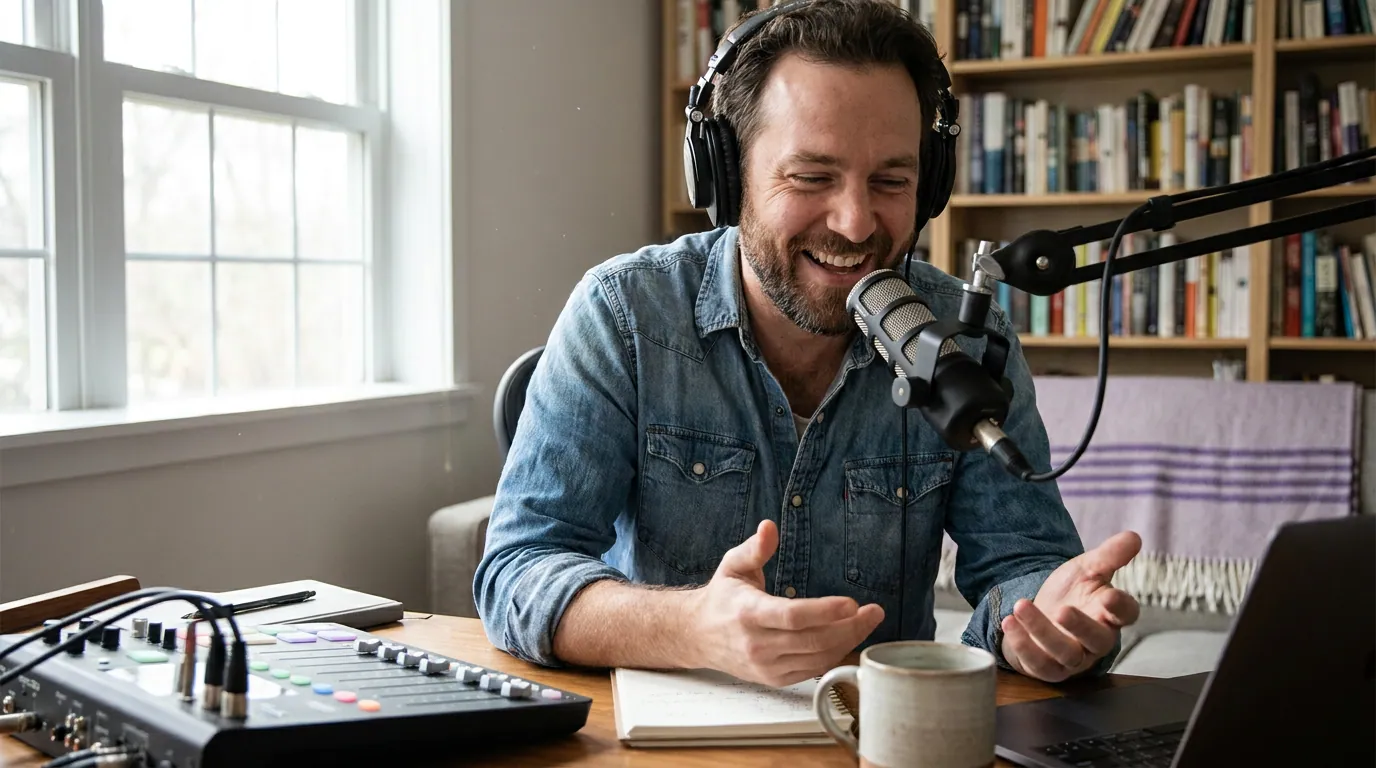
The comedy-interview dial
Treat the balance as a dial, not a fixed setting. The dial runs from a straight interview at one end to a pure bit at the other. Your job is to choose a home position for your show, then move the dial up and down inside an episode on purpose, never by accident, never stuck.
For most new shows, a home position around 60% conversation, 40% comedy is the safest place to start. It reads as an interview show with a sense of humor, a clear identity, rather than a comedy show that occasionally remembers to ask a question. Open and close nearer the conversation end so the episode has a shape; let the middle swing toward bits where the energy is highest. As you find your voice you can shift the dial, but decide where it sits before you book your first guest, because the position changes who you book and how you prep.
How do you prep a guest so the jokes land without killing the spontaneity?
Prep the setups, not the punchlines. Send a short brief with three or four areas you want to get into and one playful angle per area, then tell the guest you won't ask in order and you want them off-script. You're loading the gun, not pulling the trigger, the funniest moments come when a prepared setup meets an unprepared reaction.
The mistake new hosts make is over-preparing the comedy. They write jokes, rehearse the back-and-forth, and the guest dutifully delivers lines that already sound dead because both people know what's coming. Spontaneity is the entire point of the format; the second it sounds planned, you've lost the thing that separates you from a sketch.
Here's a guest-prep brief that protects spontaneity. Send it two or three days out, not the morning of:
- Three to four real topics, phrased as openings, not questions. "The tour-from-hell story" beats "Tell me about a bad tour." You want a door, not a quiz.
- One playful angle per topic, marked as optional. "Might do a bit where we rank your worst gigs like a sports bracket, only if it's fun in the moment." Flag it as a possibility so the guest can prepare to play without rehearsing a script.
- **One thing you promise not to ask.** Telling a guest what's off the table relaxes them, and a relaxed guest is a funnier guest.
- An explicit permission to derail. Write it plainly: "I'll have a list, I'll ignore it constantly, please take us somewhere I didn't plan." This single line gives nervous guests license to be loose.
- No scripted jokes. If you must note a callback or a running joke from a past episode, mark it as a seed, not a line to deliver.
The aim is a guest who arrives warmed up and unscripted, knowing the playground, not the play.
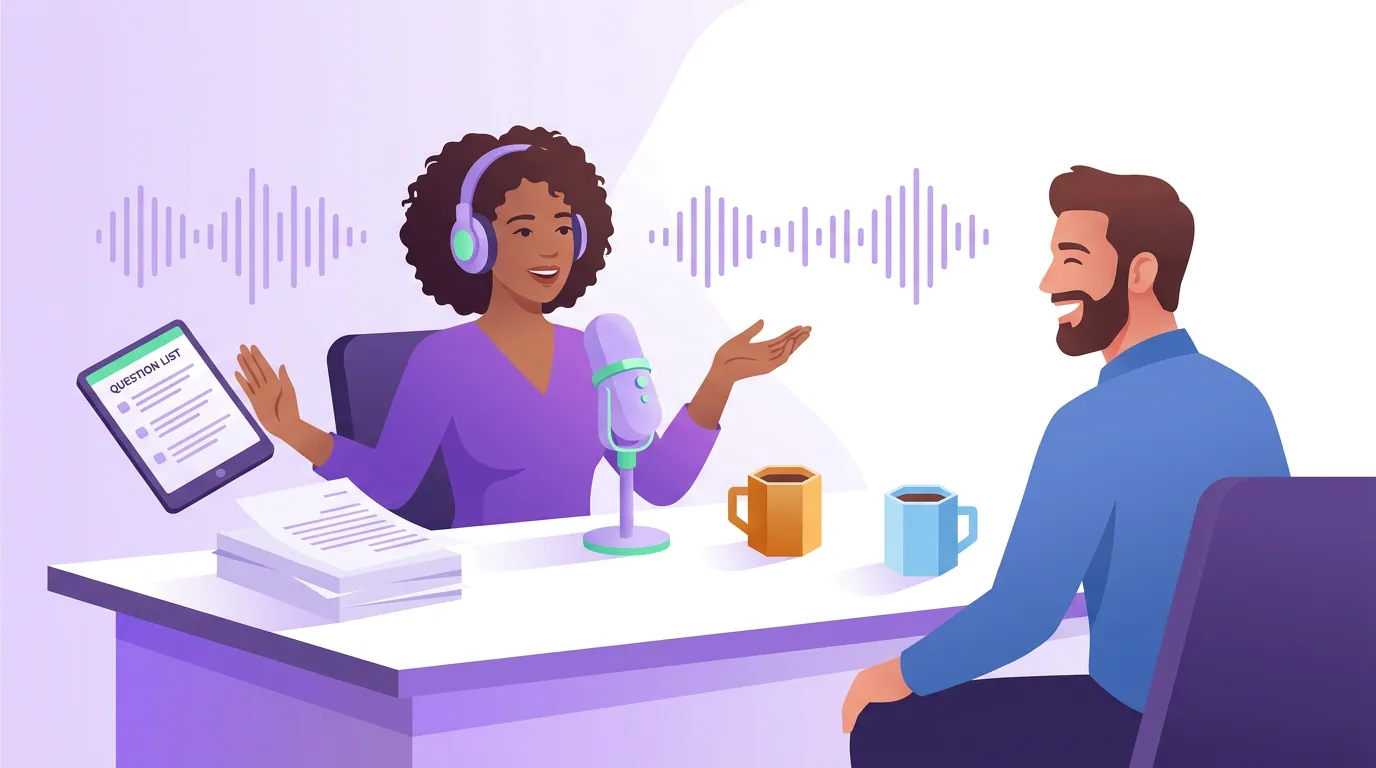
When do you drop the question list?
Drop it the moment the conversation becomes funnier or more honest than your next planned question. That's the whole rule. Your list exists to prevent dead air, not to be completed; a host who finishes every prepared question has usually steamrolled the three better moments that tried to interrupt.
Three practical habits make this work. Keep the list to five or six anchor topics, not twenty questions, fewer items means less temptation to grind through them. Put the list where you can glance at it without looking down, so reaching for it is a deliberate move and not a nervous tic. And treat a dying tangent as the cue to deploy your next-best question, not to drag the dead one back to life. The list is the reason you can afford to abandon the list.
How do you book comedian and personality guests when nobody knows you?
You don't start at the top. Book up a ladder: start with peers and people one rung above you, deliver a genuinely good experience, and use those episodes as the proof that gets the next, slightly bigger guest to say yes. Each booking earns the next.
A comedian with options will not gamble forty-five minutes on a show with no episodes and no proof they'll come off well, but they'll take a chance on a host who's clearly good with the three guests before them.
A few rules make the ladder climb faster. Make the ask easy to say yes to: offer to record remotely, send your few best clips, and tell them exactly how long it'll take. Make the guest look good, send them the clips afterward, because a comedian sharing your clip to their followers is both your distribution and your audition tape for the next booking. And lean on the strongest discovery channel you have: social media has now overtaken recommendations from friends and family as the top way US listeners find new podcasts (InsideRadio, on the State of Video Podcasting 2025 study), which means every guest's funniest 40 seconds is a recruiting tool for the next guest and the next listener at the same time.
Common mistakes when starting a comedy interview podcast
- Trying to be the funniest one in the room. Your job is to make the guest funny and to keep the conversation moving. The best comedy interview hosts are great straight men and ruthless editors of their own jokes, not the loudest voice in the take.
- Pre-scripting the bits. Rehearsed comedy sounds rehearsed. Prep setups and permissions, then let the punchline be a surprise to both of you. If it's funny in the moment, it'll be funny in the edit.
- Finishing the question list. Completing all twenty questions is a sign you ignored the better moments. Cut the list to five or six anchors and let the tangents win.
- Booking above your station too early. Cold-emailing a famous comic with zero episodes wastes your one shot. Climb the ladder; let the proof do the asking.
- Treating it like a straight interview that you hope gets funny. Decide your dial position before you record. A show with no chosen identity drifts into the dullest version of itself by episode three, and nearly half of all podcasts never make it past the first three episodes Amplifi Mediapodfade analysis), often because the format never found a reason to exist.
The format sits between two siblings, and it's worth knowing both. If your show is closer to four friends riffing with no real interview spine, our guide to starting a comedy podcast with friends is the better fit; if you want the interview discipline without the comedy load, the structure in our business podcast guide and even the sourcing rigor of a true crime show show how much a clear format identity does for retention. A fitness podcast built around a coach's expertise is yet another point on the same map, different content, same lesson: decide what your show is before you book guest one.
On gear, a comedy interview show needs nothing exotic, two clean mics and a quiet room beat any plugin. A pair from our mics-by-budget-tier guide or a reliable pick under $100 is plenty; spend the saved money on guests, not hardware.
Frequently asked questions
How is a comedy interview podcast different from a regular comedy podcast?
A comedy interview podcast is built around a guest and a real conversation, with bits and riffs breaking out inside it; a regular comedy podcast is usually a fixed cast riffing with no interview spine. The interview format gives every episode a built-in through-line and a reason for new guests, and their audiences, to show up.
Do you need to be a comedian to start a comedy interview podcast?
No. The host's job is to make the guest funny and keep the conversation moving, which is closer to being a great straight man and a good editor than a stand-up. Book genuinely funny guests, prep playful setups, and learn to drop your question list when something funnier appears, the laughs come from the room, not from you carrying every joke.
How do you get funny guests when your podcast is brand new?
Climb a booking ladder instead of cold-pitching famous comics. Start with funny friends and peers, then local open-mic and improv comedians who want reps, then niche creators open to a cross-promotion trade. Use each batch of episodes as proof that gets the next, slightly bigger guest to say yes, and send every guest their clips so they share them.
How much should a comedy interview podcast be planned versus improvised?
Plan the structure, improvise the comedy. A good home position for a new show is around 60% conversation and 40% comedy: prepare five or six anchor topics and one optional playful angle each, then let the bits be unscripted. The setups are planned; the punchlines should surprise both of you.
What gear do you need to start a comedy interview podcast?
Two clean microphones and a quiet, lightly treated room cover the essentials, clear, intelligible audio matters far more than any effect for a talk-and-laugh show. A budget pair from a by-tier mic guide is enough to start; for remote guests, record locally on both ends so the conversation stays sharp. Put the rest of your budget toward booking better guests.
Pick your dial position, prep setups instead of punchlines, drop the list when the room gets funnier than your notes, and book up the ladder one proof-of-concept episode at a time. Comedy is the biggest genre in podcasting (Statista), a clear, intentional hybrid format is how a new show earns a spot in it.