
RODECaster Pro II Alternatives: Is It Worth It?


The RODECaster Pro II is the most capable podcast console under $700, but most of its edge is production depth a four-mic interview show never touches. For three or four mics, the Tascam Mixcast 4 (~$499) does the same core job for $100–$180 less; for solo or co-host shows, the RODECaster Duo (~$498) or Zoom PodTrak P4next (~$180) handle it. Buy the Pro II only if you'll use the faders, pads, and multitrack.
That's the short version. The longer version is more useful, because the gap between the Pro II and the cheaper boards is not one thing, it's six things, and you will probably use two of them. This guide takes the Pro II apart feature by feature, marks which features the cheaper consoles already have, and tells you which of the leftover, Pro-II-only features are worth real money for your show. Prices were checked against manufacturer and major-retailer pages in mid-2026; retailer sales move them, so treat the figures as street-price anchors, not quotes.
One naming note up front, because the brief for this comparison conflates two brands: RODE makes the RODECaster line (Pro II, Duo). The PodTrak P4next and P8 are made by Zoom, not RODE. They're the cheapest credible alternatives to a RODECaster, so they belong in this comparison, just don't go searching for a "RODE PodTrak." It doesn't exist.
What the RODECaster Pro II premium actually buys
The Pro II's premium over the next-cheapest four-input board (the Mixcast 4) is about $100–$180. Most of that money buys production depth, not capability: stronger preamps, two extra physical faders, a far bigger sound-pad system, and 16-track multitrack-to-computer recording. It does not buy more mic inputs, both boards top out at four, and it does not buy standalone battery power, which neither has.
Here's the honest accounting. The Pro II's headline features split into three buckets: things every cheaper board on this list already does, things the cheaper boards do but the Pro II does noticeably better, and things only the Pro II offers.
What every board here already does: four XLR inputs (except the two-input Duo), 24-bit/48kHz recording (except the older Zoom P8, which records 16-bit/44.1kHz), mix-minus for clean call-in guests, sound pads, per-guest headphone outputs, and USB-interface mode. If your needs stop at "record four clean mics and a phone caller," you have already been served by a $180 board.
What the Pro II does better: its Revolution preamps deliver up to 76dB of gain with an ultra-low noise floor (–131.5dBV), enough to drive a hungry dynamic mic like a Shure SM7B without an inline booster (RODE). The PodTrak P8 reaches about 70dB and the Mixcast 4 about 66dB, so both run an SM7B too, though at the top of the dial, where a FetHead or Cloudlifter buys cleaner headroom. This is a margin, not a chasm, but the Pro II has the most of it.
What only the Pro II offers in this price band: six full-size physical faders (versus the Mixcast's eight smaller faders and the Duo's four), eight banks of programmable SMART pads for 64 total actions, dual USB-C ports so you can record on one computer while streaming to another, and 16-track multitrack recording to a computer (RODE). These four are the features you're really paying the premium for.
The full comparison table
| Console (mid-2026 street) | XLR inputs · recording | The one reason to choose it |
|---|---|---|
| Zoom PodTrak P4next (~$180) | 4 · 24-bit/48kHz, SD + battery | Cheapest four real preamps; records with no laptop |
| RODECaster Duo (~$498) | 2 · 24-bit/48kHz | RODE faders and DSP in half the desk space |
| Tascam Mixcast 4 (~$499) | 4 · 24-bit/48kHz | Four inputs, simplest touchscreen, ~$100+ under the Pro II |
| Zoom PodTrak P8 (~$500–$550) | 6 · 16-bit/44.1kHz, SD + battery | Only sub-$700 board with six inputs |
| RODECaster Pro II (~$595–$680) | 4 · 24-bit/48kHz | Deepest production: faders, pads, 16-track, streaming |
The table makes the core tension obvious. The Pro II is the priciest board here and shares its four-input ceiling with two cheaper options. You are not paying for more people in the room. You are paying for what you can do with the people already there.
RODECaster Pro II, ~$595–$680, the deepest board
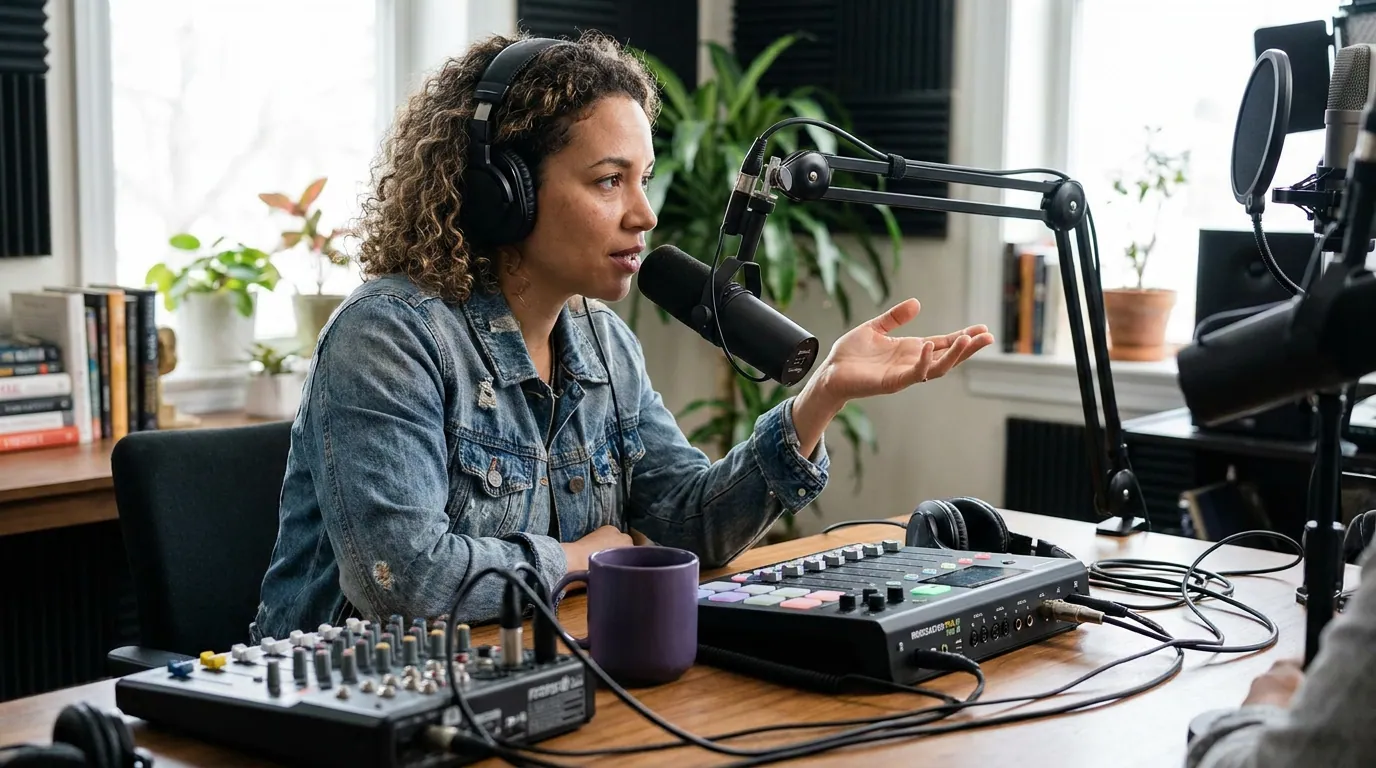
The Pro II is RODE's flagship podcast console and the most capable production board under $700. Four XLR/quarter-inch combo inputs with Revolution preamps (up to 76dB gain), six full-size faders plus three virtual channels, eight banks of SMART pads, APHEX onboard DSP, dual USB-C ports, Wi-Fi and Bluetooth, and multitrack recording of up to 16 channels to a computer (RODE). Sweetwater lists the console around $595–$678 depending on finish; its original launch MSRP was $699 (Sweetwater).
Buy it if you run a produced show, music beds, stingers, live sound effects, or a stream that runs alongside the recording. The dual USB-C ports alone justify it for streamers: you can capture a clean multitrack on one machine while sending a stream to another, which no cheaper board on this list can do. If you mix live with faders rather than fixing levels in post, the six broadcast faders earn their keep every episode.
Pros: Best preamp headroom in the group; most physical faders; 64-action pad system; dual USB-C for simultaneous record and stream; 16-track multitrack to computer; Wi-Fi. Cons: Most expensive here; still only four mic inputs; no battery power, so the standalone-recording-to-card workflow is less travel-friendly than the Zoom units; far more menu depth than a plug-and-talk interview needs (RODE).
Tascam Mixcast 4, ~$499, the closest rival
The Mixcast 4 is the board that makes the Pro II's premium hard to justify for most shows. It carries the same four XLR/TRS combo inputs, each with its own preamp and phantom power, records WAV at 24-bit/48kHz to a full-size SD card, runs 14-track recording, includes mix-minus for call-in guests over Bluetooth/USB/TRRS, eight sound pads, and a clear 5-inch touchscreen (Tascam via B&H). Sweetwater lists it at $499 (Sweetwater).
Two genuine edges over the Pro II, not marketing spin: its combo jacks accept TRS 6.3mm mic cables as well as XLR, and it uses a full-size SD slot instead of microSD. Its preamps top out around 66dB of gain, enough to run an SM7B, though many users add a FetHead for cleaner headroom on that famously quiet mic. For a straight four-mic interview recorded at a desk, the Mixcast 4 captures the same clean tracks the Pro II would, for roughly $100–$180 less.
Pros: Four inputs with per-channel phantom power; 24-bit/48kHz; XLR and TRS combo jacks; full-size SD card; simple touchscreen; bundled editing software; ~$100+ cheaper than the Pro II. Cons: No dual-output streaming workflow; plastic chassis feels less premium than the Pro II's metal shell; loading custom pad samples is fiddly; preamps are good-for-podcasting, not the absolute headroom of the Pro II.
RODECaster Duo, ~$498, the Pro II in miniature
The Duo is, in RODE's own framing, the Pro II's smaller sibling: same core audio engine, same Revolution preamps (–131.5dBV, 76dB gain), same APHEX DSP, same 5.5-inch touchscreen, in a body with a 35% smaller footprint (RODE). The trade is inputs and controls: two XLR/combo inputs instead of four, four physical faders instead of six, six SMART pads instead of eight, Bluetooth but no Wi-Fi. Sweetwater lists it at $498 (B&H).
If you record solo or with one co-host and you specifically want RODE's preamps, processing, and fader feel, the Duo gets you most of the Pro II's sound quality for less money and less desk space. The catch is the hard two-input ceiling. The day you regularly seat a third person at a mic, you've outgrown it, and at that point you're choosing between the Mixcast 4 and the Pro II again.
Pros: Pro II-grade preamps and DSP at ~$150–$180 less; real broadcast faders; compact footprint; front-edge 3.5mm headset port the Pro II lacks; built-in RODE wireless receiver. Cons: Only two mic inputs, a hard cap; no Wi-Fi; fewer faders and pads than the Pro II; costs more than the four-input Zoom P4next (RODE).
Zoom PodTrak line, ~$180 (P4next) to ~$550 (P8), the value floor
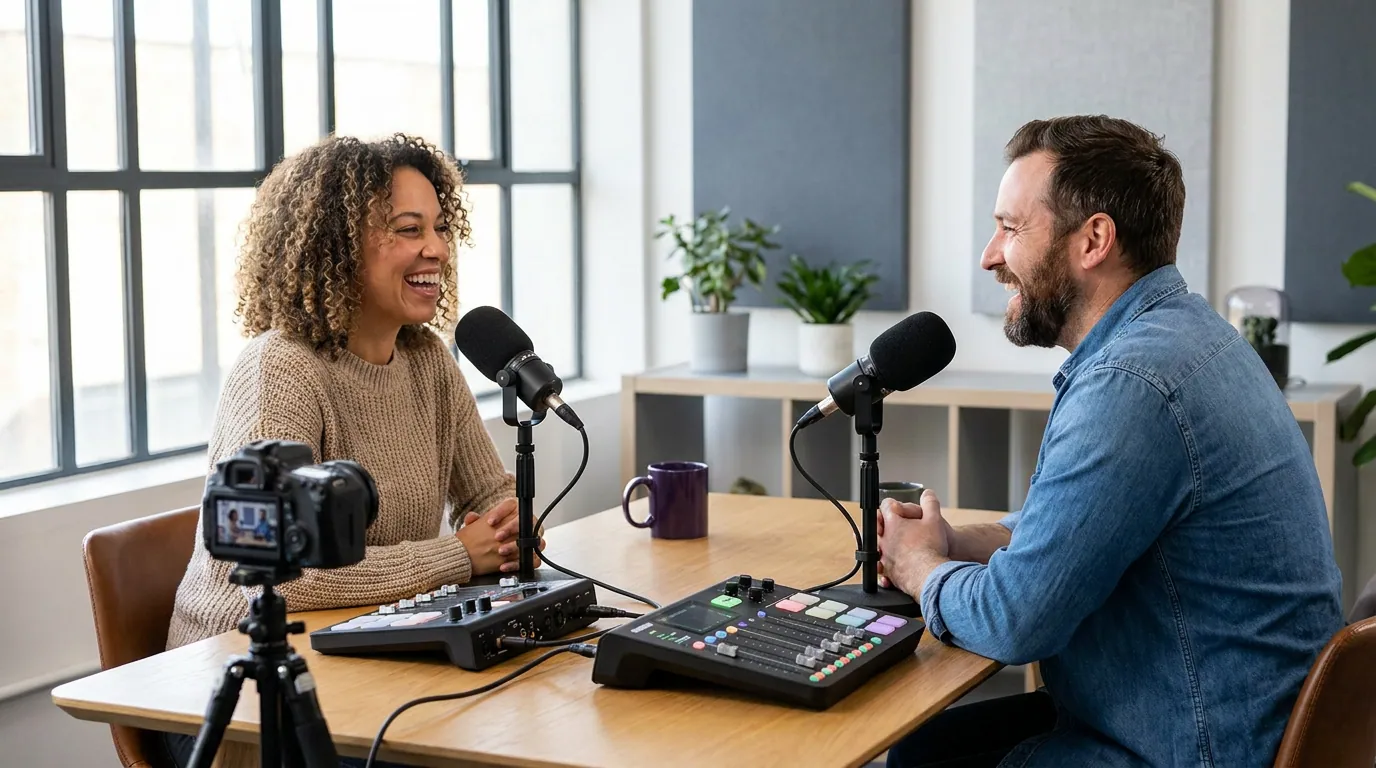
The cheapest credible alternatives to a RODECaster come from Zoom. The PodTrak P4next (~$180) gives you four XLR inputs with up to 70dB of gain, four headphone outputs, a phone/USB call-in channel, sound pads, battery power, and, in this revision, 24-bit/48kHz recording plus onboard AI noise reduction, tone shaping, and voice compression (Zoom; B&H). It's the cheapest way to get four real mic preamps and a standalone recorder in one box.
The PodTrak P8 (~$500–$550) is the only board on this list with six XLR inputs, each with its own gain, mute, and switchable phantom power, plus eight faders, six headphone outs, and onboard editing on a 4.3-inch touchscreen (Zoom). Its honest tradeoffs: it records 16-bit/44.1kHz (not 24-bit), and its USB output is a stereo mix only, so multitrack work goes to the SD card, not over USB. Stock is also thinning at major US retailers, so confirm availability before you count on it.
The PodTrak line is where you land if budget is the deciding factor, or if you need standalone battery recording the RODECasters don't offer. The P4next, in particular, is the board that exposes the Pro II premium most starkly: it does the core four-mic job for less than a third of the price.
Pros: P4next is the cheapest four-input recorder with battery power and 24-bit/48kHz; P8 is the only sub-$700 six-input board; both record with no computer. Cons: P4next has no faders (knobs only) and ganged phantom power; P8 is 16-bit/44.1kHz with stereo-only USB; neither matches RODE's preamps or DSP depth.
Who will actually use the Pro II premium
Run your show through this test before you spend. The Pro II premium pays off if you do at least two of the following regularly. If you do none of them, you are paying $100–$420 for capability you'll never touch.
The pattern across hundreds of first rigs is consistent: people buy the flagship for features they assume they'll grow into, live faders, pad banks, streaming, and then record four mics flat and fix everything in post anyway. If that's your honest workflow, the Mixcast 4 or a cheaper board records the same audio and leaves $100–$420 in your pocket for mics or room treatment, which matters more.
How we evaluated these
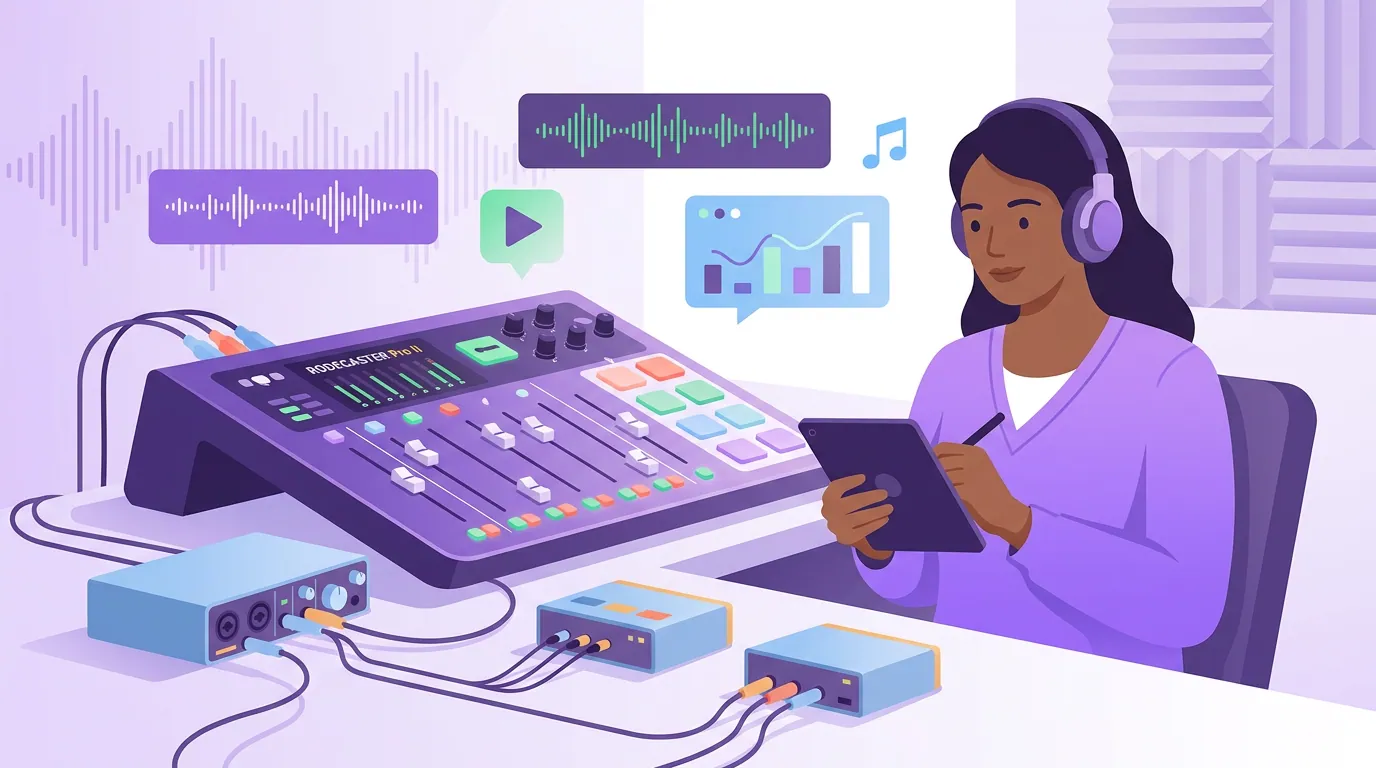
Four criteria, in order. First, price verified mid-2026 against manufacturer and major-retailer pages (Sweetwater, B&H, Zoom, RODE), not list price, retailer sales and finish options swing the street price by $50–$80. Second, shared vs exclusive features, because the only honest way to judge a premium is to subtract what the cheaper boards already do. Third, real-world workflow, does the show stream, mix live, run standalone, since that's what decides whether the premium features get used. Fourth, input count, the one hard ceiling no firmware update can raise.
We focused on purpose-built podcast consoles and left out general music mixers (Mackie, Yamaha, Behringer). They mix well but don't record standalone, lack mix-minus for clean call-in audio, and turn a simple show into a routing project.
The thing no spec sheet will tell you: Ausha's gear-cost breakdown puts a mid-tier podcast setup at $300–$700, but the gap between a $180 board and a $680 one is smaller than the gap between a noisy untreated room and a quiet one. A Pro II in an echoey kitchen sounds worse than a P4next in a closet full of coats. Spend on the room and on good dynamic mics for your space before you climb the console ladder.
Who should buy what
- Produced or streamed show, 3–4 mics, you mix live: RODECaster Pro II (~$595–$680). The premium is for you.
- Straight 3–4-mic interview, record-and-edit-later: Tascam Mixcast 4 (~$499). Identical recording, ~$100+ less.
- Solo or co-host who wants RODE's sound: RODECaster Duo (~$498). Just respect the two-input cap.
- Tightest budget, or you need no-laptop recording: Zoom PodTrak P4next (~$180). Four inputs, battery power.
- Five or six mics at a panel: Zoom PodTrak P8 (~$500–$550). The only sub-$700 board that fits.
Whatever you pick, plan the show before the signal chain. A clear call on scripting versus outlining and a tight episode structure move retention more than any fader. And if you're not sure you need a full console yet, the budget mic guide, the USB-versus-XLR gut check, and the hybrid mics that grow with your show cover the step before this one.
FAQ
Is the RODECaster Pro II worth it over the Tascam Mixcast 4? Only if you'll use the depth. Both record four mics cleanly at 24-bit/48kHz with mix-minus and sound pads. The Pro II adds two more physical faders, more programmable pads, dual USB-C for simultaneous record-and-stream, and 16-track multitrack to a computer (RODE). For a produced or streamed show, that's worth ~$100–$180 more. For a plain four-mic interview, the Mixcast 4 does the core job for less.
What's the cheapest real alternative to a RODECaster Pro II? The Zoom PodTrak P4next, around $180, gives you four XLR mic inputs with up to 70dB of gain, 24-bit/48kHz recording, battery power, and onboard noise reduction (Zoom). It has no faders and ganged phantom power, but it records the same four mics for less than a third of the Pro II's price.
Does the Pro II give me more mic inputs than cheaper boards? No. The Pro II has four XLR inputs, the same as the Mixcast 4 and the Zoom P4next, and fewer than the six-input Zoom PodTrak P8 (Zoom). The premium buys production depth, not capacity. If you need five or six mics, the P8 is the only sub-$700 option.
RODECaster Pro II or RODECaster Duo for a solo show? The Duo, in most cases. It shares the Pro II's preamps, DSP, and touchscreen at ~$150–$180 less and a 35% smaller footprint, with two inputs instead of four (RODE). A solo or co-host show rarely needs more than two mics. Choose the Pro II over the Duo only if you'll regularly seat a third person or you want the extra faders and Wi-Fi.
Can the cheaper boards record remote guests cleanly? Yes. The Mixcast 4, both Zoom PodTrak units, and both RODECaster boards include mix-minus, which feeds your remote guest everyone's audio except their own, preventing echo. You bring the guest in over Bluetooth, USB, or a phone cable depending on the model. This is not a Pro II-exclusive feature.