
Hybrid USB/XLR Mics That Grow With Your Show

For most new podcasters, the Samson Q2U (~$70) is the hybrid to buy: USB and XLR run off the same dynamic capsule, so the two outputs sound the same and the day you add an audio interface, nothing about your voice changes. If you want a step up with onboard processing, the Shure MV7+ (~$279) is the better mic, but its USB and XLR sides do not sound identical, and that matters more than the spec sheet admits. This list judges four dual-output mics on one thing nobody else tests: whether the upgrade actually keeps the sound you fell for.
The verdict, up front
A hybrid mic has one job that justifies the category: let you start plug-and-play over USB, then move to an XLR interface later without buying a new mic. The marketing for every dual-output mic promises that. The catch is that "you can use either output" is not the same as "both outputs sound the same." On some of these mics, the USB side runs through onboard digital processing the XLR side never sees, so when you "upgrade" to XLR, you can lose the exact sound you got used to.
So this list ranks on two criteria the rest of the internet skips:
- Output parity, does the XLR feed sound like the USB feed, or does USB get processing XLR doesn't?
- Migration cleanliness, how little has to change (and how little it costs) to move from laptop to interface.
Here is who wins on each.
| Mic | Best for | Output parity |
|---|---|---|
| Samson Q2U (~$70) | First mic, cleanest upgrade path | Identical, same capsule, no USB DSP |
| Audio-Technica ATR2100x (~$70) | Same as Q2U, slightly brighter | Identical, but check stock first |
| Shure MV7+ (~$279) | Voice that sounds polished on USB day one | Not identical, USB has DSP, XLR is raw |
| Rode NT1 5th Gen (~$249) | A treated room and a "studio" sound | Not identical, USB is 32-bit float, XLR is plain analog |
Prices verified June 2026 from manufacturer and major-retailer pages. List prices on mic hardware rarely move, but sales do, the NT1 routinely drops to about $214 at Sweetwater, for example, so check the current number before you buy.
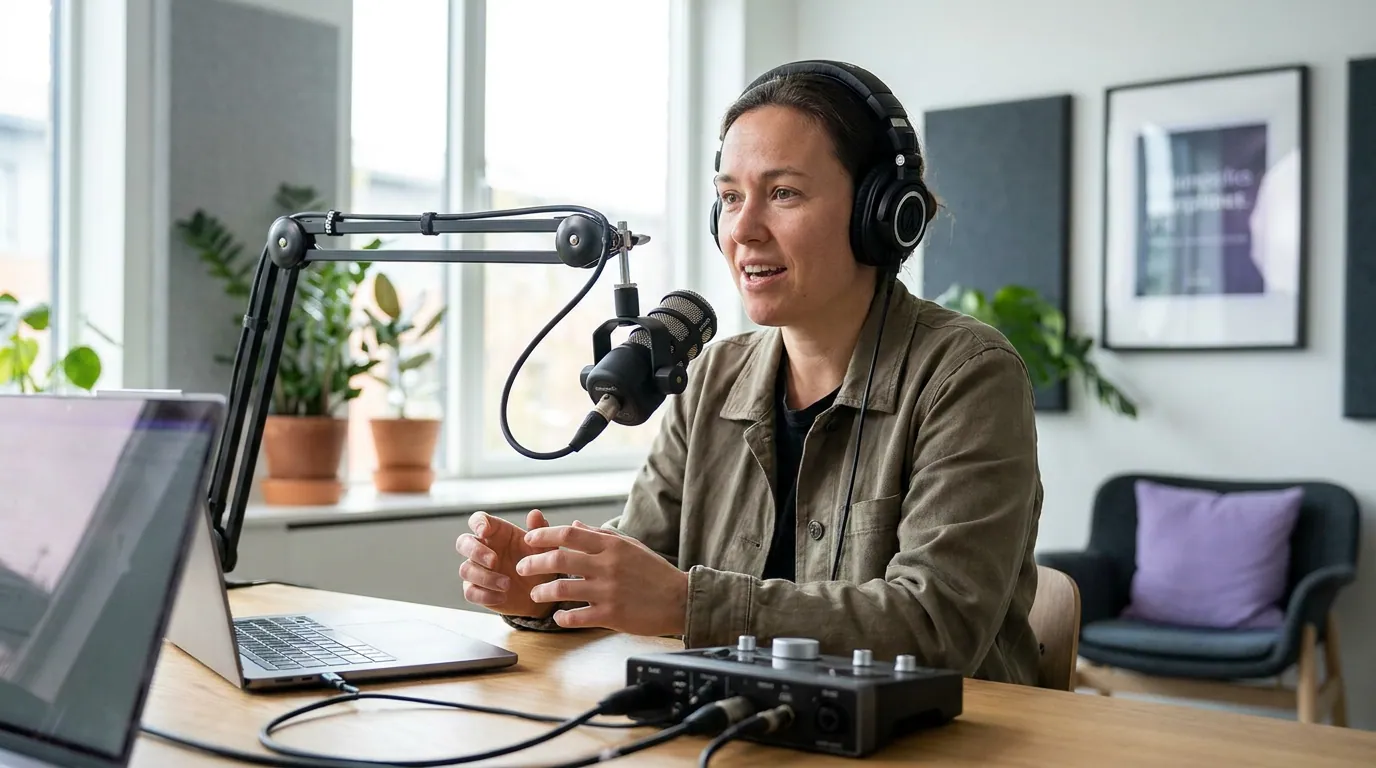
1. Samson Q2U, the cleanest upgrade path, full stop
The Q2U is a dynamic, cardioid mic with USB-C and XLR outputs, recording 16-bit/48kHz over USB, for around $70 (Samson; The Podcast Host). It wins this list because its two outputs come off one capsule with no USB-side processing in between. Record it over USB today, plug the same mic into a $100 interface in a year, and your voice sounds the same. The only thing that changes is the converter doing the work.
It also does something rare at this price: you can record both outputs at once. Many creators run USB into the laptop and XLR into an interface simultaneously as a backup track, if the computer glitches mid-record, the analog feed survives (The Podcast Host). For a new show that can't re-record a guest, that safety net alone is worth the price.
Where it falls short. Being a dynamic mic, it wants you close, within a fist's distance, and it rewards a quiet room, not a treated one. The 50 Hz–15 kHz response is honest rather than flattering; it won't add the sheen a pricier condenser does. There's no onboard EQ or noise reduction, so what you hear is what your room gives you. For a first mic, that's a feature, not a flaw: it teaches mic technique instead of papering over it.
Migration cleanliness: 5/5. No sound change, no software dependency, and an optional simultaneous backup track on the way up.
2. Audio-Technica ATR2100x, the near-twin, with a stock asterisk
The ATR2100x is the Q2U's closest rival and, for practical purposes, its twin: a cardioid dynamic with USB-C and XLR outputs, around $70, but with a higher-spec converter, up to 24-bit/192kHz over USB versus the Q2U's 16-bit/48kHz (Audio-Technica). Reviewers who have run both back to back report a marginally brighter, more present voicing on the ATR2100x and a marginally warmer one on the Q2U; most listeners can't reliably tell them apart in a blind test (Joe Crow, The Audio Pro). Like the Q2U, there's no USB-only DSP, so its outputs match each other.
So why isn't it tied for first? Availability. As of mid-2026, Sweetwater lists the ATR2100x as "no longer available" and Best Buy shows it as not available in new condition, while Audio-Technica's own product page and other retailers (Amazon, Equipboard's tracked stores) still carry it (Sweetwater; Equipboard). There's no manufacturer discontinuation notice, but the retail signals are mixed. If you can find one near $70, it's every bit as good a buy as the Q2U. If stock looks thin where you shop, the Q2U is the safer choice and the two are close enough that you won't feel the difference.
Where it falls short. Same dynamic-mic caveats as the Q2U, close-talking, quiet room, plus two ergonomic gripes reviewers consistently raise: no gain knob (you set input level in your computer's settings), and the included desk tripod is light enough to tip (Audio-Technica). Budget for a boom arm.
Migration cleanliness: 5/5 on sound, 4/5 overall, docked one point only because patchy stock makes it a less reliable "buy it and replace it for years" pick.

3. Shure MV7+, the best mic here, with the parity asterisk
The MV7+ is a dynamic, cardioid mic voiced after Shure's SM7B broadcast standard, with USB-C and XLR outputs, 24-bit/48kHz, at around $279 (Shure; The Podcast Host). It sounds noticeably more "broadcast" than the $70 dynamics and adds genuinely useful onboard tools: a real-time denoiser, auto-level mode that rides your gain as you move, and a full DSP chain (EQ, compressor, limiter) through Shure's MOTIV Mix software.
Here's the asterisk that decides whether it belongs on your list. On the MV7+, the USB output carries all that DSP; the XLR output does not, the XLR feed is raw analog with no processing (Shure; The Podcast Host). So if you spend six months loving the denoised, auto-leveled sound over USB and then "upgrade" to XLR, you don't get that sound. You get the raw capsule plus whatever your interface and your own gain-staging produce. That's not a defect, purists want the clean analog feed, but it breaks the "nothing changes when I upgrade" promise that justifies a hybrid in the first place.
There's a second wrinkle on the XLR side: the MV7+ is gain-hungry. Reviewers report needing an interface gain knob near 80% to get a healthy level, which can introduce preamp hiss unless you have strong preamps or add an inline booster like a Cloudlifter (The Podcast Host). That's an extra ~$150 and a real consideration before you treat XLR as your endgame.
Who should still buy it. If you mostly want a great-sounding USB mic now and treat XLR as a far-off "maybe," the MV7+ is the best-sounding mic in this guide and the auto-level mode is a gift for one-take solo recording. Just buy it for what its USB side does today, not for an identical-sounding XLR future.
Migration cleanliness: 3/5. The path exists and the mic is excellent, but the sound changes on the way, and the XLR side may want an extra purchase.
4. Rode NT1 5th Gen, the studio sound, if your room earns it
The NT1 5th Gen is the outlier: a large-diaphragm condenser, not a dynamic, with Rode's Dual Connect USB-C and XLR outputs, around $249 (often ~$214 on sale) (Rode; Audio News Room). Rode calls it the first mic to ship a 32-bit float USB output, which makes clipping effectively impossible, you can whisper or shout without setting levels first, and its 4 dBA self-noise is among the quietest of any studio condenser (Rode).
The parity story here is the most pronounced on the list. The USB output is 32-bit float and runs through onboard DSP (compression, gating, high-pass, even APHEX Aural Exciter and Big Bottom). The XLR output is pure analog, 24-bit-class, no 32-bit float, no DSP, and it needs 48V phantom power from an interface (Rode; Audio News Room). So USB-to-XLR isn't a small voicing shift like the MV7+; it's a different feature set. The low-noise capsule carries over either way, but the unclippable safety and the effects do not.
The bigger caveat is the mic type. A condenser hears everything, keyboard clatter, the fridge, the room's reflections, so it rewards a treated or at least soft, quiet space and punishes a bare-walled office. There's also no headphone jack on the mic for direct monitoring. If you're choosing between a condenser and a dynamic for an untreated room, read dynamic vs condenser mics for your recording room before you spend, the room usually decides this, not the mic.
Who should buy it. A host with a quiet, soft-furnished room who wants a polished, airy "studio" sound and likes the idea of an unclippable USB feed now and a clean analog feed later. In the wrong room, the same mic will sound worse than a $70 dynamic.
Migration cleanliness: 3/5. Two capable outputs, but they deliver different things, and XLR requires phantom power you don't need on the cheaper dynamics.
How we judged these
The ranking rests on each mic's documented signal path plus the listening notes of reviewers who ran these side by side, not on a quick afternoon plug-in. The criteria, in order of weight:
- Output parity, whether the XLR feed reproduces the USB feed, established from each manufacturer's own signal-path documentation (DSP on USB vs raw analog on XLR).
- Migration cost, the dollars and gear required to actually move from laptop to interface: phantom power needs, gain-staging quirks, possible inline boosters.
- Room tolerance, dynamic vs condenser, because the room ruins more recordings than the mic does.
- Price and value, verified June 2026 against manufacturer and major-retailer pages, not cached numbers.
The honest meta-point: the gap between a $150 and a $1,500 setup is smaller than the gap between bad mic technique in a noisy room and good technique in a treated one. A $70 Q2U used well beats a $279 MV7+ used badly. Spend on the room and your habits before you spend up the mic ladder. For the full ladder by price, see the best podcast mics by budget tier.
Who should pick what
- First-time host, normal room, tight budget: Samson Q2U. Identical outputs, optional backup track, an upgrade path that changes nothing about your sound. The closest thing to a no-regret buy in this category.
- Same buyer, but the ATR2100x is in stock near $70: either is fine; the ATR2100x reads slightly brighter. Confirm stock first.
- Solo host who wants to sound polished today, with XLR as a someday: Shure MV7+. The best mic here, just buy it for its USB side and treat the XLR feed as a separate, rawer sound rather than an identical upgrade.
- Host with a quiet, soft room chasing a studio sound: Rode NT1 5th Gen. Outstanding in the right space, a liability in the wrong one. If your room isn't there yet, fix the room first or stay on a dynamic.
Whichever you choose, the dual output is the point: you never have to re-buy the mic to grow. Match the mic to your room and budget today, knowing the migration path is there when you need it, cleanest on the cheap dynamics, real but not sound-for-sound on the MV7+ and NT1. If you're still deciding between connector types at all, USB vs XLR mics: which to buy and when to switch covers the broader decision, and the best budget podcast mic under $100, tested by use case goes deeper on the cheap end.