
Facebook Ads for a Podcast: A Meta Campaign Blueprint

Meta ads can grow a podcast, but only if you stop asking them to do something they can't: track a play on Spotify or Apple. There's no pixel event back from those apps, so don't optimize for a listen. Send paid traffic to something you own, a landing page or an email signup, and let the clip do the selling. The structure below is built around that gap.
This is the part most "Facebook ads for podcast" guides skip. They tell you to run a campaign and "drive listeners," then go quiet on the one thing that breaks: Meta's whole machine learns from conversion events it can see, and a podcast play in a third-party app is invisible to it. Get the objective and the destination right and the rest is ordinary advertising. Get them wrong and you'll spend a month paying for clicks that vanish.
Why podcasts are the wrong shape for Meta's funnel
Meta's ad system is a feedback loop. You define a conversion, the pixel or Conversions API reports back when one happens, and the algorithm hunts for more people likely to do it. For an e-commerce store the loop is tight: ad to product page to purchase, all measured. For a podcast, the loop is cut. Your ad sends someone to Spotify, they (maybe) press play, and Spotify tells Meta nothing. The signal never returns.
So the first decision is not creative or budget. It's what conversion you can actually feed the algorithm. That answer is almost never "a listen."
There's a real reason to do this anyway. Social video is now the single biggest driver of podcast discovery: 57% of listeners say they rely on social media for podcast recommendations, the first time it has edged out friends and family (54%) (Coleman Insights and Amplifi Media, The State of Video Podcasting 2025, 1,000 U.S. consumers, via InsideRadio). Paid social puts your show in the exact place discovery already happens. You just have to measure the part you can see.
Which Meta objective should you pick for a podcast?
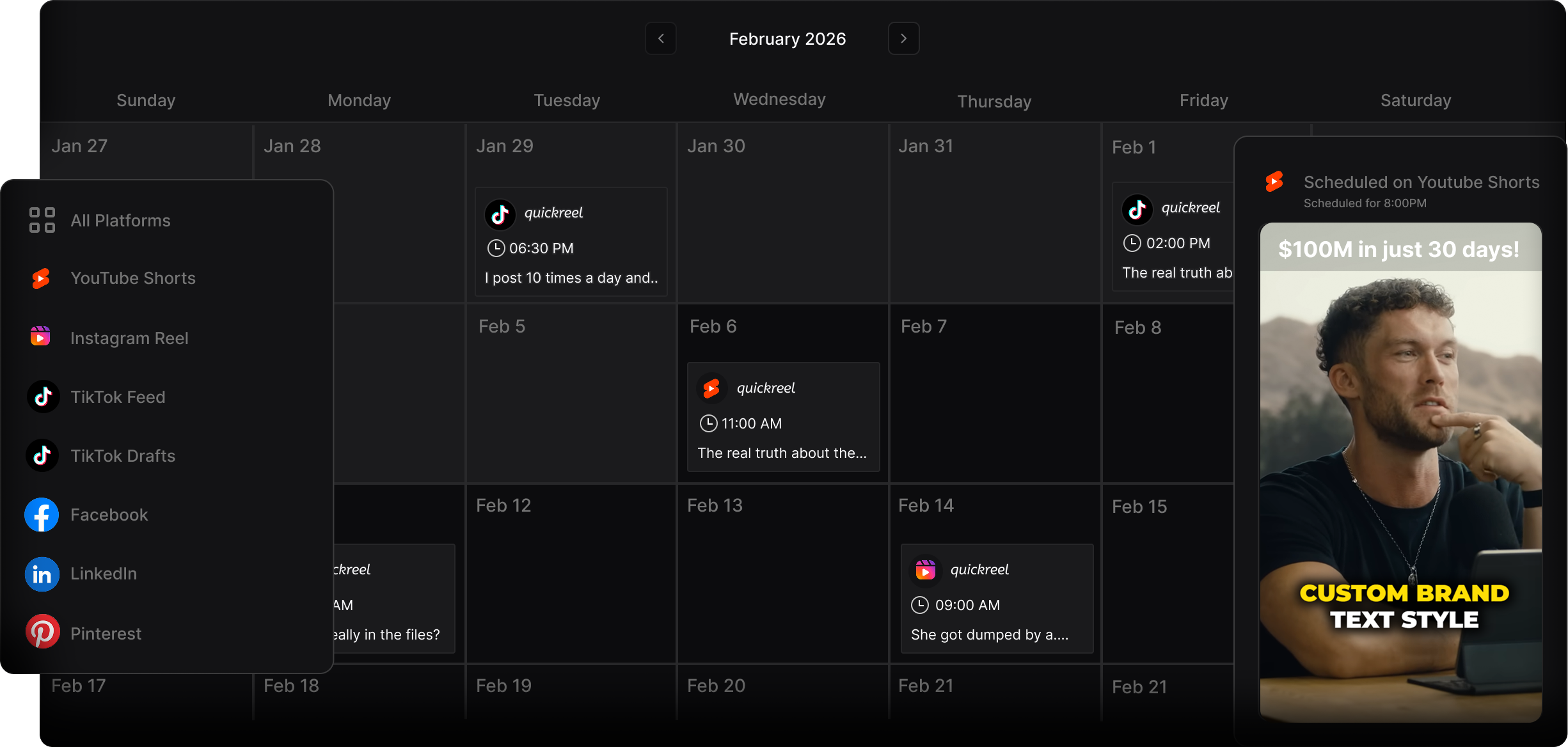
For most shows, pick the Leads objective and send paid traffic to an email capture, or the Traffic objective sending to a landing page with a tracked "Listen" button. Skip "Engagement" and "Awareness" unless you only want cheap views with no path to a follow. Optimize for the conversion you can verify, then treat listens as a downstream estimate.
Here's the logic by goal. There is no single right answer, there's a right answer for what you're trying to do this month.
| Your goal | Best Meta objective | Destination (what gets tracked) |
|---|---|---|
| Build an audience you own | Leads | Email signup form (on-Meta Instant Form or your page) |
| Drive measurable click-throughs to listen | Traffic | Landing page with a tracked "Listen on…" button |
| Cheap reach for a launch / trailer | Engagement (video views) | The clip itself; no destination |
| Retarget warm viewers later | Sales/Leads + Custom Audience | Same as above, audience = past video viewers |
The trap is the Awareness/Engagement objective. It optimizes for the cheapest possible view or thumbstop, which Meta is very good at finding, and those views are frequently from people who will never open a podcast app. You get a beautiful CPM and zero listeners. Use Engagement only as a deliberate top-of-funnel layer that you'll retarget, never as the whole campaign.
How to measure listens you can't directly track
You can't see the play, but you can triangulate it three ways: a prefix-tagged smart link, a promo-code or unique episode call-to-action, and a download-graph correlation with your spend dates. None is perfect; together they tell you whether the money worked.
- Smart link with UTMs and a prefix. Send every ad to a single landing page (Linkfire, Podlink, or your own page) that lists "Listen on Spotify / Apple / YouTube", and include the apps your audience actually uses, Overcast and other third-party players included. Tag the page URL with UTMs so analytics shows you click-throughs by ad. If you use a tracking prefix like OP3 or Podtrac on your feed, you can watch redirect traffic rise during a campaign. This measures intent (the click), not the play.
- A unique on-air CTA. Run the ad against one specific episode and, in that episode, say something the rest of your catalog doesn't, "if you found us on Instagram this week, reply to the show with the word reels." Replies, a spike in a dedicated email, or a campaign-only promo code are listens you can attribute by hand. Crude, but real.
- Download-graph correlation. Note your spend start and stop dates, then look at your hosting analytics for the same window against a baseline two weeks earlier. A clear lift that decays when you pause spend is the strongest causal signal a podcast advertiser gets. State the caveat out loud: this is correlation, and seasonality or a viral organic clip can confound it. Run it long enough that the pattern repeats.
The honest takeaway: you are buying clicks and signups you can prove, and listens you can only estimate. Anyone selling you exact cost-per-listen from Meta is guessing. (For the underlying economics of what a listener should cost you, see what it costs to buy a podcast listener.)
The clip-ad creative framework
Your best-performing podcast ad is almost never a designed graphic. It's a vertical clip of a real moment from the show, captioned, with a hook in the first three seconds. Clips are how podcasts get discovered organically; paid just buys reach for the same creative. Run three to five clip variants per launch and let Meta find the winner.
Build each clip ad on four layers:
- The hook (0–3s). A spoken or on-screen line that creates a question. "Most podcast ads waste money for one reason." Not a logo, not "welcome to the show." The first three seconds decide whether anyone sees the rest.
- The payoff (3–25s). The actual valuable or funny moment. Self-contained, it has to make sense to someone who has never heard your show. If a viewer needs context you cut out, the clip fails as an ad.
- Captions, always. Most social video is watched on mute (Verizon Media/Sharethrough put it around 75%, Digiday's 2016 figure was ~85% of Facebook video muted, both publisher-reported and directional). Burned-in captions are not optional for a paid clip.
- The CTA (last 3s + ad copy). One clear next step that matches your objective: "Free Podcast Growth Kit, link below" for Leads, "Full episode on Spotify" for Traffic. One ask, not three.
A practical production note: you don't hand-edit five vertical, captioned variants per launch. You generate the clips from the full episode, pick the strongest moments, and adjust the hooks, that's a batch job, not a week of work. (More on the mechanics in turning podcast clips into social cross-promotion.)
Budget tiers: where to start and when to scale
Start at the test tier, roughly $5–10/day per ad set, long enough to gather signal, then move budget only to creatives that earn it. Do not open at the scale tier. Meta's optimization needs conversion volume to learn, and at podcast budgets you reach that floor slowly, so patience beats spend.
When a creative proves itself at the learn tier, scale it slowly, raising a winning ad set's budget by more than ~20% every few days resets Meta's learning and can spike your cost. And before you scale anything, decide whether paid is even the right move for your show right now; it usually isn't until your organic clips are already converting. We make that call in when paid podcast promotion is actually worth it.
Common mistakes that waste podcast ad budget
Most failed podcast campaigns fail the same handful of ways. Each has a fix.
- Optimizing for listens. There's no event to optimize for. Switch to Leads or Traffic and measure the proxy. Fix: change the objective before you touch creative.
- Sending ads straight to Spotify. You hand the click to a platform you can't track and can't retarget. Fix: route through a landing page you own, then on to the app.
- Designed banner creative. Static graphics underperform real clips badly on Meta video placements. Fix: run captioned clips of actual moments.
- Opening at a high budget. You blow the test budget before you know which clip works. Fix: start at $5–10/day per ad set.
- No retargeting layer. You pay to reach people once and never again. Fix: build a Custom Audience of video viewers and run a Leads ad to them.
- No owned destination. Even a great campaign leaves nothing behind if it doesn't capture an email. Fix: pair every campaign with an email list and a welcome sequence that points new subscribers to your best episode.
FAQ
Do Facebook ads actually grow a podcast? They can, indirectly. Meta can't track or optimize for a play in Spotify or Apple, so ads grow a show by building an owned audience (email, a warm retargeting pool) and driving measurable clicks to a listen page. Treat the listen as an estimate, the signup as the real conversion.
Should I run Facebook or Instagram ads for my podcast? Run both through one Meta campaign and let placements auto-optimize, then read the breakdown. Instagram Reels and Stories tend to favor vertical clip creative; Facebook feed reaches an older audience. Don't pre-pick, let your cost per signup tell you where the budget belongs.
What's a realistic budget to start? $5–10 per day per ad set for a week is enough to find a clip that works before you commit more. Podcast budgets reach Meta's optimization threshold slowly, so plan for a learning period of several days rather than instant results.
How do I know if the ads worked if I can't track listens? Triangulate: UTM-tagged click-throughs to your listen page, a unique on-air or promo-code CTA tied to the campaign, and a download-graph lift across your spend window versus a baseline. Agreement across all three is your signal, any one alone can mislead.