
Advertising Your Podcast on Overcast: A Full Guide

Overcast sells small banner ads inside its iPhone podcast app on a self-serve, demand-based basis. You pick a category, pay a flat 30-day price set by an auction (roughly $110 to well over $2,000), and your ad shows to people already listening in that category. You get three numbers back: views, taps, and subscribers. Buy it at overcast.fm/ads.
That is the whole product. No sales call, no insertion order, no CPM negotiation. Marco Arment runs Overcast as a one-person company, so the ad system is built to need zero humans on his end. That simplicity is the appeal and also the catch: the price floats with demand, you cannot schedule a campaign in advance, and you cannot target anyone by age, location, or interest beyond the podcast category they are browsing.
This guide covers exactly how the auction works, what the ad looks like to a listener, what real campaigns have cost per subscriber, the creative and content rules that get ads rejected, and a break-even rule for deciding whether to spend at all.
What is an Overcast ad and where does it show?
An Overcast ad is a small banner that promotes your show to other Overcast listeners, natively inside the app. It appears below the playback controls on the Now Playing screen and inside the Add Podcast directory. When someone taps it, Overcast opens a native screen listing all your episodes with a one-tap subscribe button (overcast.fm/ads).
Two things make this different from a normal display ad. First, the audience is captive and qualified, they are inside a podcast app, in a listening mindset, browsing the exact category your show lives in. Second, the conversion action is a real subscribe, not a click to a landing page where most people bounce. The whole transaction happens without leaving Overcast.
The ad runs for 30 days from purchase and goes live immediately. There is no scheduling, no flighting, no A/B rotation. You buy one slot in one category and it starts that minute.
How much does an Overcast ad cost?
Overcast ads use flat 30-day pricing set per category by demand, not a CPM rate. It behaves like an auction even though Overcast calls it a demand-based model: each sale in a category raises that category's price, and if slots go unsold for two days the price drops daily until one sells. Real category prices observed on the page have ranged from about $160 (Sports) to $1,525 (the catch-all "All"), with hot categories selling out entirely (overcast.fm/ads).
There is no published rate card, because the number changes shortly after midnight GMT based on what sold. As of a recent check of the live page, listed prices included Society & Culture at $875, Comedy at $270, Arts and Leisure at $200 each, and Sports at $160, while Technology ($1,125), Business ($1,000), and News ($700) showed as sold out (overcast.fm/ads). Independent write-ups echo the same shape: Buzzsprout's roundup of in-app advertising notes Overcast prices starting around $110 and climbing into the low thousands for the most-demanded business and tech slots (Buzzsprout).
The mechanism matters more than any single number. You are bidding into a thin market of fellow podcasters, so the popular categories, Comedy, News, History, Sports, are often sold out, and the price you see is whatever the last buyer pushed it to.
How do you target on Overcast, and who will see it?
Targeting is category-only. You choose one Apple-style podcast category, and your ad shows to listeners playing or browsing shows in that category. Overcast collects no listener-demographic data, so there is no targeting by age, gender, region, language, or interest, and for that reason Overcast will not accept ads for gender-specific, region-specific, or non-English shows (overcast.fm/ads).
The audience itself is narrow but high-quality: Overcast is an iPhone-only app with a loyal, tech-leaning following. It does not publish user counts and rarely appears with a named market share, while Spotify (~32%), Apple, and YouTube dominate the app landscape (Command Your Brand). Translation: you are reaching a small slice of all podcast listeners, but a slice that already pays attention to the medium.
Pick the category your ideal new listener is already browsing, not the one that flatters your show. If your true home category is sold out, a closely adjacent one beats a prestige category your audience never opens.

How to advertise on Overcast: the steps
- Confirm you qualify. Your show must be in English, not region- or gender-specific, and clear of the banned-topic list (covered below). It also needs to be in the Apple Podcasts directory, which Overcast pulls from.
- Go to overcast.fm/ads. Everything is self-serve. There is no contact form for a custom proposal, only credit-card purchase, by design.
- Browse categories for price and availability. Each category shows its current price, open slots, and per-campaign estimates including cost-per-tap and cost-per-acquisition. Sold-out categories are common; note which adjacent ones are open.
- Prepare the creative. You need cover art and a short, accurate title and description. There is no clever copy game here, the banner is small and the tap opens your real episode list, so honest framing wins.
- Buy the slot. Payment is credit card only, all sales final, and the ad goes live immediately for 30 days. Overcast reserves the right to cancel and refund at its discretion, but do not count on a refund.
- Watch the dashboard. Overcast emails you a link to track views, taps, and subscriptions for the full 30 days. Check it against the cost-per-subscriber math below before you ever buy a second slot.
What does an Overcast campaign actually return?
Plan for roughly $0.60 to $3.00 per new subscriber, and know it can drift higher as the category auction heats up. The clearest public record comes from author David Kadavy, who ran several campaigns and published the numbers: an early Arts campaign cost about 76 cents per subscriber, a separate run came in at 63 cents, and a later 2019 campaign jumped to $2.90 per subscriber (kadavy.net).
His tap-to-subscriber conversion is the useful benchmark: about 11.8% of people who viewed his show, and 13.2% of those who downloaded, converted into subscribers, with roughly 90% of taps turning into a download (kadavy.net). Those are strong rates for paid acquisition, a captive, in-app audience converts far better than a cold social click.
The honest caveat: these are one operator's documented campaigns, not a guaranteed rate, and his own verdict turned negative. By 2019 he concluded the price had outrun the value for his show and said he would not advertise on Overcast again or recommend it, warning that you need a strong back-end business to justify the per-subscriber cost (kadavy.net). That is the same caution worth applying to any paid channel: a subscriber is only cheap relative to what that subscriber is eventually worth to you.
Common mistakes (and the fix)
- Buying a prestige category instead of your real one. Comedy and News are usually sold out and expensive. If your show is a niche business interview, an open adjacent category your listeners actually browse will out-convert a glamour slot. Match the category to where your next listener spends time.
- Judging the campaign on views or taps. Views are vanity and taps are halfway. The only number that pays rent is subscribers, and the cost-per-subscriber estimate in your dashboard (overcast.fm/ads). Set your acceptable cost-per-subscriber before you buy.
- Tripping a content rule. Overcast rejects shows primarily about investing, crypto and NFTs, gambling, weapons, alcohol or drugs, sexual content, extreme or highly divisive politics, hateful content, and misleading or anti-scientific claims (overcast.fm/ads). Read the list before you write the creative.
- Expecting a refund. All sales are final. The "discretionary refund" exists but is not a safety net, treat the spend as committed the moment you click buy.
- Treating one channel as a plan. Overcast reaches iPhone-only listeners already in a podcast app. It is a top-up, not a strategy. Pair it with the channels in our guide to when paid podcast promotion is actually worth it.
How to decide if it is worth it: the break-even rule
Use one rule before you buy: your acceptable cost per subscriber is the lifetime value of a subscriber times the share of your funnel you are comfortable spending. If a subscriber is worth $10 to you over their lifetime (through a membership, a course, or sponsor value) and you will spend a third of that on acquisition, your ceiling is about $3.30 per subscriber, comfortably inside the observed Overcast range. If a subscriber is worth $1, the math rarely works.
Most indie shows monetize thin, so be honest about that lifetime number. If your show has no membership, course, paid newsletter, or sponsor revenue tied to audience size, a subscriber's real LTV may be close to zero today, which means almost any paid acquisition cost fails the test until you build that back end. If you do not yet have a back-end that turns subscribers into value, the cheapest "ad" is still a strong clip on social, which costs nothing per view. To compare Overcast against owned and other paid channels, work through what it costs to buy a podcast listener, then weigh it against buying ads inside other podcasts' feeds and promoting a podcast with Meta ads.
Overcast ads vs other paid podcast channels
| Channel | What you buy | Best for |
|---|---|---|
| Overcast banner ad | 30-day category slot, in-app | Reaching engaged iPhone listeners cheaply per subscriber |
| Other-feed audio ad | Host-read or inserted spot | Borrowing trust from a show with your exact audience |
| Meta / Instagram ads | Targeted social reach | Demographic and interest targeting Overcast can't do |
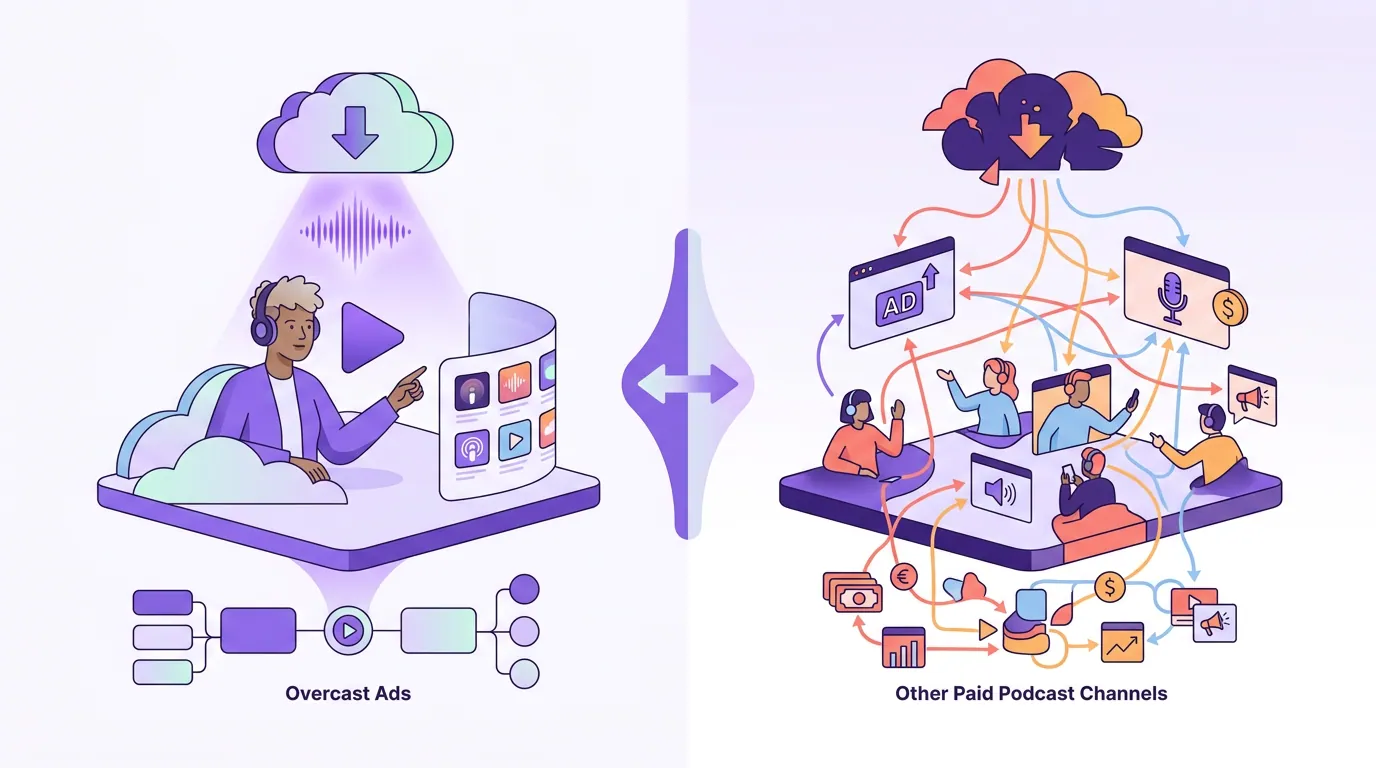
Audio spots in other feeds typically price on CPM, roughly $15–$50 depending on placement and whether they are host-read (Podscan, 2025). Overcast's flat per-subscriber economics can beat that for in-app discovery, but it cannot do the demographic targeting Meta can. Use each for the job it is shaped for.
Frequently asked questions
How much does an Overcast banner ad cost? It is a flat 30-day price set per category by demand (effectively an auction), historically ranging from about $110–$160 in cheaper categories up to $1,500+ in the most-demanded ones, with hot categories often sold out. The exact price changes daily with demand (overcast.fm/ads, Buzzsprout).
What is a realistic cost per subscriber? Documented campaigns ran roughly $0.63 to $2.90 per subscriber, with tap-to-subscriber conversion around 11–13% (kadavy.net). Treat that as one operator's real results, not a quote, your cost depends on category and the live auction.
Can I target by location, age, or interest? No. Overcast targets by podcast category only and collects no demographic data, so it does not accept region-specific, gender-specific, or non-English shows (overcast.fm/ads).
Can I schedule a campaign or book in advance? No. Ads are first-come, credit-card only, and go live immediately for 30 days. There is no scheduling and no full-service sales contact (overcast.fm/ads).
What kinds of shows get rejected? Anything primarily about investing, crypto/NFTs, gambling, weapons, alcohol or drugs, sexual content, extreme or divisive politics, hateful content, or misleading claims, plus anything not appropriate for all ages (overcast.fm/ads).
For the next stage of the funnel, converting the listeners these ads earn, see how to start a podcast email list from zero and a 5-email welcome sequence for new podcast subscribers.