
How to Practice On-Camera Before Your First Guest Spot


To practice talking on camera before your first guest spot, do five focused minutes a day for two weeks: record yourself answering one mock-interview question, watch it back against a four-point rubric, and climb a ladder from talking alone to a live mock interview with a friend. Short daily reps beat one long cram session, because the goal is to make the camera boring before it matters.
Most people prepare for a guest appearance by re-reading their talking points the night before. That's the wrong rehearsal. The thing that trips up first-timers isn't what to say, it's the strange split-second when the red light comes on and your own face appears in a little box and your voice suddenly sounds like a stranger's. You can't think your way out of that. You can only get used to it, and getting used to it takes repetition, not reading.
How do you practice talking on camera by yourself?
Practice on camera alone by recording short, real answers and watching them back against a checklist, not by talking to a mirror. Open your phone or laptop camera, ask yourself one interview question out loud, answer in 60 to 90 seconds, then review the clip on four things: filler words, pace, eye contact, and energy. Once a day.
The mirror is the classic advice and it's close to useless. A mirror shows you live, so you fix posture in real time and learn nothing about how you actually come across. The camera is honest in a way the mirror can't be. It catches the "um" you didn't hear, the place you sped up because you got nervous, the moment your eyes drifted off the lens to read your notes. Reviewing a recording is uncomfortable for about four clips. After that it becomes data, and data is fixable.
This matters more than it used to because the camera is now the front door. Watching is the default way people meet a show: 53% of new US weekly listeners say they prefer to watch a podcast, up from 30% in April 2022 (Backlinko). Your guest spot won't just be heard. It'll be seen, and the most quotable 45 seconds will likely get cut into a vertical clip and shown to people who've never heard of you.
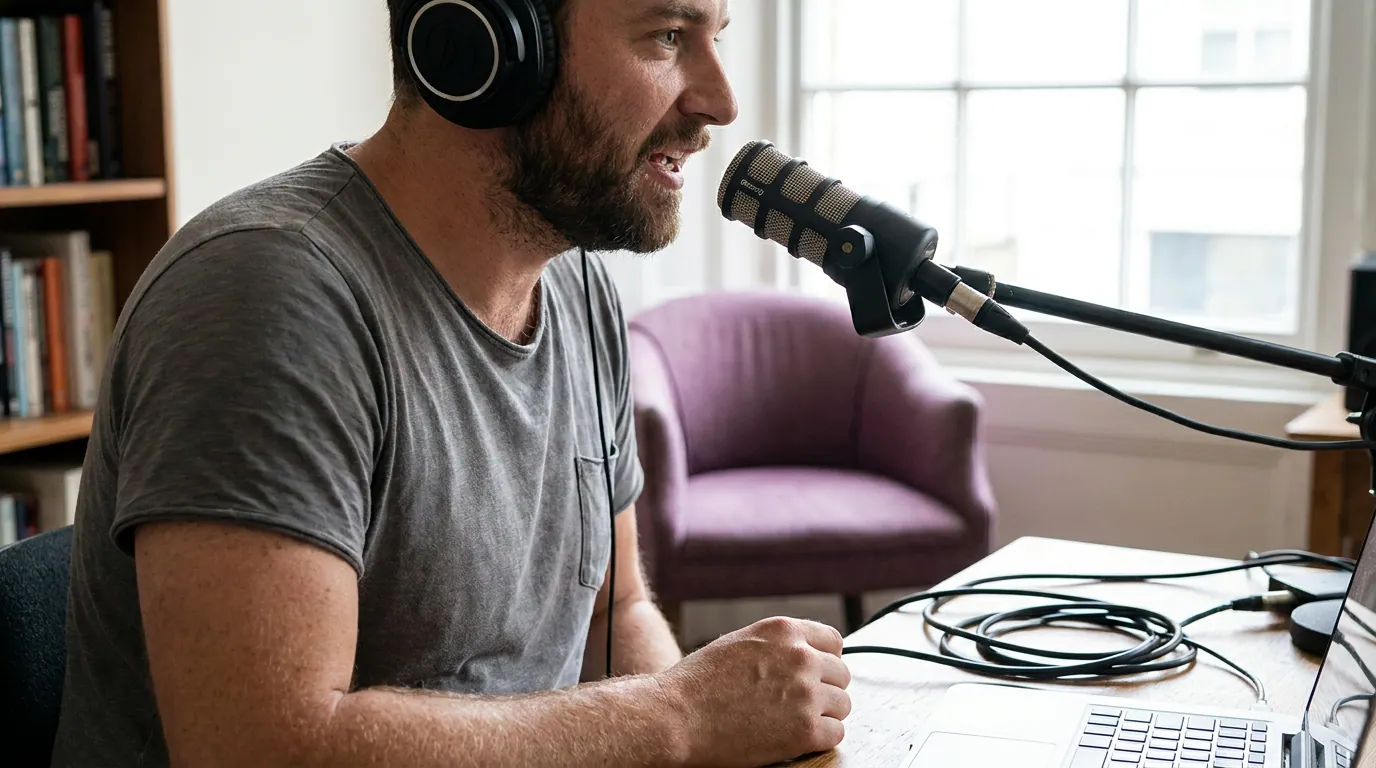
The two-week, five-minutes-a-day plan
Spread the work across 14 days. Week one is solo: build the habit of recording and reviewing so the camera stops feeling like an event. Week two adds a real person, because conversation with another human is a different skill than monologuing, and you want to meet that gap before the host does.
Five minutes is the whole point. A long practice session feels productive and almost never repeats, so you get one anxious marathon instead of fourteen calm reps. The reps are what rewire the nerves. If you miss a day, don't double up, just continue. The streak matters less than the total count of times you've watched yourself talk and survived it.
Mock-interview prompts to rehearse with
Don't rehearse a script. Rehearse answers to the questions a host will actually ask, so your brain has trodden the path before. Most podcast interviews recycle the same handful of openers and pivots. Practice these out loud, on camera, one per day:
- "Tell people who you are and what you do." The dreaded intro. Get yours to 30 seconds, conversational, no résumé recital.
- "How did you get into this?" Your origin, as one short story with a beginning and a turn, not a timeline.
- "What's a common misconception about your field?" A built-in chance to say something sharp and clippable.
- "What's something you changed your mind about?" Hosts love this; it makes you sound like a thinker, not a brochure.
- "What would you tell someone just starting out?" Your practical, generous answer, the one most likely to get shared.
Notice that none of these have a single right answer. That's deliberate. You're not memorizing words; you're getting comfortable finding words while the camera watches. If you can answer an unexpected follow-up without freezing, you're ready, which is exactly what day 10 in the plan trains.
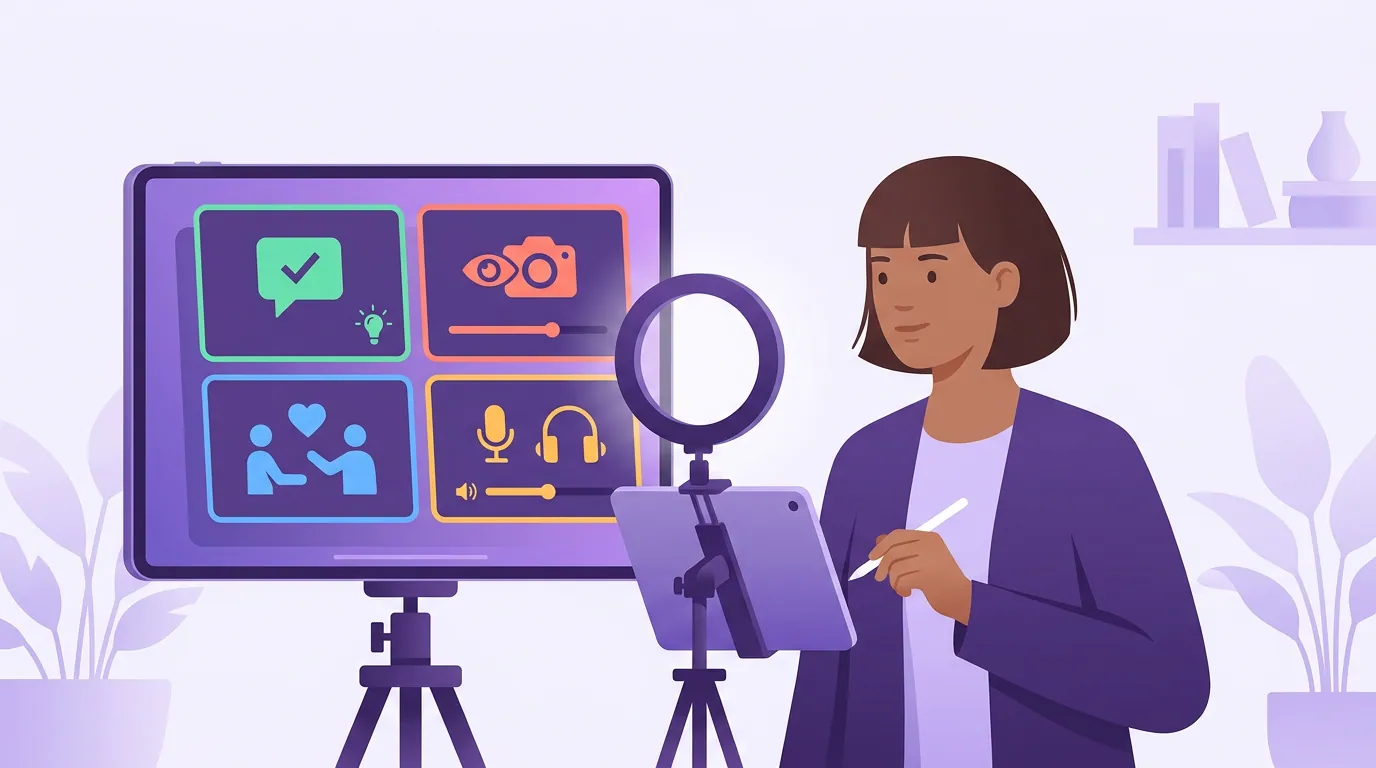
The self-review rubric: score four things, not "did I sound okay"
Vague review ("that was bad," "that was fine") teaches you nothing. Score every practice clip on four specific axes and you'll see exactly what to fix next. This rubric is the engine of the whole plan.
A note on each one. Filler words are the easiest to fix once you can hear them, pause instead of saying "um," and the pause sounds thoughtful, not nervous. (More on that in how to stop saying um and like when you're interviewed.) Pace almost always means too fast; nerves accelerate everyone, so practice deliberately slowing the parts where you rush. Eye contact means looking at the camera lens, not at the host's face on your screen or at your own thumbnail, a small but real difference, and worth getting right (where to look on a video podcast). Energy is the sneaky one: the camera flattens you, so the level that feels slightly too much in your room reads as normal on screen.
The desensitization ladder: don't jump to the top
Nerves shrink through gradual exposure, so climb in small steps instead of leaping straight to a live recording with a stranger. Each rung adds one new source of pressure, a camera, then a clock, then another person, then unpredictability. You only move up when the current rung feels boring.
The reason the ladder works is that the brain stops firing the alarm once a situation proves safe enough times. Skip rungs and the alarm stays loud, which is why people who book a big show as their very first on-camera experience often describe freezing. You're not trying to eliminate nerves, a little adrenaline sharpens you. You're trying to lower the baseline so the real recording feels like rung four, not a cliff. For the day-of routine that takes over from here, see looking confident as a first-time guest.
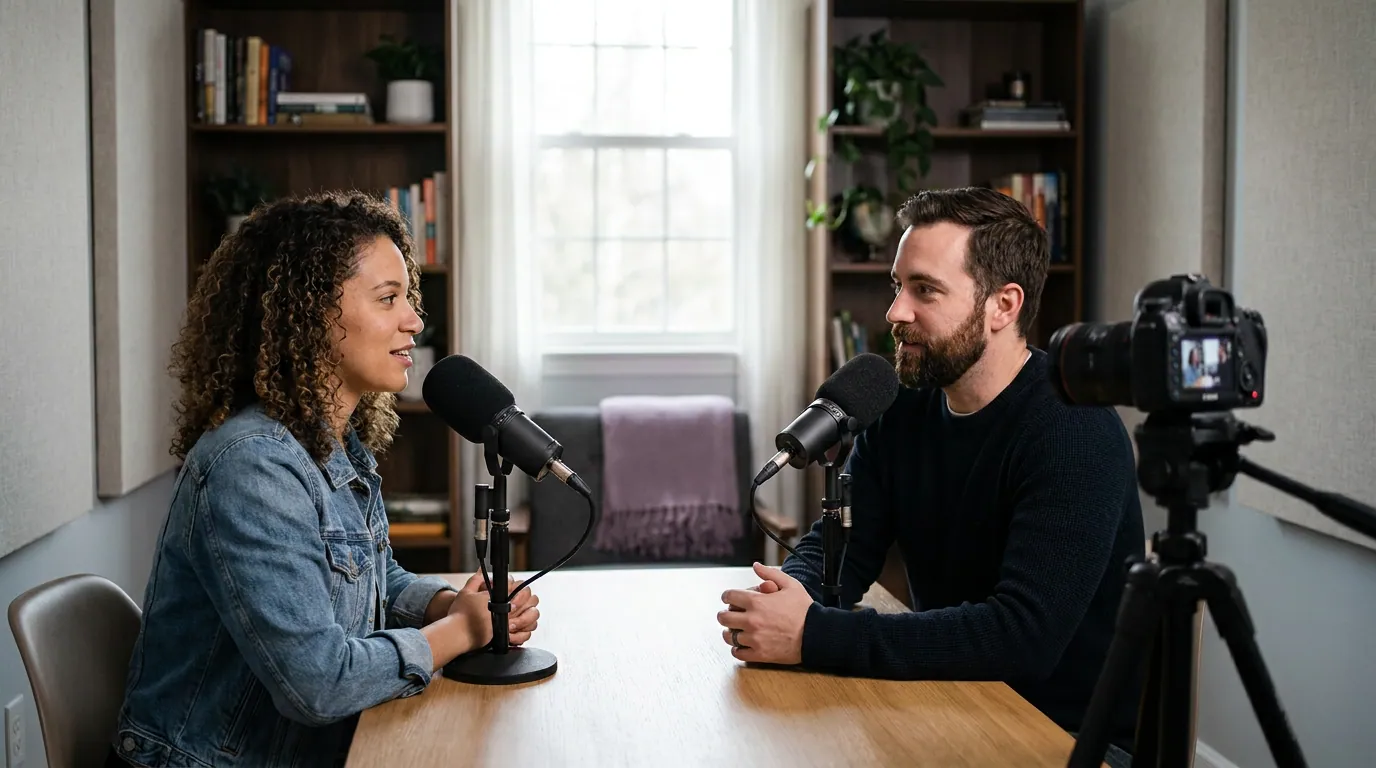
Common mistakes when practicing on camera
Even people who do the reps undermine them in predictable ways. Watch for these.
- Memorizing word-for-word. A script you forget mid-sentence is worse than no script. Rehearse the shape of an answer, the point and the example, not the exact words.
- Practicing only monologues. Talking alone is rung two. A real interview is a back-and-forth where you react, so week two's live questions aren't optional padding; they're the part that transfers.
- Reviewing without scoring. Watching yourself and cringing isn't review. Without the four numbers you'll fixate on how you look and miss what's actually fixable.
- Over-lighting and over-tweaking gear. A clean frame at eye level with a window in front of you beats a ring light you bought yesterday and haven't figured out. Sort the basics, then stop fiddling.
- Cramming the night before. One anxious 90-minute session the evening before raises your nerves instead of lowering them. The plan front-loads the work so the last day is rest and a single confident run.
FAQ
How long does it take to get comfortable on camera?
For most people, the worst of the discomfort fades within one to two weeks of short daily reps. The first three or four recordings are genuinely unpleasant to watch; by the end of week one, watching yourself becomes routine. Full ease takes months, but a first guest spot only needs "comfortable enough not to freeze", two weeks gets you there.
Is talking to a mirror good practice for being on camera?
No. A mirror lets you correct yourself live, so you never learn how you actually come across or build tolerance for seeing your recorded self. Record on your phone or laptop and watch it back instead. The mild discomfort of reviewing a clip is exactly the thing you're trying to desensitize, and a mirror skips it entirely.
Where should I look when I practice, the camera or the screen?
Practice looking at the camera lens, because that's what reads as eye contact to a viewer. On a video call your instinct is to look at the host's face or your own preview, which makes you appear to glance away. A small sticky note or arrow next to the lens helps retrain the habit during week one. More on this in camera vs. the host's face.
What if I still get nervous on the real recording?
Some nerves are fine and even useful, they raise your energy, which the camera flattens anyway. The two-week plan lowers your baseline so the real spot feels like a rung you've already climbed, not a brand-new cliff. A short vocal warm-up just before you go live takes the edge off the first minute (a 5-minute warm-up).
Do I need good equipment to practice?
No. Your phone or laptop webcam is the right tool for practice, because it's roughly what a remote interview will use. Spend your effort on framing and light, camera at eye level, a window or lamp in front of you, not on buying gear. Knowing the basics of your setup also makes you an easy guest, which hosts remember; see podcast guest etiquette and the matching host etiquette guide.