
When a Podcast Host Talks Too Much: Find the Balance


If you host an interview show, aim to talk for roughly 20–30% of the runtime, not half. The fastest fix isn't biting your tongue, it's cutting your questions to one sentence, killing the parallel story you were about to tell, and letting a guest's answer finish before you respond. Measure your real ratio once from a recorded episode, then close the gap with those three moves.
The catch is that "talk less" is bad advice on its own, because some host talk is the most valuable sound on the show. The skill is knowing which seconds earn their place. Below is a talk-ratio target by show type, a way to audit your own audio in fifteen minutes, the three habits that pull your share down, and a test for the host talk worth keeping.
How much should a podcast host talk?
On an interview show, a host should talk for about 20–30% of the episode and let the guest hold the other 70–80%. A co-hosted or solo-led show is closer to an even split. The number isn't sacred, what matters is that the person the audience came to hear is the one talking most. If you're the draw, talk more; if the guest is, get out of the way.
That range is a working guide, not a measured industry standard, there's no public dataset that fixes the "correct" host share, and any clean number you see online is someone's rule of thumb, including this one. Treat it as a target to audit against, not a law. The point of a number is that it makes a vague worry ("am I talking too much?") into something you can actually check.
What pushes most hosts over the line isn't ego. It's nerves about dead air, a script of twenty questions they feel they must get through, and the urge to relate by matching every guest story with one of their own. Each is fixable, and none requires you to become a quiet, characterless host who just reads questions off a card.

Why over-talking costs you the episode
The part you talk over is usually the best thing the guest was about to say. People bury their real material in the clause they'd reach if you gave them two more seconds, the admission, the number, the "honestly, I almost didn't." A host who jumps in to react, agree, or relate clips that flare off before it lands, and the conversation flattens into the guest's rehearsed version.
It also hurts you where it's hardest to see: in what travels. Discovery has moved to feeds, 57% of listeners now rely on social media for podcast recommendations, the first time that source passed friends and family (Inside Radio, 2025, citing Coleman Insights / Amplifi Media). The exchanges that make good clips are the ones with a clean, uninterrupted guest answer. If you talk across the best line, there's nothing to cut. You can't clip a moment you stepped on.
And it shapes who says yes next time. Guests talk to each other. A host known for letting people finish gets better guests and better answers, because the word is that your show is a good place to actually say something. That reputation is worth more than any single episode.
Audit your own talk ratio in fifteen minutes
You can't fix a ratio you've never measured, and almost no host has. Most of us badly misjudge our own share, the talking feels shorter from the inside than it sounds on the recording. Run this once on a real episode and the number will probably surprise you.
- Pick a recent interview episode, ideally one you felt good about. Open it in whatever editor or transcript tool you already have. If you record video, even the waveform alone is enough.
- Tally talk time by speaker. Many transcript tools (Descript, Riverside, most AI clip tools) already label speakers; some show per-speaker talk time directly. If yours doesn't, scrub the waveform and rough-estimate the split across the episode, you don't need second-level precision, you need to know if you're at 25% or 55%.
- Calculate your share: your talk time ÷ total talk time. Compare it to the target for your show type in the chart above. Anything more than about 10 points over target is worth acting on.
- Find your three longest turns. Listen back to your single longest stretches of talking. Ask of each: did that set up, redirect, or translate something for the listener, or was it a reaction, a parallel story, or me thinking out loud? That sorting (covered in the next section) tells you exactly what to cut.
- Re-measure in a month. Run the same check on a later episode. The number moving is the only proof the habit changed.
The point of the audit isn't guilt. It's that "talk less" is unmeasurable and easy to ignore, while "I was at 48% and my target is 25%" is a problem you can fix on the next record.
The three habits that pull your share down
Most over-talking traces to three specific habits. Fix these and the ratio follows on its own, you won't have to think about it mid-interview.
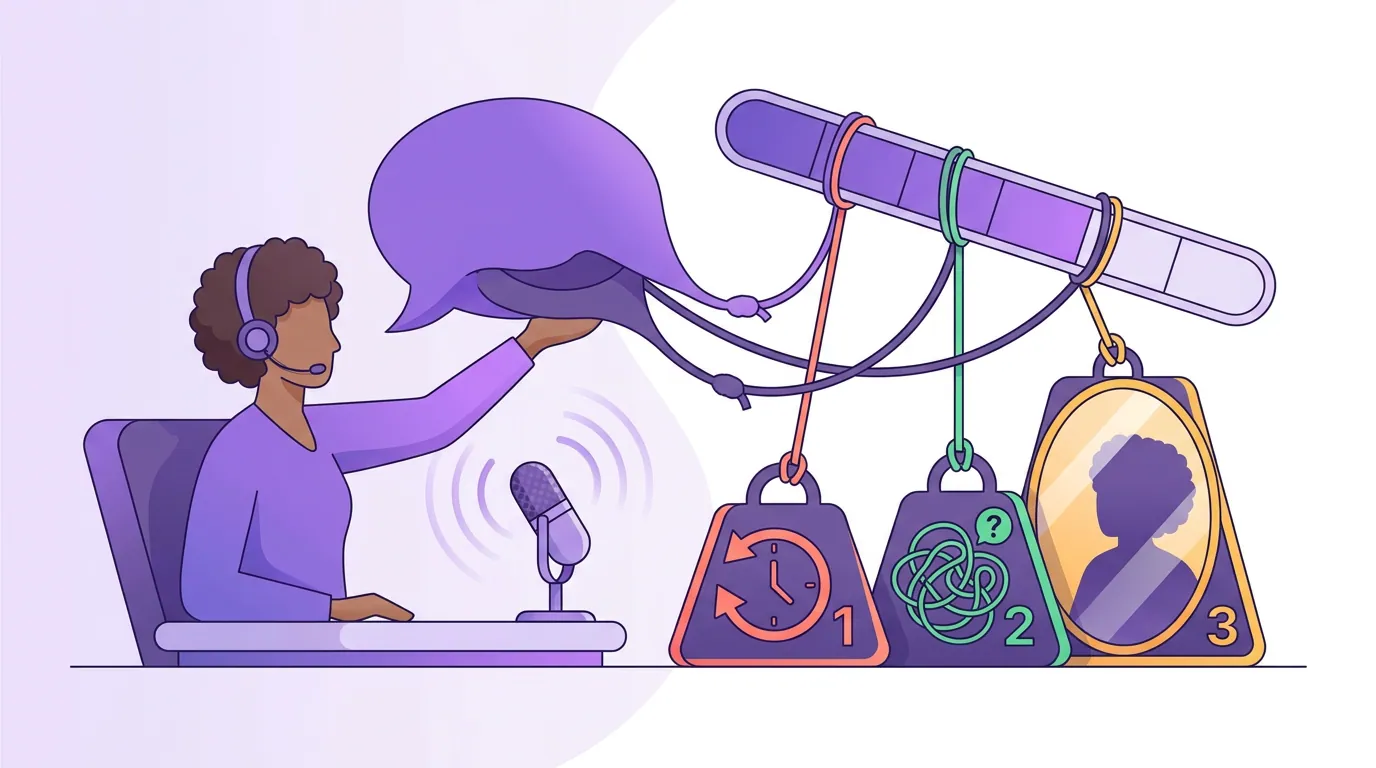
- One-sentence questions. The most common form of host over-talk is the question that's secretly a speech: "So I was reading about your early career, and it reminded me of when I, anyway, how did you get started?" Cut everything before the actual ask. A good question is one sentence and ends on a question mark. If you need help building questions that open guests up rather than box them in, start with the open-question shapes that get real answers.
- Kill the parallel story. The urge to relate, "oh, the same thing happened to me", feels like warmth, but it hands the floor back to you and signals you'd rather talk than hear the rest. Hold your story. If it's genuinely useful, offer it in two sentences after the guest is fully done, not as an interruption.
- Let the answer finish, then wait a beat. Rushing in the instant a guest pauses buries the realest line, which usually lands one second into the silence. A full beat of quiet after their last sentence is the single highest-return habit on this list, and it's the foundation of the follow-up that the episode actually lives in. The discomfort of the pause is the price of the better answer.
These are easier when you've prepped properly. A host with six themes in their head instead of a twenty-question script doesn't talk to fill space, because they're not anxiously steering toward the next item on a list.
When host talk actually earns its place
Talking less is not the goal. A host who never talks is as bad as one who never stops, the guest is left to carry the structure alone, and the episode wanders. The real skill is spending your share on the seconds that help the listener. Three kinds of host talk earn their place almost every time.
Setup and stakes. A short frame before a question, "this next part is the bit nobody believes until they've lived it", tells the listener why to care, and it's something only the host can do. Ten seconds well spent.
Redirect and translate. When a guest goes down a tangent or into jargon, the host's job is to pull the thread back or ask them to say it for someone outside the field. "For someone who's never raised money, what does that actually mean?" That's host talk doing real work for the audience.
The callback that proves you heard. Repeating a guest's charged phrase back to them, or linking two things they said minutes apart, is host talk that opens the guest up rather than crowding them out. It's the opposite of the parallel story, it keeps the floor with them. More on the listening that makes this possible in active listening for hosts who are busy thinking.
Common mistakes when fixing your talk ratio
- Overcorrecting into silence. Dropping to monosyllables makes guests work harder and the show worse. The target is a balance, not zero. Keep the setup, the redirect, and the callback; cut the reaction and the me-too story.
- Editing the ratio in post instead of fixing it live. You can trim some of your over-talk afterward, but you can't edit back in the guest answer you talked over, it never happened. Fix the habit at the record. Editing is for polish, not for rescuing a smothered interview.
- Measuring once and declaring victory. The ratio drifts back without attention. Re-audit every month or so until letting the answer finish is automatic.
- Blaming a quiet guest for your share. Sometimes a low-talk guest does push your number up legitimately, but check first whether your one-sentence-question and finish-the-answer habits are actually in place. Often the guest got quiet because you weren't leaving room, so check your own habits before you fault the guest for a lopsided ratio.
Frequently asked questions
How much should a podcast host talk versus the guest? On an interview show, aim for the host at roughly 20–30% of the talk time and the guest at 70–80%. Co-hosted and solo-led shows are closer to even. The number is a working target, not a measured standard, what matters is that whoever the audience came to hear is the one talking most.
How do I know if I talk too much as a host? Measure it. Open a recent episode, tally talk time by speaker (many transcript tools label speakers automatically), and divide your time by the total. If you're more than about 10 points over the target for your show type, you talk too much. Most hosts underestimate their share, so the number usually surprises.
Is it ever good for a podcast host to talk a lot? Yes, when the talk sets up stakes, redirects a tangent, translates jargon for the listener, or calls back something the guest said. That's host talk doing real work for the audience. The talk to cut is reactions, parallel "me too" stories, and thinking out loud, which crowd the guest out without helping anyone.
What's the fastest way to talk less in interviews? Cut your questions to one sentence, hold your parallel stories until after the guest is fully done, and leave a full beat of silence after each answer before you respond. Those three habits drop your ratio without you having to monitor it mid-conversation, and the pause tends to surface the guest's best line.
Should I fix my talk ratio in editing or while recording? While recording. You can trim some host over-talk in post, but you can't recover the guest answer you talked over, it was never said. Editing polishes a balanced interview; it can't rescue a smothered one. Fix the habit live and let editing handle the small stuff.
Related guesting guides
- How to ask questions that get real answers, one-sentence questions that open guests up instead of boxing them in.
- The follow-up question is where the episode lives, what to do with the silence after an answer instead of filling it.
- Active listening for hosts who are busy thinking, the listening that makes a good callback possible.
- How to research a guest in under 90 minutes, building the six-theme map that stops you talking to fill space.