
Turn One Episode Into a TikTok Posting Series


To turn one episode into a TikTok series, cut five to seven self-contained clips, give each a spoken hook inside the first two seconds, layer a trending sound under the clip audio, burn in captions, and post them one per day across a week instead of dumping them at once. One recording feeds a full week of For You attempts, each post a fresh chance at the algorithm.
The mistake almost every podcaster makes on TikTok is treating it like a dumping ground: export ten clips, post them in one afternoon, watch them flatline, and conclude TikTok "doesn't work for podcasts." TikTok works fine for talk content. What doesn't work is posting a series like a single broadcast. Below is the native way to do it, how the For You loop tests each post, the four ingredients that make a clip read as TikTok-native rather than a recycled Reel, and a copyable seven-post calendar built from one episode.
How do you turn a podcast episode into a TikTok series?
Pull five to seven clips from one episode, each built around a single moment that stands on its own, then make each one TikTok-native: a spoken hook in the first two seconds, a trending sound layered low under the talk, burned-in captions, and an ending that loops. Post one per day, not all at once, so each clip gets its own run at the feed.
A series beats a one-off because clips are now the primary way new listeners find shows. Short clips drive an estimated 20–40% of new audience for video podcasts and can raise reach two to five times (Podcast Studio Glasgow, industry estimate). And the discovery itself has moved to social: 57% of listeners now rely on social media for podcast recommendations, the first time it surpassed friends and family (InsideRadio, reporting industry survey data). On TikTok specifically, that discovery runs through one mechanism, and the series is designed around it.
Why a series, not a single dump?
TikTok shows each clip to a small test audience first and widens distribution only if enough of them watch through. That makes every individual post a separate draw, seven posts is seven tests, and one breakout clip can carry a whole week. Dumping all seven in one hour wastes six of those draws by making them compete with each other in the same feed window.
There's a second reason to spread them out. A series teaches you what works on your topic, fast. Post a clip a day and by Thursday you can see which moment, which hook style, and which sound the test audience actually stays for, then make more of that. Posting all seven Monday gives you one noisy data point. Posting one a day gives you seven clean ones.
The four ingredients of a TikTok-native clip
A TikTok-native clip has four things a re-uploaded Reel usually doesn't: a hook spoken inside the first two seconds, a trending sound layered under the talk, captions burned in, and an ending that loops back to the start. Miss these and your clip reads as "imported from somewhere else," which is exactly the signal TikTok's feed is least generous with.
The 2-second spoken hook. TikTok decides fast, and on talk content the hook has to be the words, not a title card. castmagic calls the first few seconds "absolutely critical for social media success" (castmagic). Open on the most charged sentence in the clip, the claim, the confession, the contrarian line, and let it land before anything else. Cut the "so, yeah, I think" run-up; start on the verb. If your strongest line is 40 seconds into the moment, move it to the front and let the context follow.
Trending sound, layered low. This is the most TikTok-specific move and the one podcasters skip. Adding a current trending sound under your clip audio, quiet, around 10–15% volume so it doesn't fight the talk, gives the feed a signal it favors, because the platform surfaces content tied to sounds people are engaging with. You're not remixing your clip; you're attaching it to a live trend. Pick a sound that fits the tone, keep it well under the dialogue, and swap it weekly as trends rotate.
Burned-in captions. Most social video is watched on mute, commonly cited in the range of 75–85%, which makes on-screen text the difference between a watched clip and a scrolled-past one (Digiday's 2016 report put ~85% of Facebook video muted; publisher-reported and directional, but the muted-default behavior holds across platforms). Burn the captions in, place them upper-center so TikTok's right-hand button rail and bottom bar don't cover them, and read them once before posting, one wrong auto-transcribed word in your hook line undercuts the whole clip.
A loopable ending. TikTok counts rewatches, so a clip that ends on a beat flowing back into its opening line earns extra watch-time for free. End on a question, a punchline setup, or a half-finished thought that the first frame answers, the seam disappears and the loop racks up seconds.
The seven-post, one-week cadence
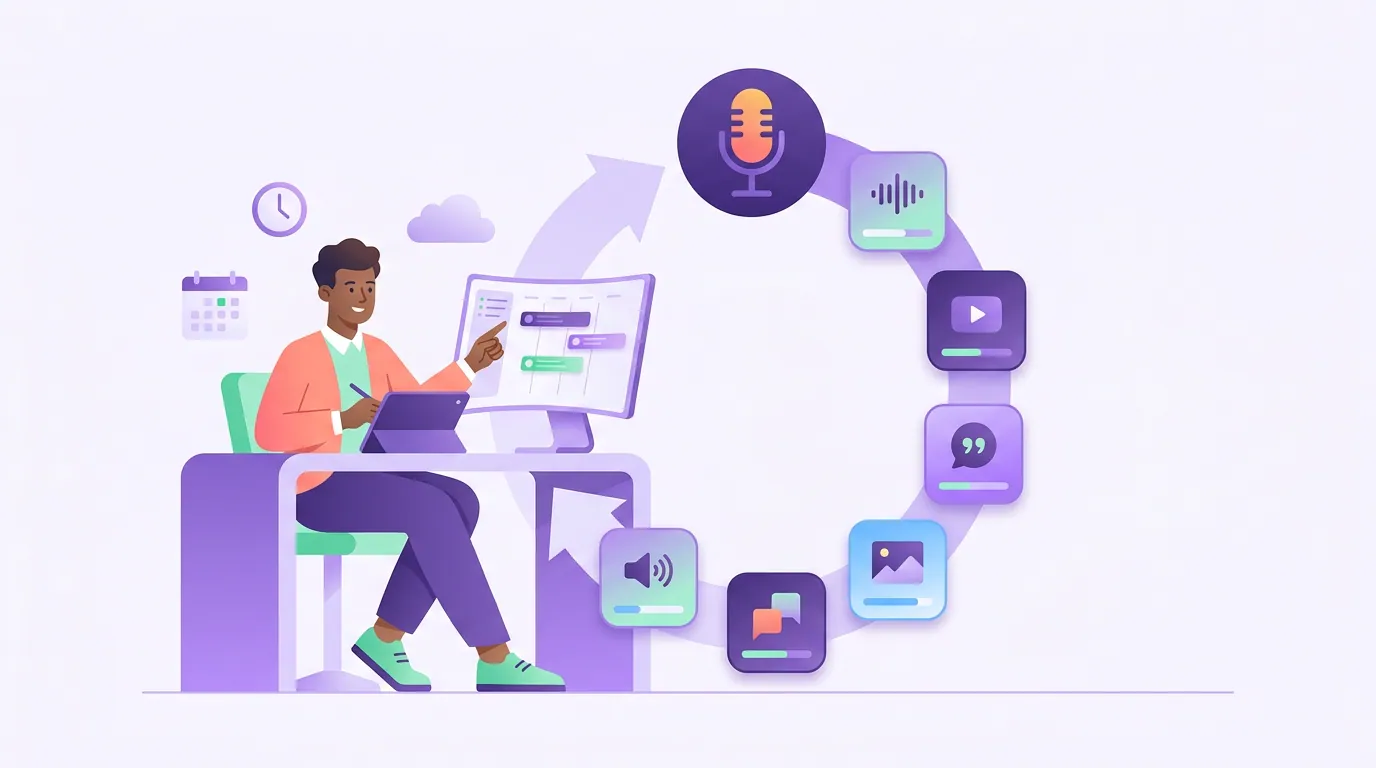
Post one clip per day for a week from a single episode, varying the type of clip across the seven slots so you're not running the same beat every day. A mix of hook styles tells you what your audience responds to and keeps your profile from reading as one note. Here's the template I use.
The Sunday slot matters more than it looks. Reposting your strongest clip of the week with a different trending sound and a tweaked first caption line isn't lazy, it's how you give a proven moment a second draw at the loop, which is the cheapest reach you'll get all week. Vary the sound and the on-screen hook text; keep the clip. Use the same approach to choose the underlying moments in the first place, how to pick the clips most likely to travel and how AI clip detection surfaces them from the transcript both feed straight into this calendar.
Common mistakes turning an episode into a TikTok series
Posting all the clips in one session. Seven clips in one hour is one feed draw, not seven, and it floods your followers in a single window. Spread them across the week so each gets a clean test. A simple scheduler removes the discipline problem entirely.
Re-uploading a Reel with the watermark still on it. A clip carrying another app's logo reads as recycled, and TikTok is the platform least generous with reposts that aren't native. Export a clean file with no watermark and add the sound and captions inside TikTok or a tool that doesn't stamp its brand on the frame.
Leaving the podcast intro on the front. Your show's three-second logo sting is death on TikTok. The feed tests the opening seconds, and a branded card spends them on something nobody scrolling cares about. Start on the spoken hook; the branding can live in the caption or a lower-third later in the clip.
Skipping the trending sound. A clip with only your talk audio is missing the one signal that's unique to TikTok. Layer a current sound underneath, quietly. It costs ten seconds and it's the difference between a native post and an import.
Treating views as the win. A clip that gets 50,000 views and zero new listeners did nothing for your show. As we say internally: virality without strategy is empty engagement, views are not conversions. Put the show name and a reason to follow in the caption, and watch profile visits and follows, not just the view counter. A clip that travels is reach, not a subscriber, which only counts when the clip points somewhere.
FAQ
How many clips should I post on TikTok per week? One per day from a single episode is a sustainable, effective cadence, roughly five to seven posts a week. That gives the feed a fresh draw daily without burning through your material or your time, and it produces enough data to learn what your audience stays for. If you publish weekly, one episode comfortably covers the whole week.
Do I need trending sounds, or can I just post the clip? You can post talk-only, but layering a current trending sound low under the clip audio gives the feed a signal it favors and is one of the few moves unique to TikTok. Keep it around 10–15% volume so it never competes with the dialogue. Swap the sound weekly as trends rotate.
How long should a TikTok podcast clip be? Most podcast moments land best in the 30–90 second range, long enough to make one point, short enough to finish and loop. castmagic supports the 30–90s framing for short-form clips (castmagic). Pick the natural boundary of the moment over a fixed number; a tight 25-second clip beats a padded 70-second one.
Should the same clips go to Reels and Shorts? The clips can, but adjust per platform, caption placement and sound trends differ, and a watermark from one platform hurts you on another. The underlying moments are the same, so the same episode that fuels this series also fuels an Instagram carousel and shareable quote graphics; only the format changes.
How do I know which clip to repost on Sunday? Use watch-through and profile visits, not raw views. The clip that kept the test audience to the end and sent people to your profile is the one worth a second run with a new sound. If two clips tie on views but one drove follows, repost that one.