
12 Common Mistakes New Podcasters Make


The mistakes that kill a new podcast are rarely the dramatic ones. They're quiet: a topic too broad to stay interested in, a room with a hard echo, a launch with one episode instead of three, a recording schedule that slips one week and never recovers. Nearly half of all podcasts never get past their first three episodes, around 47% stop there Amplifi Mediafailure-rate analysis citing SquadCast), and the single biggest predictor of survival is publishing consistency. Below are the twelve errors that cause most of that attrition, grouped by the phase where they happen, each with the symptom you'll notice and the fix.
This is a diagnostic list, not a scare list. Read it by phase. If your show isn't out yet, the planning and recording mistakes are the ones to catch now. If you've published a few episodes and momentum is fading, jump to the launch and consistency sections, because most shows die there, not at launch.
Why these specific mistakes matter
A new podcast doesn't usually fail because the host ran out of things to say. It fails because the unglamorous parts, a tight topic, a quiet room, a real publishing rhythm, got skipped, and the friction compounded until recording stopped feeling worth it. Roughly 90% of podcasts are no longer publishing at all (The Podcast Host, industry stats), and the danger zone is episodes 7 to 25, well after the launch excitement fades.
So the goal of this list is narrow: catch the errors that raise per-episode effort or quietly suppress discovery, before they push you into that danger zone. None of the twelve require money to fix. Most require a decision you make once.
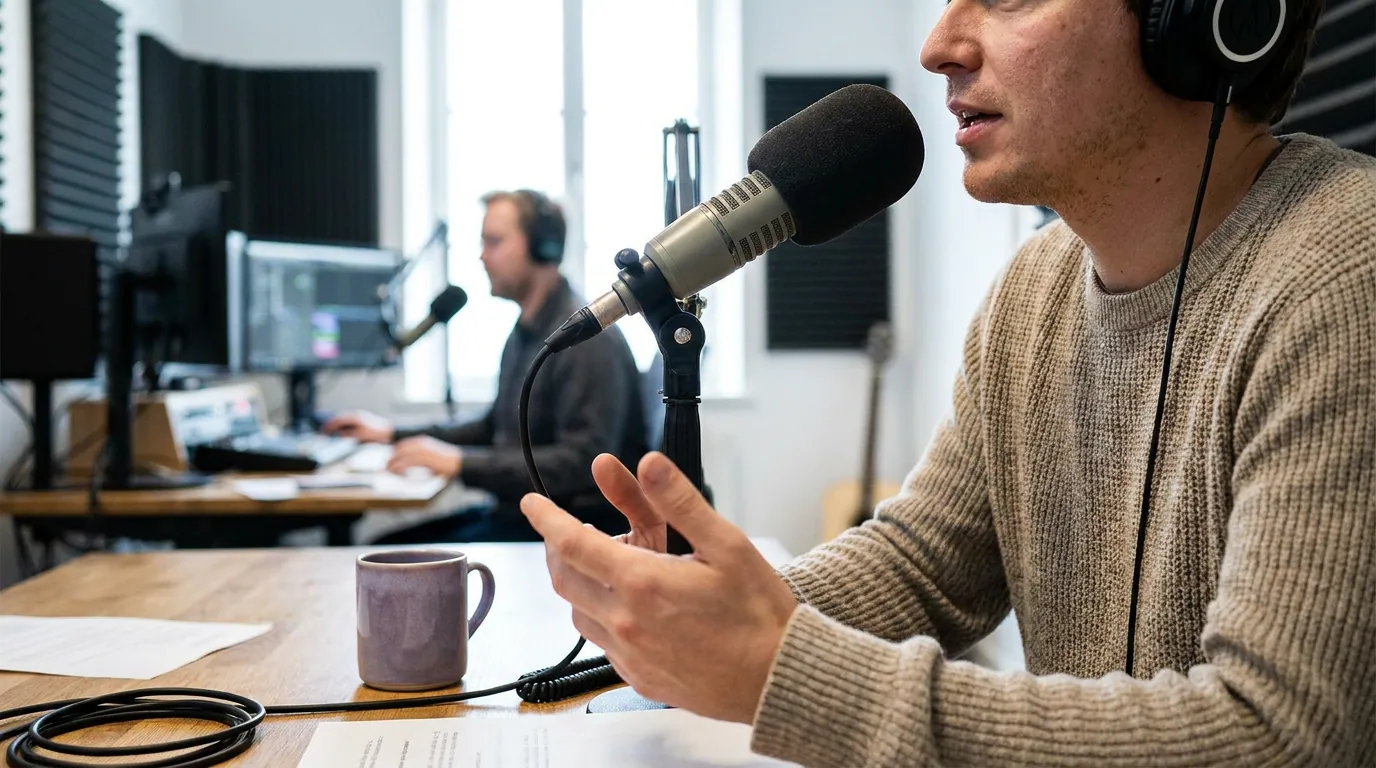
Planning phase: the mistakes you make before you record
Mistake 1, Picking a topic too broad to sustain
Symptom: you describe your show as being "about life," "about business," or "interviews with interesting people," and you struggle to name episode eight before you've recorded episode two.
A topic that broad gives you nothing to come back to. It also gives a listener no reason to subscribe, there's no promise to keep. The fix is to narrow until the show is a sentence a stranger could repeat: not "a business podcast" but "how solo founders get their first ten customers." Narrow keeps you interested for fifty episodes and tells the algorithm and the audience exactly who it's for. Work through this before anything else with our guide to finding your podcast niche and topic.
Mistake 2, Recording before you've planned the episode
Symptom: episodes run 70 minutes with no clear arc, and editing takes longer than recording because you're cutting tangents.
You don't need a script. You need a one-page outline: the hook, three or four beats, and where it ends. A 10-minute outline beats a 60-minute ramble every time, and it cuts your edit time more than any plugin will. See how to plan a podcast before you record for the outline format that keeps episodes tight.
Mistake 3, Buying gear before proving you'll publish
Symptom: you've spent $400 on a mic and interface and recorded zero episodes, or you're "waiting for the right setup" to start.
The mic is the last thing to buy, not the first. Launch on the phone or laptop you already own, prove to yourself you'll publish six to ten episodes, then spend, and you'll know exactly what to buy because you'll have felt the friction. When that day comes, start with our pick for the best podcast mic under $100, and see the full mic tiers by budget before going higher. If you want the numbers before you commit, what it really costs to start a podcast breaks down the $0, ~$300, and ~$900 paths. The whole "start free, spend later" sequence is in how to start a podcast for free.
Recording phase: the mistakes that make every episode harder
Mistake 4, Recording in a hard, echoey room
Symptom: your voice sounds distant and "boxy," with a faint reverb tail, no matter what mic you use.
This is the single most common beginner audio problem, and no software fixes reverb well. The room beats the mic. Record in your smallest carpeted room, away from windows, surrounded by soft things, a closet full of clothes is a genuinely good vocal booth. A phone mic in a quiet, soft room out-performs a $200 mic in an echoey kitchen. The gap between good technique in a treated room and bad technique in a bare one is larger than the gap between a $150 and a $1,500 rig.
Mistake 5, Mic too far away, or no consistent distance
Symptom: your levels swing loud-to-quiet within a sentence, or the audio sounds thin and roomy.
Most dynamic podcast mics want to be a fist's width from your mouth, slightly off-axis so plosives don't pop. Set the distance once and hold it. Wandering off the mic is what makes a recording sound amateur faster than anything else, and it can't be fully fixed in editing.
Mistake 6, Not recording a backup or local track
Symptom: your remote guest's audio drops out, lags, or arrives as a low-bitrate mess tied to their Wi-Fi.
For remote interviews, record each person locally rather than capturing whatever survives the call. Tools that record local tracks per participant protect you from a guest's bad connection. For in-person recording, run a simple second capture (even a phone voice memo) as insurance. Losing a great interview to a corrupted file is the kind of mistake you only make once.
Mistake 7, Over-editing the first episodes
Symptom: you spend three or more hours polishing a single episode, chasing perfection no listener will notice.
Beginners over-edit because editing feels like progress. It isn't. A clean cut and even loudness is roughly 90% of what listeners actually register. Trim the dead air, cut the worst two or three tangents, normalize loudness to around −16 LUFS so you're as loud as other shows, export, publish. Resist learning five plugins before episode five.

Launch phase: the mistakes that waste your best moment
Mistake 8, Launching with a single episode
Symptom: one episode goes live, a few friends listen, and the show stalls before it has a chance to be discovered.
A new listener who likes episode one and finds nothing else to play will move on. Launch with three episodes at once, then settle into your regular cadence. Three gives a first-time listener a reason to subscribe, there's a backlog to binge, and gives directory algorithms early signal. It's the closest thing to a free growth lever a new show has. Our step-by-step plan to launch your first podcast walks through the three-episode launch in order.
Mistake 9, Treating "publish" as the finish line
Symptom: you publish to your host and assume Apple and Spotify will surface you. Downloads stay flat, and you conclude podcasting "doesn't work."
Publishing is the start of distribution, not the end. The biggest discovery channel now is social video: 57% of listeners rely on social media for podcast recommendations, just ahead of friends and family at 54%, the first time, per Coleman Insights, that social has taken the top spot (InsideRadio, 2026). A few short clips from each episode, posted where your audience already scrolls, do more for a new show than any directory placement.
Consistency phase: the mistakes that quietly end shows
Mistake 10, Setting a cadence you can't sustain
Symptom: you promise weekly, hit it for a month, miss a week, then another, and the gaps grow until you stop.
Consistency is the #1 predictor of survival, and consistency means sustainable, not frequent. A reliable every-other-week show beats a weekly show that collapses after six episodes. Pick the cadence you can keep on your worst week, not your most motivated one. The danger zone is episodes 7 to 25, exactly when the launch adrenaline is gone and the schedule is the only thing carrying you.
Mistake 11, Doing everything one episode at a time
Symptom: every episode is a fresh scramble, record, edit, write notes, make graphics, and the per-episode effort never drops, so burnout arrives by episode ten.
The fix is batching. Record two or three episodes in one sitting, then edit them as a block. Build a repeatable template for show notes and titles so they aren't a blank page each week. Lowering per-episode effort is the most direct defense against podfade, because the mistake that ends most shows isn't a bad episode, it's the rising cost of making the next one. (Clipping the same episode into short social posts in one batch, rather than one at a time, is part of the same workload-reduction move.)
Mistake 12, Quitting in the danger zone without checking the data
Symptom: downloads look small around episode 10–20, you feel like no one is listening, and you decide to stop.
Small early numbers are normal, not a verdict. Most new shows sit in the low double digits per episode for months; benchmarks skew high because the platforms that publish them host a minority of indie shows. Before you quit, check whether your retention is holding and whether the listeners you do have finish episodes. A small, loyal audience that finishes every episode is a show worth continuing. Quitting on raw download counts in the danger zone is the last mistake on this list, and the one that turns a fixable slump into a dead feed.
FAQ
What is the most common mistake new podcasters make?
Inconsistency. Publishing consistency is the single biggest predictor of whether a show survives, and nearly half of all podcasts, around 47%, stop at three episodes or fewer Amplifi Media. The fix is choosing a cadence you can keep on a bad week, not your most motivated one.
Do I need expensive equipment to avoid sounding amateur?
No. The most common audio mistake is recording in an echoey room, and no gear fixes reverb. A phone mic in a small, soft-walled room beats a $200 mic in a bare kitchen. Treat the room first, buy a mic only after you've proven you'll keep publishing.
How many episodes should I launch with?
Three. A single launch episode gives a new listener nothing to binge and no reason to subscribe. Releasing three at once provides a backlog, early algorithmic signal, and the best shot at converting first-time listeners, then settle into your regular cadence.
Why are my podcast downloads so low at the start?
Low early numbers are normal. Most new shows sit in the low double digits per episode for months, and public benchmarks skew high because they come from hosts serving a minority of indie shows. Judge a young show by whether listeners finish episodes, not raw downloads.
When should new podcasters start promoting on social media?
From episode one. Social media now drives podcast discovery more than friends and family, 57% of listeners rely on it for recommendations (InsideRadio, 2026). Posting a few short clips per episode does more for a new show than waiting for directory placement.