
How to Name Your Podcast (Without Regret)


Name your podcast by scoring two things against each other, how findable it is in search and how easily someone remembers it after hearing it once, then confirm the name is actually free before you commit. Pick the name that lands in the upper-right of that trade-off, and run a five-check availability test (domain, handle, trademark, directory, spelling) so you never have to rebrand later.
A bad name doesn't kill a podcast. But a name you have to abandon at episode 30 costs you the cover art, the social handles, the directory listing, the URL, and every backlink and mention you'd earned under the old one. Renaming is the most expensive avoidable mistake in a launch, costlier than most of the actual line items in a launch budget, and it's avoidable with about an hour of work up front. This guide gives you the trade-off to optimize for, a quick scoring rule, and the checklist that confirms the name is yours before you fall in love with it.
What makes a good podcast name?
A good podcast name is searchable enough that the right people can find it, memorable enough that they can come back to it, and available across the domain, social handles, and podcast directories so you never have to rebrand. It clears all three; most names manage only one. That gap is how shows end up findable but forgettable, or clever but impossible to spell.
Searchability and memorability pull in opposite directions, and that tension is the whole problem. A name like The Marketing Podcast is searchable, it contains the words people type, but it's generic, crowded, and forgettable. A name like Acquired or Huberman Lab is memorable and ownable but tells a cold searcher nothing about the topic. The job isn't to win one axis. It's to find the name that scores acceptably on both, then to make sure it's free.
Why the name carries more weight than it used to
Discovery has moved off the directory shelf and onto social feeds, where your name gets spoken, screenshotted, and typed from memory. 57% of listeners now rely on social media for podcast recommendations, the first time it surpassed friends and family (InsideRadio, on podcast discovery data). When a clip of your show lands on someone's feed, the name has to survive being read off a phone and re-typed into a search bar without a single typo.
That shift changes the brief. A name that only works when you can see it spelled correctly, odd punctuation, a silent letter, a homophone, loses you the listener who heard it in a clip and searched for the wrong spelling. The name has to pass the say-it-out-loud test as much as the read-it test. If you're still mapping out the launch around it, plan the podcast before you record so the name and the concept lock together rather than fighting each other later.
The five-step naming framework
Work the name in order. Each step narrows the field, and skipping ahead is how people end up attached to a name they can't legally or practically use.
Step 1, Start from the topic and the listener, not a clever phrase
Write one sentence: this show is about [topic] for [specific person]. "Honest money advice for people in their first real job" beats "a podcast about finance." The name doesn't have to contain those words, but it has to feel like it belongs to that sentence. A name chosen before the concept is settled is a name you'll outgrow. If your concept isn't nailed down yet, settle it first with a step-by-step launch plan, the name is downstream of the show, not the other way around.
Step 2, Generate three name types, then score them
Don't brainstorm a hundred random options. Generate a handful in each of three proven shapes, because each shape sits in a different spot on the trade-off:
- Descriptive (topic words): The Solo Travel Podcast. High searchability, low memorability. Easy to find, easy to forget, often already taken.
- Brandable (a coined or distinct word): Acquired, Lex Fridman, Darknet Diaries. High memorability, lower cold-search value. You have to teach people what it's about.
- Hybrid (a distinct word plus a topic clue): Smartless won't tell a searcher the topic, but Money for Couples or Lenny's Podcast (product/growth) anchors a memorable word to a clue. This is usually the target zone.
Then score each candidate from 1 to 5 on searchability, 1 to 5 on memorability, and a simple pass/fail on "can I say this once and have someone spell it right." The hybrid names that score 4+ on both axes and pass the spelling test are your shortlist. Three to five finalists is plenty.
Step 3, Keep it short, spellable, and CTA-friendly
Shorter names survive the real world better. They fit the cover-art square at a legible size, they fit a social handle without truncation, and they're easier to say in your own outro ("if you liked this, follow [name]"). Avoid numbers spelled as digits versus words (is it 4 or four?), avoid hyphens in the spoken name, and avoid words people routinely misspell. Every ambiguity is a fork where a searcher can take the wrong path and never find you.
Step 4, Pressure-test for search intent
This is where searchability gets concrete. Type your finalists, and the topic words around them, into Apple Podcasts, Spotify, and Google as if you were a listener. Are the results crowded with near-identical names? Does a huge existing show already own the phrase? A name that's invisible next to an incumbent isn't searchable in any way that helps you. Keyword choice carries real discovery weight, podcast search optimization treats the show title and the words in it as a primary ranking signal (Ausha, on choosing podcast keywords). A useful middle path: keep a memorable brandable name as the show title, and let a clear keyword-rich subtitle or description carry the search terms.
Step 5, Run the availability checklist before you commit
You're not done until the name is confirmed free. This is the step everyone skips and everyone regrets. It gets its own section below because it's the part that prevents the expensive rebrand.
The pre-launch availability checklist
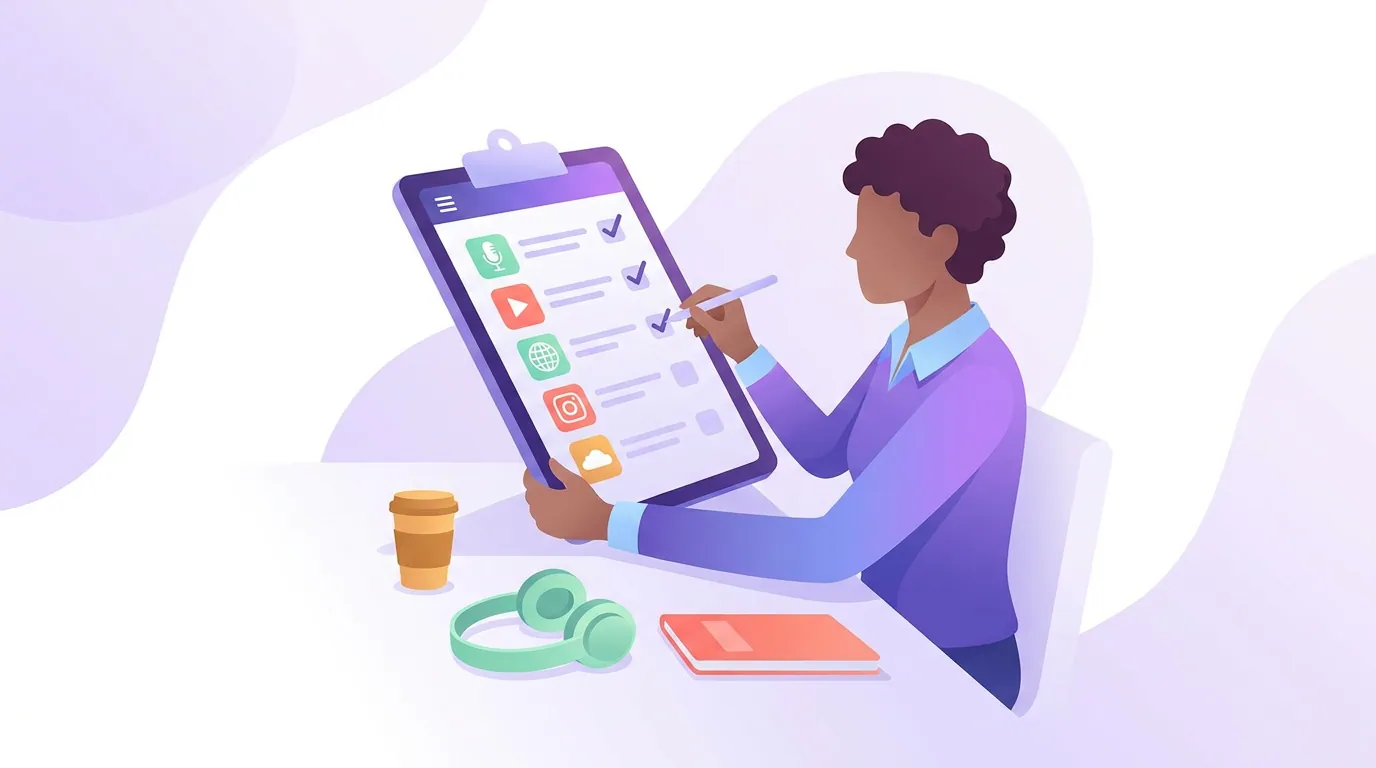
Before you commission cover art or record a word, confirm the name is genuinely available everywhere it needs to live. Run all five checks. A name that fails any of them is a name to drop now, not after you've built equity in it.
- Domain. Search a registrar for the matching
.com. If it's taken or for sale at a silly price, a close variant or a.fm/.cois fine for a podcast, but confirm something clean is buyable before you decide. A name with no reachable web home is a name you'll fight forever. - Social handles. Check the same handle on the platforms you'll actually use, Instagram, TikTok, YouTube, X. Matching handles across platforms make you findable and screenshot-proof. If the exact handle is gone everywhere, a consistent prefix or suffix (
@theXpodcast) beats four different handles. - Trademark. Do a free search of the relevant trademark database (USPTO's TESS in the US, or your country's equivalent) and a plain web search for any business already using the name in media. This isn't legal advice, and a clear database search isn't a guarantee, but launching into an obvious live conflict is the one mistake that can force a rename under threat. Catch it now.
- Directory search. Search the exact name in Apple Podcasts and Spotify. If an active show already owns it, you'll be permanently buried beneath them in the one place listeners look. A dead show with the name is a softer obstacle than a growing one, but both are signals to pick something cleaner.
- The spelling test. Say the name out loud to three people and ask them to spell it and find it. If even one fumbles, you've found a leak, every time your name is spoken in a clip or on another show, you'll lose the people who guess wrong. Fix it before launch, not after.
Common naming mistakes (and the fix for each)
Most regretted names trace back to a handful of avoidable errors. Each has a one-line fix.
- Naming it after yourself when you're unknown. The Jane Doe Show only works once people know Jane. Fix: lead with the topic now; you can lean on your name once you've earned recognition.
- Boxing yourself in too tightly. Couch-to-5K Stories is great until you want to cover marathons. Fix: name the theme, not the single format, so the show can grow without a rebrand.
- Copying the format of a hit. Another ...Daily or ...Unfiltered drowns in a sea of identical names. Fix: a distinct word makes you searchable and screenshot-recognizable.
- Ignoring the cover-art constraint. A six-word name is unreadable at thumbnail size on a phone. Fix: test the name in the actual cover-art square before you commit. (Need the specs? Plan your launch end to end so artwork and name are decided together.)
- Falling in love before checking availability. The single most expensive mistake. Fix: run the five-check list above before you let yourself get attached.
FAQ
Should my podcast name include a keyword? It helps, but it doesn't have to be in the title itself. The show title and the words around it are a real search signal (Ausha, on choosing podcast keywords), so a memorable brandable title paired with a clear, keyword-rich subtitle and description usually beats a generic keyword name that blends into a crowded shelf.
How long should a podcast name be? Short enough to read at thumbnail size and say in one breath, roughly one to four words for most shows. Long names get truncated in directories and social handles and are harder to recall after a single clip. Shorter is almost always safer.
Can I rename my podcast later? You can, but it's costly. You lose ranking and equity tied to the old name across your directory listing, domain, backlinks, and social handles, and listeners who knew the old name may not find the new one. Renaming is recoverable, not free, which is exactly why the availability checklist is worth an hour now.
Do I need to trademark my podcast name? For most independent shows, a free trademark and web search to avoid an obvious conflict is the practical minimum, not a filed registration. This isn't legal advice. If your show becomes a real brand or business, that's the point to talk to a professional about registering it.
How many podcasts are competing for names right now? Of roughly 4.5 million indexed podcasts, only about one in ten are still actively publishing (demandsage podcast statistics). So while a directory search may show a name "taken," many of those shows are dormant, a dead show with your name is a much softer obstacle than an active, growing one. Once the name clears all five checks, you can stand the whole show up for free and start publishing under it.