
Sports Podcasts Built Around the Season Calendar


The best sports podcasts to learn from, New Heights, The Pat McAfee Show, Pardon My Take, The Bill Simmons Podcast, Club Shay Shay, all win on the same operating habit: they are scheduled by the sports calendar, not by a fixed weekly slot. They publish fast on game days, run a repeatable debate-segment scaffold, and survive the off-season with evergreen content. That calendar discipline, not the takes, is the part you can copy.
You can find a "top 10 sports podcasts" list anywhere. This page does the part that actually helps if you are building a show: it reads the leaders as operations. How they ride the schedule, how few people they really need, and what a new host should steal before they ever land a single famous guest.
What are the best sports podcasts to learn from?
By Edison Podcast Metrics, the US sports podcasts with the largest weekly audiences for full-year 2025 are New Heights (#1), Club Shay Shay (#2), and The Pat McAfee Show (#3) (Edison Research, full-year 2025). The Bill Simmons Podcast and Pardon My Take round out the shows worth studying. Each one runs on the season calendar.
Sports is one of the genres holding its place near the top of the medium, Edison and Statista consistently list it among the most-listened US podcast categories alongside comedy, news, and true crime (Edison Research / Statista). It is also one of the fastest-growing. That growth is the reason this is a crowded niche to enter, and the reason format discipline matters more here than almost anywhere else.
How does the season calendar drive a sports podcast?
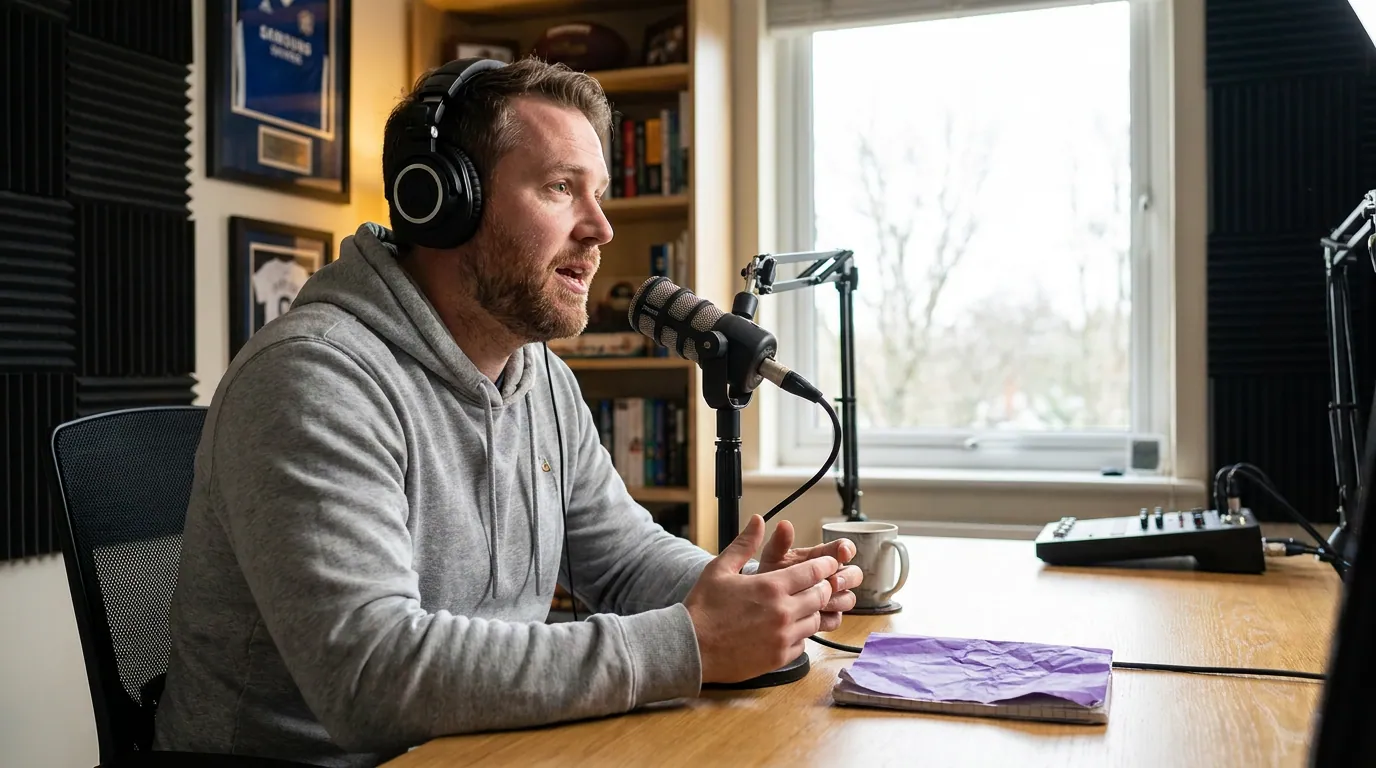
The calendar sets when the show publishes, how fast it turns around, and what it covers. During a season, the audience wants reaction within hours of a game, so cadence spikes around game days. In the off-season, the same show pivots to evergreen interviews and retrospectives to hold the feed. The schedule is the content plan.
The clearest evidence is in the rankings themselves. The Bill Simmons Podcast jumped to #36 from #67 in the overall US top 50, a move Edison attributed to the start of football season, while The Pat McAfee Show hit an all-time high of #26 in the same quarter (Edison Podcast Metrics, Q3 2025, via Podnews). A show can roughly halve its rank position by leaning into the calendar at the right moment. That is not luck. That is publishing into demand.
The lesson for a new show is uncomfortable but freeing: your publishing schedule should not be a flat "every Tuesday." It should bend toward the calendar of whatever you cover. A college basketball show that posts the same volume in July as in March is fighting its own audience.
The debate-segment scaffold: the repeatable shape
Here is the framework this page exists for. Strip a top sports talk episode to its skeleton and you find the same recurring scaffold, a small set of named segments the hosts run every time, in roughly the same order. The topics change with the week; the structure does not. That scaffold is why these shows can record fast, clip cleanly, and never stare at a blank page.
The recurring segment is the load-bearing piece, and it is the one new hosts skip. Pardon My Take has run named recurring bits for nine years, which is a large part of why it stays consistent enough to win the 2026 iHeartPodcast Award for Best Sports Podcast over a field that included New Heights and The Ringer's Zach Lowe show (Barrett Media, March 2026). A recurring segment turns a one-time listener into a returning one, because they know the bit is coming.
What each leader does that you can steal
- New Heights, the athlete-hosts model. Two brothers in the NFL talking with the register of two people who actually play the sport. Wondery's reported deal worth more than $100 million over three years (Variety, August 2024) confirmed what the audience already knew, that lived authority inside the game is the rarest asset in the genre. You probably can't be an NFL star, but you can be the person who genuinely plays, coaches, or covers the thing. (New Heights entity page.)
- The Pat McAfee Show, daily reaction speed at scale, built on a former player's personality and a flood of guests. It is the rare sports show that publishes essentially every weekday, which is why it generates the volume it does. (The Pat McAfee Show entity page.)
- Pardon My Take, comedy-first sports. The takes are real but the register is satire, which makes the clips travel beyond hardcore fans. The recurring segments are the spine. (Pardon My Take entity page.)
- The Bill Simmons Podcast, long-form analysis plus a deep guest rolodex, with cadence that visibly rises and falls with the NBA and NFL calendars. The format he built, long interviews, rotating co-hosts, a willingness to follow a tangent, became the default most sports shows now copy. (The Bill Simmons Podcast entity page.)
- Club Shay Shay, the interview show that books guests other hosts cannot land and asks the questions other hosts skip. Proof that in sports, a single great long-form conversation can out-reach a week of hot takes. (Club Shay Shay entity page.)

Reaction speed: the part most new sports shows get wrong
The single hardest operational demand in sports podcasting is speed. The biggest game of the week creates a few-hour window where the audience is actively looking for reaction, and a show that posts its take two days later is posting into a dead conversation. The leaders treat game day as a deadline, not a topic. That is why a clipping workflow matters more in sports than in almost any other niche: the recap clip has to be out while people still care.
This is also where the calendar gives a new show its opening. You cannot out-reach New Heights. You can out-react them on a smaller beat, a single conference, a single team, a single league everyone else covers slower. Reaction speed on a narrow beat is a real, defendable edge. Discovery now flows through that speed: 57% of listeners rely on social media for podcast recommendations, the first time that surpassed friends and family (InsideRadio, 2025). The fast post on a game everyone is talking about is how a small sports show gets found.
The honest caveat the big shows won't tell you: speed without a real take is empty. A fast clip of a lukewarm opinion gets views and converts nobody. Pick the genuine disagreement, post it fast, and let the argument, not the reaction time, be the thing people share. The same build-versus-payoff judgment that the best true crime hosts apply to a reveal applies to a sports hot take: keep enough setup that a stranger understands the fight, and cut everything else.
The off-season problem: evergreen versus recap
The flip side of a calendar-driven show is the gap. Every sport has a dead stretch, and a show that only does game reaction goes quiet for two or three months. The leaders solve this two ways: evergreen interviews that don't expire, and retrospectives that mine the season just ended. The off-season is when you build the library that the in-season audience binges later.
Evergreen content is also where your back catalog earns its keep. An off-season is the right time to clip your best in-season episodes into highlight pieces, the argument that aged well, the interview that still holds up. The library does not stop working when the season ends; only your live reaction does.
How few hosts do these shows actually use?
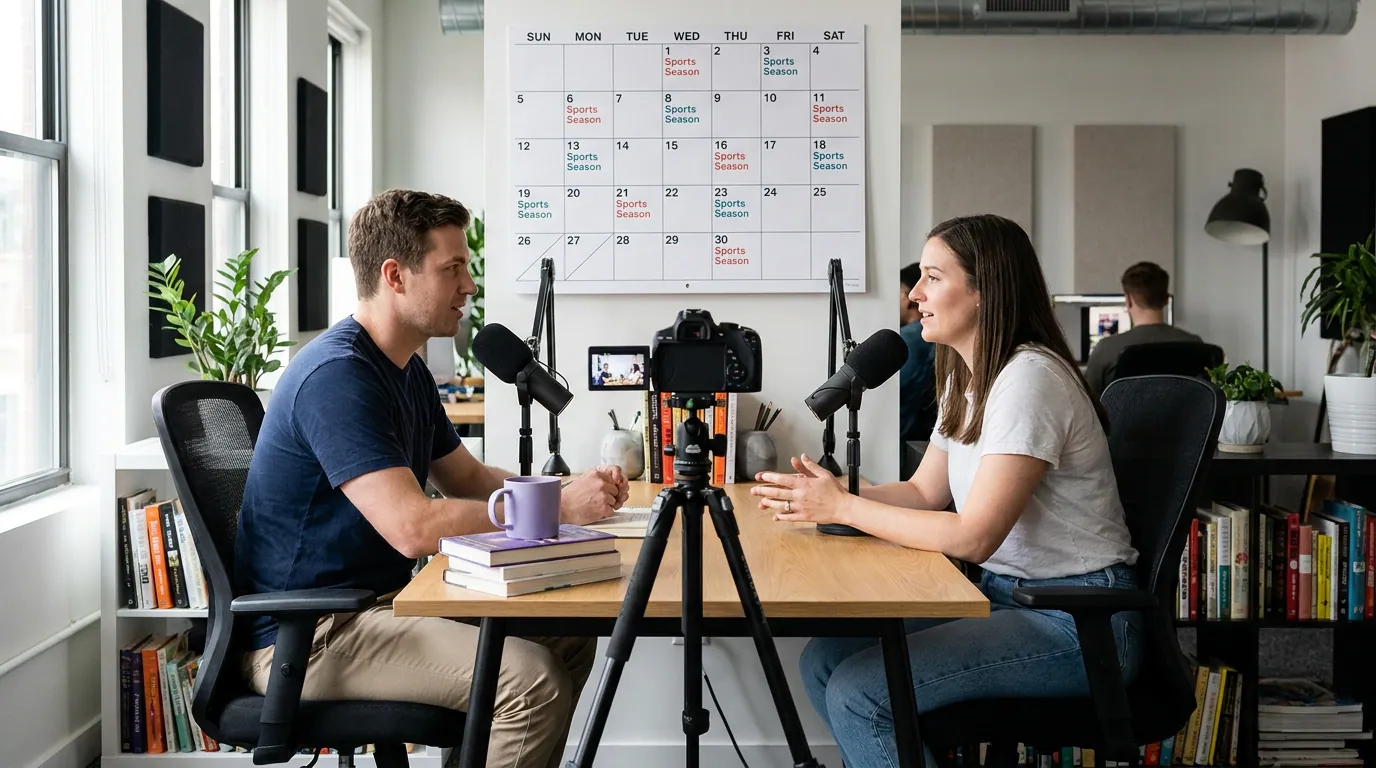
Fewer than you would guess: the top sports shows run lean. New Heights is two hosts. Pardon My Take is built around two. Club Shay Shay is one host plus a guest. The Pat McAfee Show carries a larger desk, but the franchise is one personality. The reach is enormous; the core team that records is small. That is the encouraging part for anyone starting, you do not need a network's roster, you need a clear format and a calendar.
The trade-off that small core demands is filming. Most of these are video podcasts, and the two-host setup exists partly because the reaction shot, one host's face while the other makes the argument, is the clip. An audio-only sports debate throws away its best 30 seconds. The transferable rule is two cameras (or one wide two-shot), not two more co-hosts. Add people only when they add a beat you can't cover, not to fill the frame.
So what should you build?
If you are starting a sports show, the decision rule is straightforward: pick a beat narrow enough to out-react the big shows, build a debate-segment scaffold with one named recurring bit, and schedule by the season, not the week. Post fast on game days, go evergreen in the gap, film both hosts, and clip every episode into the argument that travels. None of that requires a famous name. All of it requires consistency, which is the real moat in a calendar-driven genre.
For the patterns that recur across every niche, see the top US podcasts and the habits behind them and why the UK podcast top 10 looks nothing like the US. For neighboring format studies, business podcasts worth studying as a new host and comedy podcasts new hosts should steal from cover the scaffold-and-clip thinking in adjacent genres.
FAQ
What is the #1 sports podcast in the US? By Edison Podcast Metrics, New Heights with Jason and Travis Kelce had the largest US weekly sports audience for full-year 2025, ahead of Club Shay Shay and The Pat McAfee Show (Edison Research). Edison measures weekly reach by survey, counting shows people listened to or watched, so it captures YouTube viewing that download charts miss.
Why do sports podcast rankings change so much during the year? Because audiences follow the calendar. Edison saw The Bill Simmons Podcast climb from #67 to #36 in the overall US top 50 as football season started (Edison Q3 2025, via Podnews). Sports listening spikes when the games are on, so rank tracks the season more than it tracks audio quality.
How often should a new sports podcast publish? Match the calendar, not a fixed slot. In season, post reaction within hours of the games that matter on your beat; in the off-season, drop to a steady, lower cadence of evergreen interviews and retrospectives. A flat year-round schedule fights your own audience's attention.
Do sports podcasts need to be video? For the debate format, effectively yes. The reaction shot, one host's face while the other makes the argument, is the most clippable moment, and audio-only throws it away. Film both hosts, then cut the disagreement into vertical clips. Long-form interviews survive audio better, but even there a filmed version gives you clips to post.
Can a new sports show compete with New Heights or Pat McAfee? Not on overall reach, those audiences and budgets are unrepeatable. But the format is fully copyable at your scale: narrow your beat, build a recurring segment, out-react the big shows on a single league or team, and clip every game-day take fast. The blocker is consistency through a long season, not talent.