
Best Solo Podcasts to Learn From (and Steal)


The best solo podcasts to learn from are The Mel Robbins Podcast, The Mindset Mentor, Dan Carlin's Hardcore History, anything goes with emma chamberlain, and Financial Feminist. Each carries a full episode on one voice across a different niche, which makes them the clearest masters of the hardest format in podcasting: holding a listener with no guest to lean on. Study them for mechanics, not topic.
A solo episode is the format where everything that usually does the work is gone. No second voice to break the rhythm. No guest to carry a dead patch. No banter to fall back on when you lose the thread. That is why most solo shows feel flat and a handful are unmissable, the unmissable ones rebuilt, on purpose, what a guest used to provide for free.
What makes a solo podcast hard to pull off?
A solo podcast is hard because a guest quietly does three jobs the host now does alone: supplying energy through back-and-forth, generating tension that keeps you listening for the answer, and breaking the monotony of one voice. Remove the guest and all three land on one person who must also talk, structure, and hold attention at once.
Most failed solo shows fail the same way. The host records a monologue as if a co-host might wander in, leaving conversational gaps a guest would normally fill, drifting toward a point instead of arriving at one, and never deciding whether the episode is written or off-the-cuff. The shows below made those decisions deliberately, and that is the whole difference between an episode you finish and one you abandon at minute four.
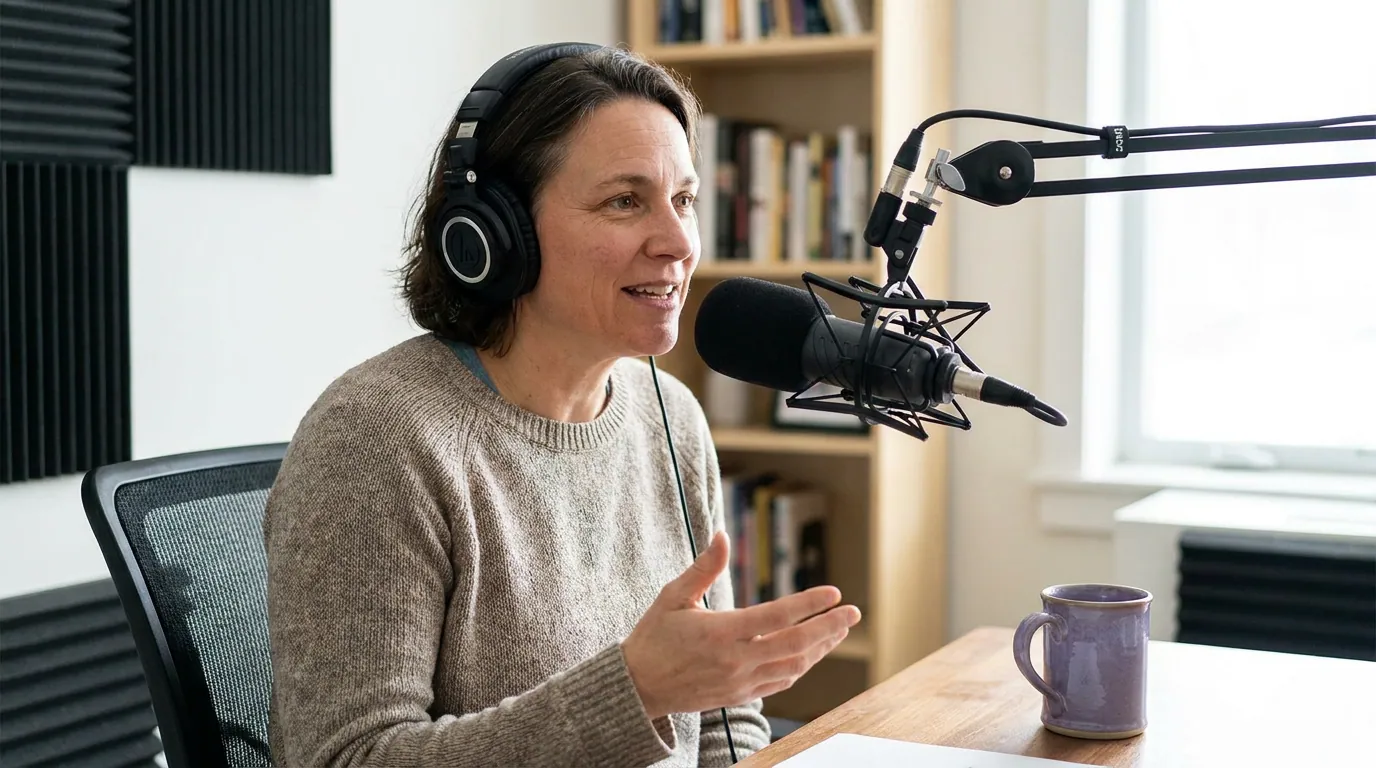
The solo shows worth studying, and what to steal from each
These five span self-improvement, mindset, history, lifestyle, and money. No single solo topic exists, only a solo shape, and seeing it across niches is the point. The full episode histories live on the directory; the craft analysis lives here.
- The Mel Robbins Podcast, Robbins runs a mixed show, but her solo episodes are the master class. They open on a relatable pain point, deliver a small number of named tools, and close on one action you can take tonight, her June 15, 2026 episode "7 Things to Tell Yourself Every Night for More Happiness and Positivity" runs 1h 3m and frames the whole hour around seven sentences to repeat before bed (Apple Podcasts listing). The steal is the promise-and-payoff frame: tell the listener exactly what they'll be able to do, then hand it over. See the Mel Robbins entity page for the full run.
- The Mindset Mentor, Rob Dial's high-frequency solo show is the cadence machine: he reports 1,600+ episodes and 450M+ downloads (robdial.com), publishing several short episodes a week, Apple lists it as "Updated Semiweekly", each breaking one neuroscience or psychology idea into roughly twenty minutes (recent episodes run about 16–21 minutes). The steal is constraint. One idea, ten to twenty-five minutes, multiple times a week, which is only survivable because the format is small on purpose. (The Mindset Mentor page.)
- Dan Carlin's Hardcore History, The opposite extreme, and proof the format scales in both directions. Carlin's recent episodes run four to six hours and release every four to seven months, and the show is built on a "theater of the mind" style of narration (Hardcore History, Wikipedia; Variety, 2024). He positions himself as a fan of history rather than an academic, which frees him to chase story over scholarship. The steal is narrative tension, Carlin turns known history into suspense by withholding and pacing, not by adding a second voice.
- anything goes with emma chamberlain, A genuinely unscripted, freeform solo show recorded, as she puts it, from bed and other places, where the value is candor and an off-the-cuff voice young listeners feel they know. The steal is the parasocial register: she talks like a friend, not a broadcaster, and never pretends to a structure she doesn't have. (anything goes page.)
- Financial Feminist, Tori Dunlap's mostly-solo personal-finance show flexes its format with themed series and the occasional guest, which is how a single host keeps a money show from going dry. The steal is format variety inside one show, so the host never bores themselves into quitting. (Financial Feminist page.)
One honest caveat before the patterns: several of these shows bring in a guest now and then. "Solo" in practice means host-led and host-carried, not a vow of total isolation. The test is whether an episode holds when it's just one voice, and that's what we're pulling apart now.
How do solo hosts sustain energy for a whole episode?
Solo hosts sustain energy by treating it as a delivery decision, not a mood. They lift their pace and pitch slightly above normal conversation, talk to one imagined person rather than an audience, and lean on structure so they never stall mid-thought. Energy on a solo mic comes from preparation and address, not from caffeine or a naturally loud personality.
The mistake is waiting to feel energetic. Robbins and Dial both sound switched-on across hundreds of episodes because the energy is built into how they record, not how they feel that day. Two habits do most of the work. First, talk to one person, picture a specific listener and address them as "you," which raises your delivery without you trying. Second, never read flat text; even scripted hosts perform the script rather than reciting it, which is why Robbins sounds like she's explaining something to a friend and not narrating a document.
The practical version for your own show: stand up to record if you can, keep a glass of water and an outline in front of you, and re-record any open where you can hear your own energy dip. Listeners forgive a stumble. They do not forgive flatness in the first thirty seconds.
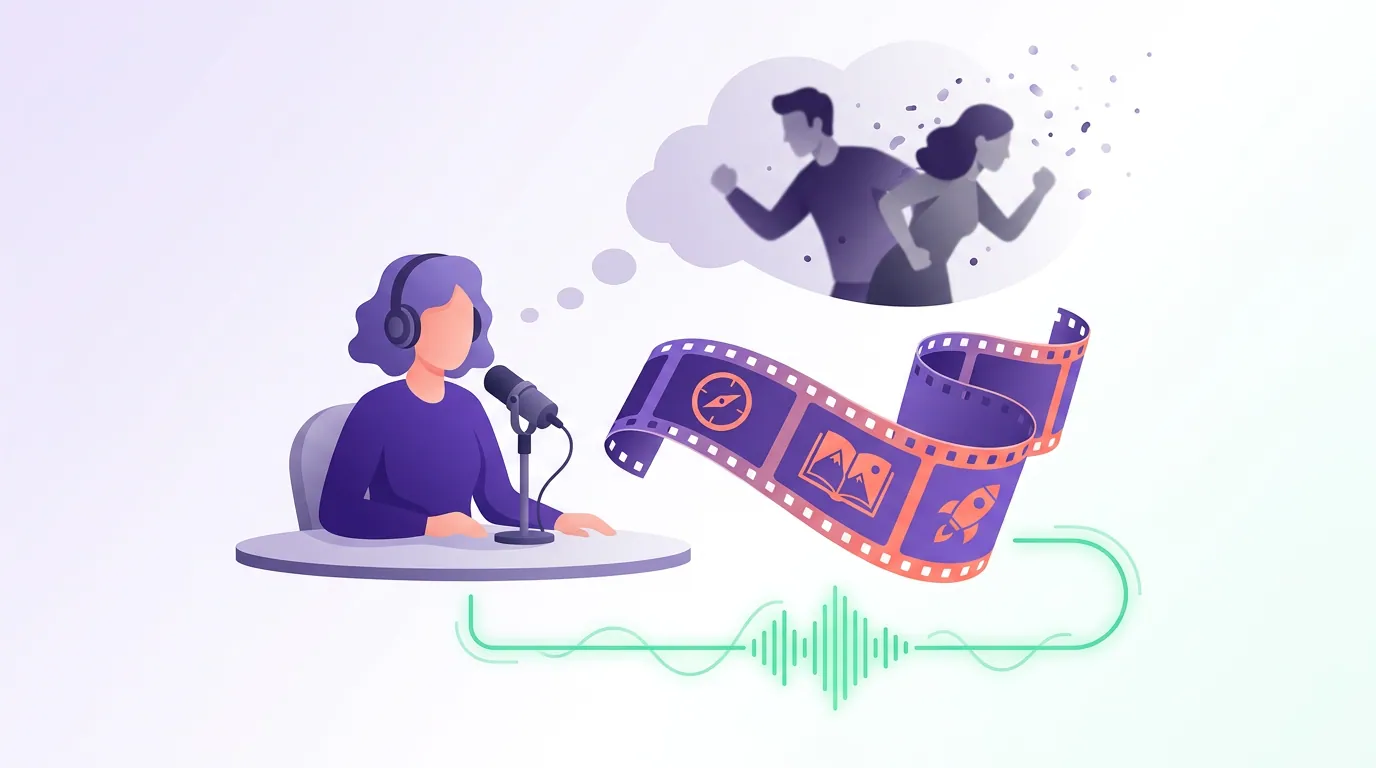
How do you replace guest tension with narrative?
You replace guest tension by opening a loop the listener wants closed. In an interview, suspense comes from not knowing what the guest will say. Alone, you manufacture it with structure: pose a question, half-tell a story, or promise a payoff early, then withhold the resolution until the end. The listener stays because something is unfinished.
This is the single most transferable habit across the whole list. Carlin builds hours of tension out of history everyone already knows by controlling what he reveals and when. Robbins opens on a problem and doesn't hand over all seven tools at once. The cold open is the simplest version, instead of "hi, welcome back, today we're talking about," drop the listener into the middle and explain later. The first seconds decide whether they stay, and platforms treat early drop-off as a quality signal.
The rule for your own episodes: decide the one question each episode answers, pose it in the first thirty seconds, and don't resolve it until the end. If you can't name that question, the episode has a topic, not a structure, and a topic alone won't hold anyone.
The data: length, scripting, and cadence across standout solo shows
Here's the part the listicles skip. The strong solo shows don't share a length or a script level, they share a deliberate match between the three. A daily show has to be short and lightly scripted or it's unsustainable. A four-hour history epic has to be tightly built or it collapses. The constant isn't a number; it's that length, scripting, and cadence are chosen together.
| Show (niche) | Typical length · cadence | Scripting level |
|---|---|---|
| The Mindset Mentor (mindset) | ~10–25 min · several×/week | Light, outline, one idea |
| The Mel Robbins Podcast (self-improvement) | ~60 min solo eps · twice weekly | Medium, structured, performed |
| anything goes (lifestyle) | ~30–60 min · weekly | Minimal, freeform, unscripted |
| Financial Feminist (finance) | ~30–50 min · weekly+series | Medium, spine scripted, looser delivery |
| Hardcore History (history) | ~4–6 hrs · every 4–7 months | Heavy, researched, tightly narrated |
Sources: episode lengths and cadence per the shows' own listings and publisher pages, Apple Podcasts, robdial.com, melrobbins.com, and Variety, 2024 for Hardcore History. Scripting levels are an editorial read of each show's published format, not a measured figure.
Read the table as a decision tool, not a ranking. Find the row whose cadence you can actually keep, and the length and scripting that go with it. A new solo host who wants to publish weekly should look at the middle rows, not at Carlin, his model only works because he releases a few times a year and spends the gap researching. Trying to run a several-times-a-week Mindset Mentor cadence at Hardcore History depth is the fastest route to quitting.
That quitting risk is not hypothetical. About 47% of podcasts stop at three episodes or fewer (Amplifi Media analysis), and the cause is almost always workload outrunning what the host can sustain, a danger that lands hardest on solo creators with no one to share the load.
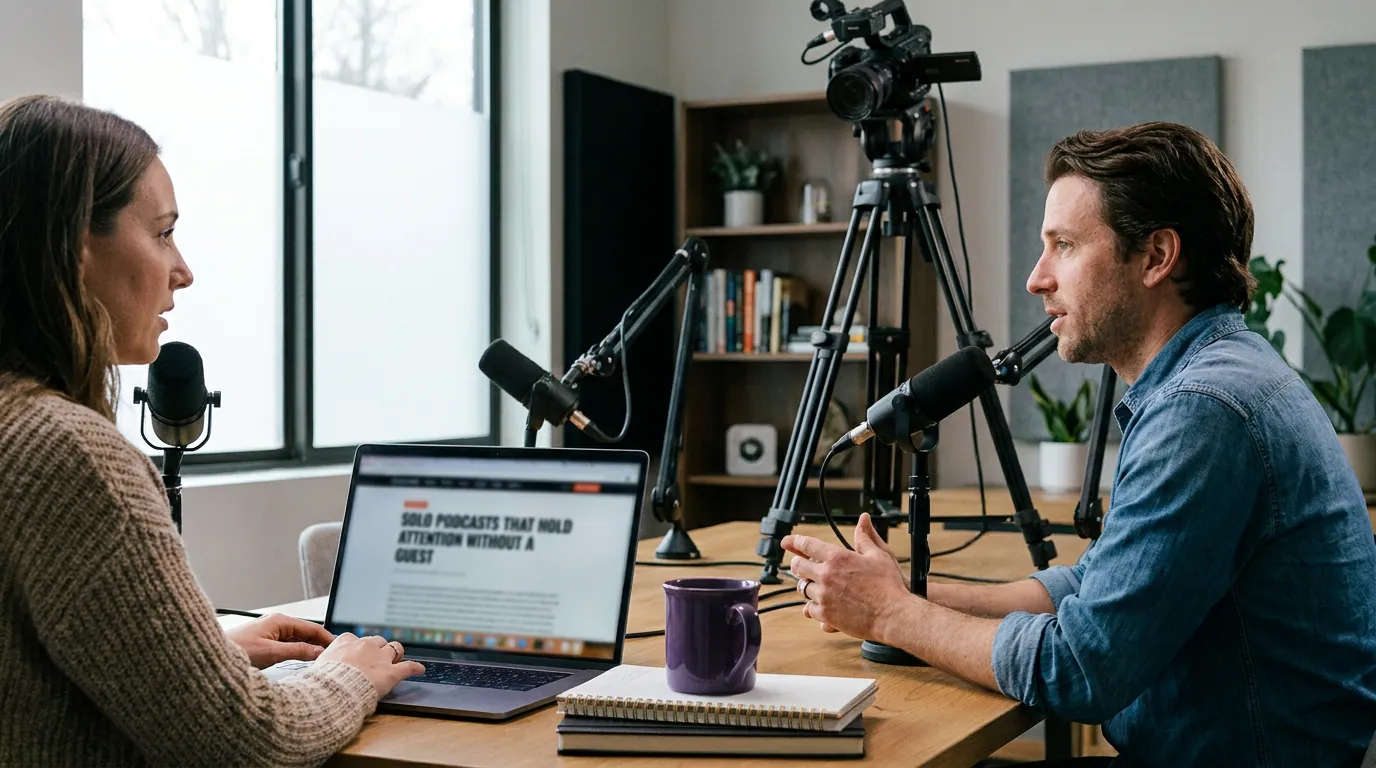
What every great solo show still borrows: clips
Holding the listeners you have is structure, energy, and a chosen cadence. Finding new ones is a separate job, and here even the biggest solo shows lean on the same engine as the giant interview shows, short, captioned clips. Discovery now runs through social: 57% of listeners rely on social media for podcast recommendations, the first time it edged past the 54% who rely on friends and family (Coleman Insights / Amplifi Media, via InsideRadio, 2025). For a host with no guest network to borrow, a clip that travels is often the only way a new listener finds the show.
Two caveats apply double for solo shows. First, film if you can, or at least build audiograms, because a clip a stranger can read beats one they can only hear: about 75% of mobile video is watched on mute (Verizon Media / Sharethrough, 2017). Second, the cadence that builds a loyal solo audience is exactly what burns out a one-person team, so automating the clip step is how a solo show keeps a schedule a listener can rely on instead of going quiet by episode four.
So what should a solo host actually copy?
Not the download counts, the production budget, or the four-hour ambition. Copy the system. Manufacture energy through preparation and one-to-one address rather than waiting to feel it. Replace the missing guest's tension with an open loop you control. And match your length and scripting to a cadence you can keep, the table above is a menu, not a leaderboard.
Then handle discovery as its own job. The format habits keep the listeners you earn; clips are how you earn them. For the educational solo model up close, see business podcasts worth studying as a new host and finance podcasts that teach hosts how to explain money. For genre craft that scales down to one voice, read what the best true crime hosts do differently and comedy podcasts new hosts should steal from. And for the broader patterns, the top US podcasts share three production habits and the UK top 10 looks nothing like the US, the same levers under different market pressure.
FAQ
What are the best solo podcasts to learn from? The Mel Robbins Podcast, The Mindset Mentor, Dan Carlin's Hardcore History, anything goes with emma chamberlain, and Financial Feminist are strong models because each holds a full episode on one voice across a different niche, self-improvement, mindset, history, lifestyle, and money. Study them for how they sustain energy, structure a monologue, and match length to cadence, not for their topics.
How do solo podcast hosts keep their energy up alone? By treating energy as a delivery choice rather than a mood. They talk slightly above normal pace and pitch, address one imagined listener as "you," and lean on an outline so they never stall mid-thought. Standing to record and re-recording any flat opening helps, listeners forgive a stumble but not a flat first thirty seconds.
Should a solo podcast be scripted or improvised? It depends on length and cadence. Short, frequent shows like The Mindset Mentor stay lightly scripted; long, researched shows like Hardcore History are tightly built; freeform shows like anything goes are barely scripted at all. Pick a deliberate point on that dial that matches the cadence you can sustain, rather than drifting between the two.
How long should a solo podcast episode be? There's no universal number, match length to how often you publish. Daily solo shows run roughly 10–25 minutes; weekly ones often run 30–60; a multi-month epic can run hours. The strong shows choose length, scripting, and cadence together so the workload stays survivable for one person.
How do solo shows get discovered without a guest's audience? Through clips. Social media now drives podcast discovery ahead of personal referral (InsideRadio, 2025), so a captioned clip that travels is often how a stranger meets a one-host show. Because a solo host has no guest network to borrow, consistent clipping matters more, not less, and automating it keeps the cadence survivable.