
Short-Episode Podcasts and Why the Format Works


The best short podcasts to learn from are The Indicator from Planet Money, Short Wave, Consider This from NPR, Everything Everywhere Daily, The Daily, and The Memory Palace, shows built around a sub-15-minute runtime and a daily slot. The lesson is not their topics. It is that each one carries exactly one idea and shows up at the same time every day.
Most "best short podcasts" lists rank by reach and stop there, which teaches a new host nothing. This page treats length as a strategy and reverse-engineers it: the single rule that keeps these episodes short, the daily-commute habit they build, and a data cut comparing runtime, cadence, and single-topic structure across all six. The runtime is the constraint that forces every other good decision.
What makes a short podcast worth learning from?
A short podcast is worth learning from when its brevity is a deliberate format choice, not a thin episode. The shows below run roughly 6 to 15 minutes, publish daily or near-daily, and resolve one idea per episode. That combination, short, frequent, single-topic, is the actual lesson. It is reproducible on a show nobody has heard of yet.
The trap is treating "short" as "easy." A 10-minute episode with one tight idea is harder to make than a 60-minute ramble, not easier, because every cut decision happens up front. What you are studying in these shows is editorial restraint: the willingness to pick one thing and drop everything else. That restraint is free. It costs no studio, no staff, and no famous guest.
There is a second reason the format matters now. Discovery has moved to feeds where attention is counted in seconds, and 57% of listeners now rely on social media for podcast recommendations, the first time it surpassed friends and family (InsideRadio, 2025). A single-idea episode is the easiest kind to clip, because the whole episode is already close to clip length.
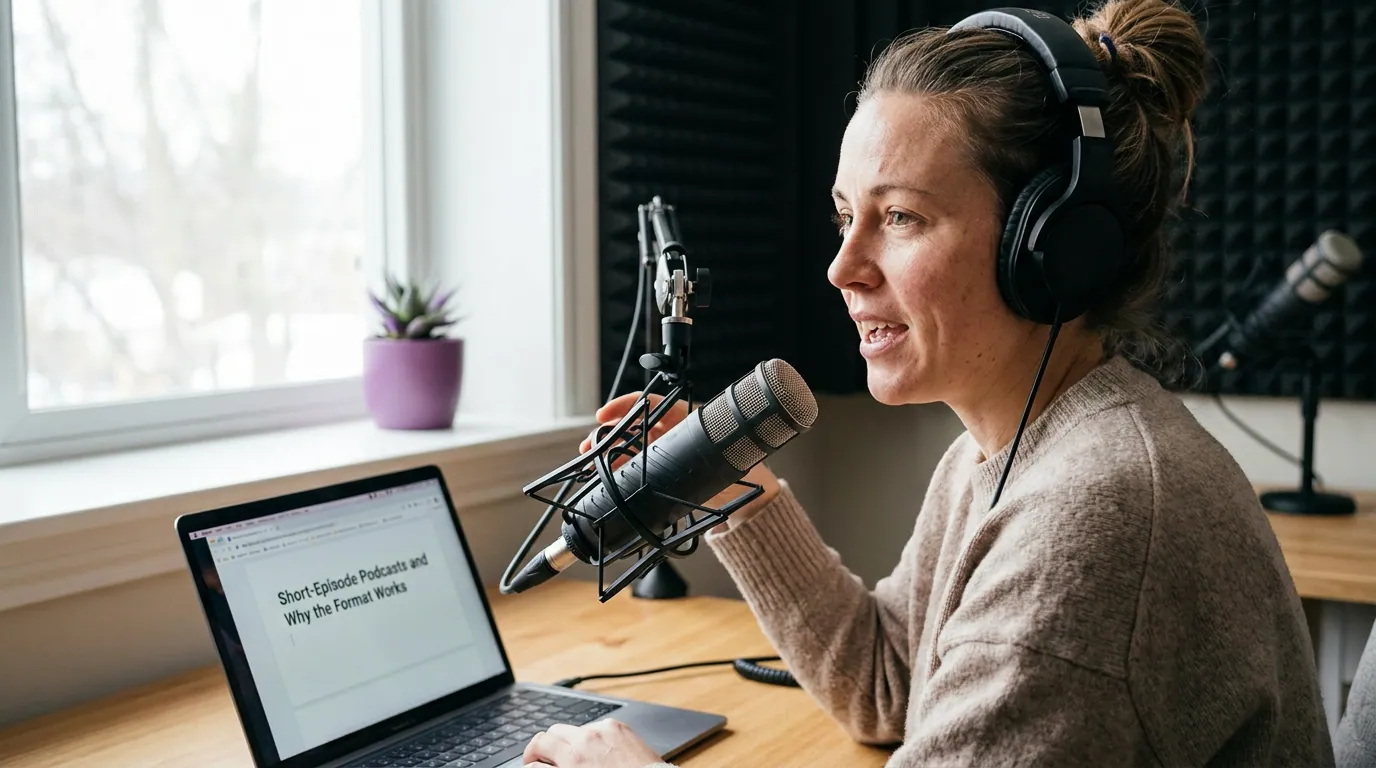
The best short podcasts to learn from (and what to steal from each)
These span economics, science, news, history, and ideas, which is the first thing worth noticing. There is no single short-form genre. There is a single short-form skill: ending before the listener wants you to. The full episode histories and host backgrounds live on the directory; the editorial read lives here.
- The Indicator from Planet Money, NPR's daily economics show, Monday through Friday, "in 10 minutes or less" by the show's own description (NPR). Each episode takes one number or idea, why rent climbs, how a tariff actually lands, and resolves it without jargon. The steal: name the single idea in the title, and finish it before the listener arrives at work. See The Indicator entity page.
- Short Wave, NPR's daily science show with Emily Kwong and Regina Barber, usually 10 to 15 minutes (NPR). It turns one discovery or "everyday mystery" into a tight story with a little humor. The steal: a warm two-host dynamic that serves the explanation, then gets out of the way, the banter never becomes a chat. See the Short Wave page.
- Consider This from NPR, a single major news story explained "in 15 minutes," six days a week, Sunday through Friday (NPR). It is the afternoon companion to All Things Considered, and the discipline is the focus: one story, not a roundup. The steal: depth on one thing beats a shallow sweep of five. See Consider This on the directory.
- Everything Everywhere Daily, host Gary Arndt's solo daily show, one fact or story from history, science, or geography in about 12 minutes, with more than 2,000 episodes published (everything-everywhere.com). The steal: proof a one-person show can hold a daily slot for years if the format is strict enough to run on rails, a fixed shape removes the daily decision of what kind of episode to make. See Everything Everywhere Daily on the directory.
- The Daily, The New York Times' weekday news show, "twenty minutes a day, six days a week" by its tagline, though Wikipedia lists actual episodes at 20 to 30 minutes). It is the honest outlier on this list: longer than the others, and it focuses on one or two stories rather than strictly one. The steal: even at the upper edge of "short," it earns the runtime by going deep on a single story instead of summarizing the day. See The Daily on the directory.
- The Memory Palace, Nate DiMeo's narrative history show on Radiotopia, most episodes under 10 minutes and some under two (Radiotopia). Each piece is a single, emotionally precise story scored like a short film. It does not publish daily, which is the deliberate exception here, proof that the one-idea rule travels even when the cadence does not. The steal: brevity as craft. DiMeo pares history to its emotional core and trusts the silence. See The Memory Palace page.
A fair caveat on any "best short podcasts" list, including this one: no neutral chart ranks shows by quality at a given runtime. Edison's quarterly US ranking and the platform charts measure reach across all lengths, not short-form specifically. These six are editorial picks chosen for how clearly they demonstrate the discipline, not because a dataset crowned them. Treat the list as a teaching set.
The single-idea filter: the one rule they all run on
Here is the framework worth keeping. Before recording, run every episode through one question: can you name the single thing this episode delivers, in one sentence, without the word "and"? If you cannot, you have two episodes, not one. Split it.
Every show above passes that filter, and it is the filter, not the runtime, that does the work. The Indicator names one economic idea. Consider This takes one news story. The Memory Palace tells one history. The minutes stay short as a consequence of the filter, because once you commit to one idea, the cold-open re-introduction, the multi-topic grab-bag, and the "we'll come back to" tangent have nowhere to live. The clock did not make these shows tight. The single-idea rule did, and the short runtime followed.
What gets cut to keep the filter clean is consistent across all six: re-introductions, recap segments, multi-topic sweeps, flagged tangents, and dead air between sentences. The trimming is the format. The same principle scales down to a 45-second clip, a clip that needs setup to make sense is two clips, the same way an episode that needs "and" is two episodes.

What these short podcasts have in common
The shared traits are three, and together they are the lesson: a tight runtime, a daily or near-daily cadence, and one topic per episode. Five of the six publish at least six days a week; the Memory Palace is the deliberate exception that proves the one-idea rule survives without the daily slot. None of them ranks where it does because it is short. They rank because they are predictable, same shape, same time, one idea.
Look at the pattern and the usual advice falls apart. "Short means light" is contradicted by The Memory Palace, which fits a complete emotional arc into under 10 minutes. "Daily is only for newsrooms" is contradicted by Everything Everywhere Daily, a solo show with 2,000-plus episodes. The honest common thread is not a magic length. It is a single idea, delivered on a rhythm the listener can set a watch by.
The trait that ties it together is consistency, which the industry data also names as the number-one predictor of survival. Roughly 47% of podcasts stop at three episodes or fewer Amplifi Mediaciting industry data), almost always from workload rather than lack of ideas. A short, single-idea format is easier to sustain precisely because each episode is smaller, which is why so many durable daily shows are short ones.
How to build your own short show on the same discipline
You do not need NPR's staff to run this format. You need three rules, in this order, that the shows above never break.
- Pass the single-idea filter. Before recording, name the one thing the episode delivers in a sentence with no "and." If you cannot, the episode is two episodes. This is the rule that makes everything else possible.
- Hold a slot, not a length. The daily shows do not hit exactly 10 minutes; they hit a predictable shape at a predictable time. Pick a cadence, daily, three times a week, weekly, and never miss it. Cadence is what kills new shows, and a small episode is far easier to keep shipping than a big one.
- End early. When you think you are done, you are. Cut the recap and land on the strongest line. The single most copied habit of every show here is the willingness to stop while the listener still wants more.
A short format has a quiet distribution advantage too. Because the episode is already close to clip length, the gap between "finished episode" and "postable clip" is tiny, the hook is usually the first 15 seconds and the most quotable line is usually the close. If you film even a simple version, most of your discovery clips are already inside the runtime. Captions are the one non-negotiable: most mobile video is watched on mute, around 75% of people keep their phone muted while watching, per Sharethrough, so an uncaptioned clip is a silent clip to most of the feed.

Where short podcasts fit a listener's day
Short shows win the in-between time: the commute, the coffee line, the dog walk, the gap before a meeting. A 15-minute ceiling is not a limit on those listeners, it is the exact shape of the time they have. That is why the format keeps producing durable shows across genres that look nothing alike, and why a daily slot beats a longer weekly one for habit. The 53% of new US weekly listeners who now prefer to watch a podcast, up from 30% in April 2022 (Backlinko), are mostly watching in those same gaps, which is one more reason a short, clip-ready episode fits the moment.
For the wider context on what leaders do regardless of length, the top US podcasts share three production habits worth copying, and the UK top 10 looks nothing like the US for format reasons. For genre playbooks, see business podcasts worth studying as a new host, finance podcasts that teach hosts how to explain money, what the best true crime hosts do differently, and the comedy podcasts new hosts should steal from.
FAQ
What is the best short podcast to learn from? For a daily habit, The Indicator from Planet Money is the cleanest example of the form, one economic idea, "10 minutes or less," Monday through Friday (NPR). For science, Short Wave; for news, Consider This; for a solo blueprint, Everything Everywhere Daily. The best pick is the one whose single daily slot matches your topic.
How long is a short podcast episode? Roughly 6 to 15 minutes for the cleanest examples, which fits a single commute or break and forces a one-idea structure. The Memory Palace runs many episodes under 10 minutes and some under two (Radiotopia). The Daily stretches to 20–30 minutes (Wikipedia)), included here as the honest outlier rather than excluded for it.
Are short daily podcasts better for new listeners? Often, yes. A short episode is a lower-commitment way to sample a show, and a daily slot builds a habit faster than a weekly one. It is also easier to clip for discovery, which matters now that 57% of listeners rely on social media for recommendations (InsideRadio, 2025). The caveat: short does not mean easy to make well.
Can a solo host run a short daily podcast? Yes. Everything Everywhere Daily is a one-person show with more than 2,000 daily episodes (everything-everywhere.com). A strict, repeatable format is what makes a solo daily survivable: a fixed shape removes the daily decision of what the episode should be, so the only daily work is the content.
Why do short podcasts end so abruptly? Because ending early is the core discipline. The best short shows cut the recap and land on the strongest line instead of summarizing. The Memory Palace is the extreme case, episodes stop the moment the emotional point lands. The abruptness is deliberate; a recap would spend minutes the single-idea format does not have.