
Best Self-Improvement Podcasts to Learn From


The self-improvement podcasts worth learning from hand you something to do, not just something to feel. Seven earn the spot: Huberman Lab (numbered, zero-cost protocols), The Tim Ferriss Show (the routine pulled out of a guest), The Mel Robbins Podcast (one named tool per episode), Happier with Gretchen Rubin (a "Try This at Home" habit built into the format), The Jordan Harbinger Show (advice applied to a real listener's case), Hidden Brain (research explained, not prescribed), and the Rich Roll Podcast (the long, reflective conversation). The skill to steal is what separates them all: a takeaway a listener can act on by Tuesday.
Most lists in this category sort by inspiration, which is the wrong axis if you are building a show. A motivating episode you forget by lunch is a worse product than a plain one that changes how you spend tomorrow. So this list sorts on a single question, does the episode end with a framework you could repeat, or only a feeling that fades, and closes by counting roughly how many concrete takeaways each show delivers per episode, plus where the authority comes from: the guest, or the host. The names below are theirs. The takeaway habit is borrowable, and it is the whole game.
What separates a great self-improvement podcast from a forgettable one?
A self-improvement podcast is worth learning from when each episode leaves the listener with a specific, repeatable action, a protocol, a question, a rule, a single habit, rather than a warm feeling that evaporates by the next scroll. The forgettable ones run on the motivation loop: stirring story, soaring music, vague "you've got this," nothing to do. The durable ones close the loop with an instruction.
This is the platitude-fatigue problem, and audiences feel it before they can name it. "Believe in yourself" is true and useless. "Set a single alarm that signals bedtime, and treat it like a meeting" is small and usable, and it is exactly the kind of thing Gretchen Rubin builds into every episode. The difference is not depth or production budget. It is whether the host did the work of converting the idea into a step, or stopped at the idea and let the listener supply their own.
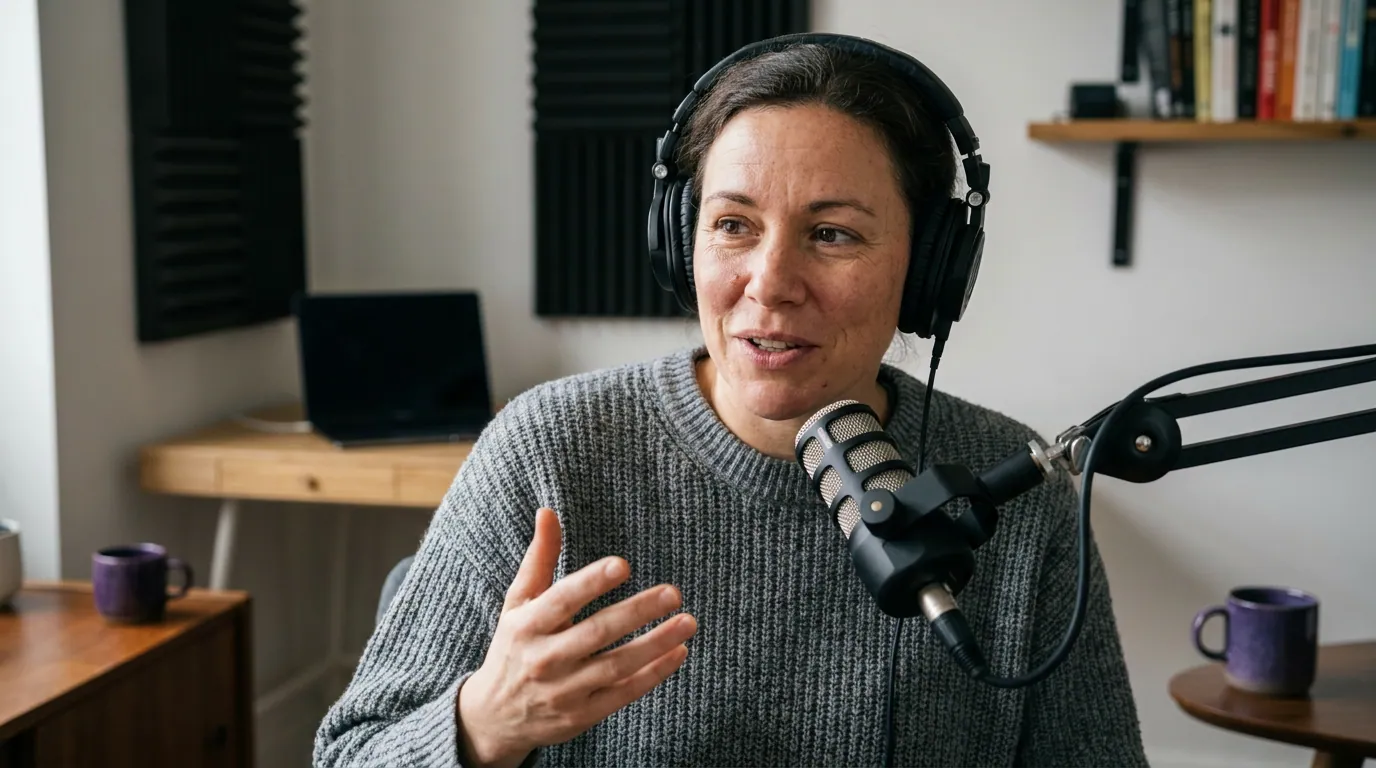
The self-improvement podcasts worth studying (and the takeaway move to steal from each)
These are not ranked by audience size. Each is here for a specific way it turns an idea into something a listener can use, or, in two honest cases, for what it deliberately does not do. The full episode histories and host backgrounds live on the directory; the format breakdown lives here.
- Huberman Lab, the numbered protocol. Andrew Huberman, a Stanford neuroscientist, builds episodes as discrete, zero-cost tools you can act on: an "exercise snack," a physiological sigh, a bedtime light rule, each timestamped and modifiable. His Essentials episodes (~30 minutes, released Thursdays) compress past episodes down to the protocol, and the free Neural Network Newsletter ships the steps as short PDFs. The steal: end every episode with a named, repeatable action, and give people a way to keep it. (Huberman Lab on the directory.)
- The Tim Ferriss Show, the guest deconstruction. Ferriss deconstructs top performers across investing, sport, business, and the arts to extract "the tactics, tools, and routines" you can use (tim.blog/podcast), refusing abstraction, pulling the exact routine, the exact number, the exact failure out of each one. He has said the format can change completely from episode to episode, but the one constant is that "you will have actionable stuff that you can use" (Ferriss on Deviate with Rolf Potts). The steal: replace "tell me about your morning" with "walk me through what you actually did yesterday." (The Tim Ferriss Show on the directory.)
- The Mel Robbins Podcast, the named tool. Robbins packages an idea into a sticky, repeatable phrase, the "Let Them Theory," the "5 Second Rule", so the takeaway has a handle the listener can carry into the week. It works at scale: Apple named it the most-followed show on the platform in 2025, where it placed third in overall listenership behind Joe Rogan and The Daily (CNN, Nov 2025). The steal: give your core idea a name people can say out loud. (The Mel Robbins Podcast on the directory.)
- Happier with Gretchen Rubin, the habit built into the format. Every episode, Rubin and her sister give a "Try This at Home" suggestion, one small, concrete habit, like the one-minute rule or a bedtime alarm (gretchenrubin.com/happier). The takeaway is not optional or buried; it is a fixed segment. The steal: make the actionable moment a recurring slot the audience expects, not a thing you hope to remember to include. (Happier with Gretchen Rubin on the directory.)
- The Jordan Harbinger Show, advice applied to a real case. Alongside guest interviews, Harbinger's weekly "Feedback Friday" answers actual listener dilemmas with co-host Gabriel Mizrahi, turning general principles into a specific verdict on a specific situation (jordanharbinger.com). The steal: a recurring Q&A segment forces abstraction into application, and listener questions are an endless, free content well. (The Jordan Harbinger Show on the directory.)
- Hidden Brain, research explained, not prescribed. Shankar Vedantam, NPR's former social-science correspondent, leads with a human story, then layers in the psychology that explains it (NPR). The honest framing: this is closer to the explanatory end than the instructional one, it changes how you understand behavior more than it tells you what to do tomorrow. The steal: the story-then-science structure is the cleanest way to make a research point land without lecturing. (Hidden Brain on the directory.)
- Rich Roll Podcast, the long, reflective conversation. Roll runs roughly two-hour conversations he explicitly calls conversations, not interviews (richroll.com), intimate, wide-ranging, philosophy-heavy. The honest framing: it sits at the feeling-and-reflection end, and that is the point; you do not finish with a checklist, you finish thinking differently. The steal: depth and patience are their own format, but only if you have the runtime discipline to let a conversation breathe without padding. (The Rich Roll Podcast on the directory.)
Notice what the list is doing. The shows at the top hand you steps; the shows at the bottom hand you perspective. Neither is wrong, but if you are building a self-improvement show and your goal is for people to come back, the cheapest reliable way to earn that is to end with one thing they can do. The patterns underneath are worth measuring.
Where does the authority come from, the guest, or the host?
The second axis that sorts this category is whether the value lives in a rotating cast of expert guests or in the host's own framework. It matters for a new host because the two models cost completely different things to run. Guest-expert shows need booking access; host-philosophy shows need a point of view you can repeat without anyone else in the room.
The guest-expert model (Ferriss, Harbinger's interviews, Rich Roll, Hidden Brain) extracts the takeaway from someone else's expertise, which means the show is only as good as who you can get on. The host-philosophy model (Huberman, Mel Robbins, and Happier's recurring segments) puts the framework in the host's mouth, which is harder to fake but far cheaper to sustain, no calendar, no pitch, no waiting on a guest's PR team. For a beginner with no network, the honest read is that the host-philosophy lane is the one you can actually start in.

What these self-improvement podcasts have in common
The shared trait is not a tone or a topic, it is that the durable shows close the loop. Whether the authority is the host or the guest, the episodes people return to convert an idea into a step, a name, a habit, or a verdict. The category's failure mode, platitude fatigue, is what happens when a show keeps opening the loop (here is an inspiring idea) and never closing it (here is what to do with it).
The second shared trait is structural discipline. Huberman's Essentials, Happier's "Try This at Home," Harbinger's "Feedback Friday," Mel Robbins's named tools, each is a fixed container that guarantees the takeaway shows up. That is the real lesson for a new host, because the actionable moment is too important to leave to inspiration. Build a slot for it and the slot does the remembering.
The third trait is consistency. Nearly half of all podcasts never publish past their third episode Amplifi Media, a widely repeated figure that, in fairness, no host or directory has tied to a clean primary dataset, so treat it as directional, not exact. None of these seven died in that danger zone, because each locked a format that made the next episode easy to produce: a protocol template, a Q&A inbox, a named recurring segment. The shows that last are not the most inspiring. They are the most repeatable.
How to apply the takeaway habit on your own show
Pick your lane first: host framework or guest expert. If you have no network, start host-led, the honest path for a beginner is a point of view you can repeat solo, the way Huberman and Mel Robbins do, rather than a guest list you cannot yet book. Then write your recurring takeaway slot before you record episode one, and run it every single time so the audience learns to expect it.
End each episode by stating the action out loud in one sentence. That sentence is doing double duty. It closes the loop for the listener, and it is almost always the sharpest 30-to-60 seconds in the whole recording, which makes it your first clip. Choosing which exchange to cut is its own skill, the same one that separates a clip that travels from one that sinks.
The reason that clip matters is where new listeners now come from. Social media just passed friends and family as the top way people find new podcasts, 57% of listeners now rely on social media for recommendations, against 54% for friends and family (Coleman Insights / Amplifi Media's State of Video Podcasting 2025, via InsideRadio). Most of those clips live on YouTube, now the #1 US podcast platform at 42% of weekly listeners, ahead of Spotify at 15% and Apple at 7% (Backlinko, citing Cumulus Media, Oct 2025).
If you want to study how the takeaway habit changes by genre, the business podcasts worth studying as a new host lean on a single repeatable format move, the finance podcasts that teach hosts to explain money live or die on making one number land, and even the best true crime hosts and the comedy podcasts new hosts should steal from work by ending each beat on something the audience remembers. For the production patterns behind the biggest shows generally, see what the top US podcasts have in common, and for how taste shifts by market, why the UK top 10 looks nothing like the US.
FAQ
What is the best self-improvement podcast to learn from as a beginner? For a new host with no network, Huberman Lab and Happier with Gretchen Rubin are the most learnable, because their value comes from the host's own framework and a fixed actionable segment, not from booking famous guests. Copy the structure: a recurring slot that guarantees one concrete takeaway every episode.
Which self-improvement podcasts are the most actionable? On an editorial takeaway count, Huberman Lab delivers the most discrete, do-it-tomorrow actions per episode (its numbered, zero-cost protocols), followed by Happier and The Tim Ferriss Show. Hidden Brain and the Rich Roll Podcast deliver the fewest by design, they trade steps for perspective, which is a valid choice, just a different product.
Do I need expert guests to make a self-improvement podcast? No. Roughly half the shows here run on the host's own framework rather than guests, Huberman Lab is solo, Mel Robbins is host-led, and Happier is two co-hosts. The host-philosophy model is cheaper to sustain because it needs no booking calendar, which makes it the practical starting lane for a beginner.
How do I avoid sounding like generic motivation? Close the loop. Generic motivation opens an inspiring idea and stops there; the durable shows convert it into a step, a named tool, a habit, or a verdict on a specific case. Build a recurring segment whose only job is to deliver one concrete action, and state that action out loud in a single sentence at the end of every episode.
What do the top self-improvement podcasts have in common? Three things: each episode closes the loop with something the listener can act on, each show has a structural slot that guarantees the takeaway appears, and all of them publish on a consistent cadence. Cadence matters because most new shows stall early, nearly half never publish past their third episode Amplifi Media, a directional figure that lacks a clean primary source. The seven here all cleared that wall by locking a repeatable format.