
Science Podcasts That Explain Without Dumbing Down


The best science podcasts to learn from are the ones that make a hard idea feel obvious without quietly making it wrong. Judged on explainer craft, disciplined analogies, an honest treatment of what scientists don't know, and a clear choice between expert-guest interviews and host narration, six shows stand out: Radiolab, Ologies, Hidden Brain, Science Vs, Short Wave, and Unexplainable. Each teaches a different part of the skill.
This is not an audience leaderboard. None of these shows publishes verified download numbers, and the platform charts measure reach, not how well a show explains. What I scored is the craft you can copy if you make a science show yourself: how a host turns a peer-reviewed paper into something a stranger finishes on the train. The angle matters because most "best science podcast" lists rank by fame. Fame and explaining ability are not the same thing.
How I judged explainer craft
Three signals separate a show that teaches from a show that merely sounds smart. The first is analogy discipline, does the host reach for a comparison that genuinely maps onto the science, then drop it before it breaks? A lazy analogy ("the cell is like a tiny factory") gets you in the door and then misleads you the moment the details matter. A disciplined one is built for the specific idea and abandoned on time.
The second is uncertainty honesty: when the evidence is thin or contested, does the show say so, or does it round every open question up to a confident headline? The third is structure, whether the show runs on an expert guest, on host narration, or on a hybrid, because that choice decides where the explaining actually happens.
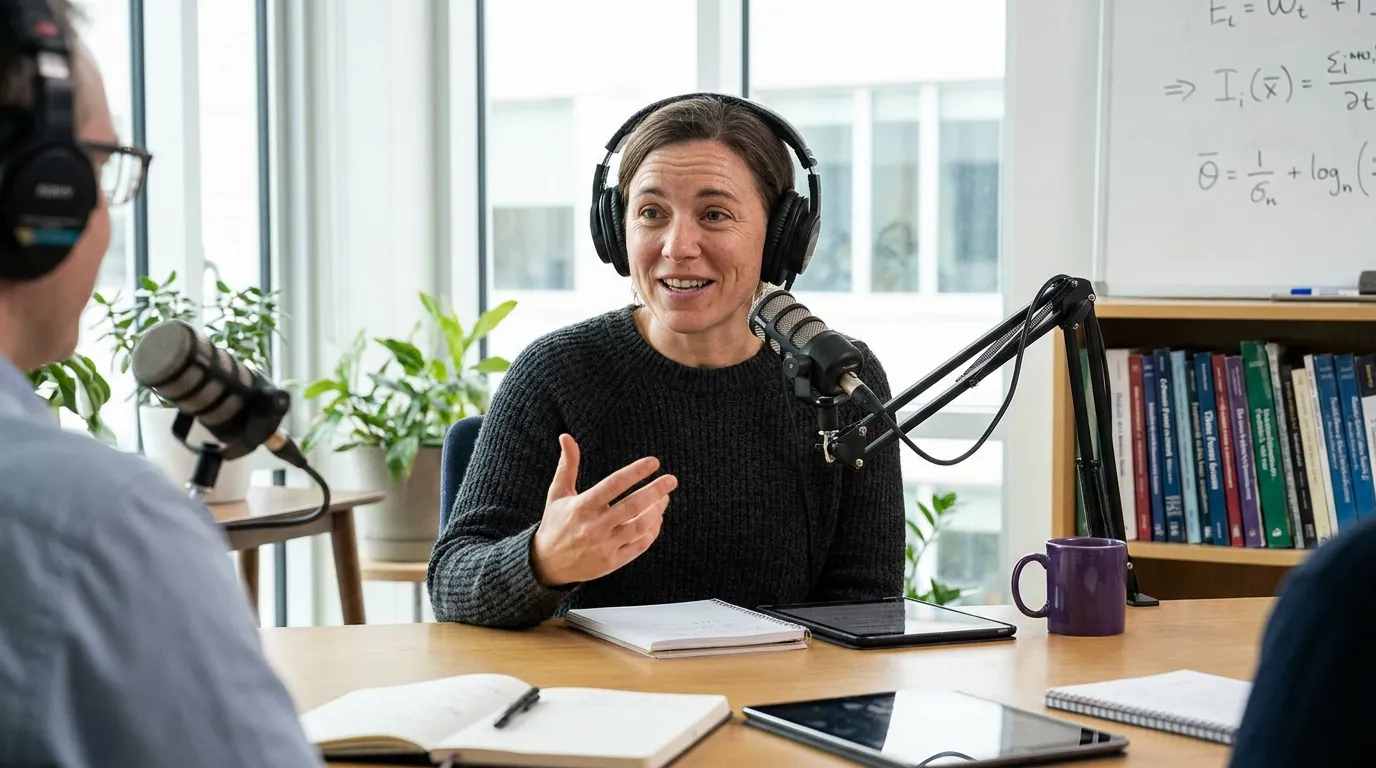
The expert-guest vs host-narration choice (and why it decides everything)
The biggest structural fork in science podcasting is who does the explaining. In the guest model, the host's job is to interview well; in the narration model, the host has to become the expert by the time they hit record. Both can be excellent. They fail in different ways, and a new host should pick one on purpose rather than drift between them.
Guest-driven shows live or die on the host's curiosity and editing. The risk is the "expert sound bite", a researcher who answers in jargon while the host nods along, leaving the listener behind. The shows that beat that risk do one specific thing: the host cuts in with a plain-language aside the second a guest introduces a term, instead of waiting and hoping you kept up. Alie Ward built Ologies around exactly that edit (Ologies, Wikipedia)).
Narration-driven shows put the burden on the producers. The risk there is false confidence: when one writer controls the whole story, it is easy to sand off the contested parts and present a tidy arc that the actual literature doesn't support. The best narration shows fight this by naming their own doubt out loud.
Six shows, and the exact habit to steal from each
Radiolab, analogy carried by sound, not just words
Radiolab is the show that proved science could be told like a story without losing the science, and it is still the reference point for the genre. Now hosted by Lulu Miller and Latif Nasser after creator Jad Abumrad's 2022 departure (Radiolab, on its co-hosts), it runs roughly weekly and around an hour, though episode lengths swing widely by topic.
Its signature craft is using sound design as a second analogy layer, a sonic recreation of a process so you feel the idea before the narration spells it out. The steal for a new host: don't only describe the mechanism, recreate the experience of it. A well-placed sound, a tape of the actual scientist's voice catching on a surprise, does explaining work that a script can't. Radiolab scores medium on uncertainty only because the storytelling pull sometimes resolves a messy question more neatly than the evidence does, the cost of a great arc. See the Radiolab entity page for its full run.
Ologies, the host who asks the question you're embarrassed to ask
Ologies, hosted by science correspondent Alie Ward, is the strongest pure-interview show on this list and the clearest model for guest-driven explaining. Each episode covers a single field, volcanology, melittology, somnology, and Ward's whole method is asking the "dumb" questions a listener is actually wondering, then editing in clarifying asides so a guest's jargon never strands you (Ologies, Wikipedia)). Episodes run 30–90 minutes, with shorter classroom-friendly "Smologies" cuts.
That asides-edit is the most copyable technique in this entire piece. The steal: when your guest says a term, interrupt your own tape to define it in one plain sentence, then return. It costs you a little polish and buys enormous comprehension. Ologies also scores high on uncertainty because Ward routinely lets experts say "we don't actually know," and keeps it in. The accessibility layer, transcripts and bleeped versions, is part of why it sits among the top science shows on Apple. See the Ologies entity page.
Hidden Brain, the analogy that makes behavioral science stick
Hidden Brain, hosted by veteran science journalist Shankar Vedantam, is a hybrid: research interviews wrapped in narrative, pairing a study's findings with a human story so the data has somewhere to land (Hidden Brain). Episodes typically run around an hour, and the show is routinely described as one of the most popular science podcasts in the US.
Its craft strength is the narrative-as-analogy: instead of explaining a cognitive bias in the abstract, Vedantam tells a story whose shape is the bias, so you recognize it in yourself before he names it. The steal: anchor every abstract finding to one concrete person doing one concrete thing. Hidden Brain scores medium on uncertainty because the single-story format, by design, tends to dramatize a clean version of effects that are often smaller and more contested in the literature, useful to know going in. For the broader pattern of US shows that explain through story, see the habits the top US podcasts quietly share. See the Hidden Brain entity page.
Science Vs, the show that buries its claims under citations
Science Vs, created and hosted by Wendy Zukerman, is the rigor benchmark. The format is myth-busting: take a claim from the public conversation, then work through the actual literature and tell you what the evidence supports. What makes it a teaching tool is the sourcing, a typical episode carries over a hundred citations and draws on background interviews with dozens of scientists beyond the experts you hear (Science Vs, Wikipedia).
Zukerman scores medium on analogy, the show leans on data over metaphor, but it sets the bar for uncertainty honesty, reporting consensus rather than manufacturing a false 50/50 debate. The steal: separate "what one study found" from "what the field as a whole supports," out loud, in every episode. One honest caveat: even a heavily sourced show draws criticism for occasionally over-simplifying a study into a punchier claim than the paper makes, which is the eternal tension of pop-science. Worth knowing it can happen even here. See the Science Vs entity page.
Short Wave, explaining one idea in under 15 minutes
Short Wave is NPR's daily science show, and it is the model for compression. Most weekdays it delivers one discovery or one everyday mystery in just under 15 minutes (Short Wave, NPR). The constraint forces the craft: with no time to wander, the hosts pick one analogy, land it fast, and stop.
That discipline is the whole lesson. The steal: give yourself a hard time budget and build the episode around a single takeaway. A 12-minute show that explains one thing cleanly teaches more than an hour that explains five things halfway. Short Wave scores medium on uncertainty mostly because the format's brevity leaves little room to dwell on what's unsettled, the trade-off you accept for daily, digestible science. Its tight, single-idea episodes also happen to be the most naturally clip-shaped on this list, which is no coincidence. See the Short Wave entity page.
Unexplainable, the show built entirely on not knowing
Unexplainable, from Vox, inverts the explainer format: it is a science show about questions, not answers. Host Noam Hassenfeld and a team of reporters take listeners "right up to the edge of what we know, and then keep on going", episodes on what 95% of the universe is made of, or how the nose actually works (Unexplainable, Apple Podcasts). It is the purest expression of uncertainty honesty in the genre, which is why it tops that column.
The steal is counterintuitive but powerful: an open question, framed well, holds attention better than a settled fact. Curiosity is the engine, and Unexplainable proves you can build a whole show on the gaps. It scores medium on structure and analogy because the open-ended format sometimes leaves a listener without a firm handle to walk away with, the cost of refusing to oversimplify. That is a deliberate trade, and an honest one. See the Unexplainable entity page.

What the best science podcasts have in common
Run the six through their public data and three patterns hold. First, episode length is not the variable that decides quality, the list spans Short Wave's sub-15-minute dailies to Radiolab and Hidden Brain at roughly an hour, and both ends teach well. What matters is whether there is one clean idea to carry away. Second, the shows that score highest on uncertainty are the ones that name their own doubt as a feature, not a flaw. Third, the guest-driven shows win on access and surprise, while the narrated shows win on structure, and the strongest performers borrow the other side's strength.
There is a structural reason the clip-shaped shows keep doing well, and it has nothing to do with audio. YouTube now reports more than 1 billion monthly podcast viewers (Variety, Feb 2025), and 57% of listeners now rely on social media for podcast recommendations, the first time it passed friends and family (InsideRadio, 2025). A single clean analogy is exactly what survives the trip into a 45-second clip; a tangled one falls apart. Much of that social video plays with the sound off as people scroll, which is why a captioned clip of one well-told idea, readable on mute, is how a curious stranger first meets a science show.
One honest caveat on the whole exercise: these are qualitative reads from public episodes and transcripts, not an audience ranking. None of these shows publishes verified downloads, and the platform charts measure reach, which is a different thing from teaching ability. Treat the scorecard as a guide to what to copy, not a leaderboard.
So which should you actually listen to?
Match the show to the skill you want. For story-driven explaining and sound design, start with Radiolab. For a masterclass in interviewing an expert without losing the listener, Ologies. For making research stick through narrative, Hidden Brain. For rigor and honest sourcing, Science Vs. For compression, Short Wave. For the art of sitting with what we don't know, Unexplainable. The decision rule: pick the show whose explaining you'd be proud to imitate, because in science podcasting the explaining is the entire product.
For adjacent craft, business podcasts worth studying as a new host cover the operator-vs-pundit version of credibility, finance podcasts that teach hosts to explain money show the same discipline in a niche where a bad analogy costs real money, and comedy podcasts new hosts should steal from teach the timing that keeps a clip alive. For the broader pattern, why the UK top 10 looks nothing like the US explains how format norms diverge by market, and what the best true crime hosts do differently is the sharpest version of turning information into a moment.
FAQ
What is the best science podcast for someone who wants to actually learn, not just be entertained? Science Vs and Ologies are the two strongest learning tools. Science Vs gives you the weight of the evidence, over a hundred citations per episode (Wikipedia), while Ologies gives you depth in one field with a host who defines every term on the spot. Pair one of each and you cover both breadth and rigor.
What is the best science podcast for short commutes? Short Wave, NPR's daily show, runs just under 15 minutes and explains one idea per episode (NPR). The constraint is the point: a tight, single-takeaway episode fits a commute and tends to stick better than a sprawling hour you only half-finish.
Are popular science podcasts accurate, or do they oversimplify? Most are accurate on the main claim and lose nuance at the edges. Even a heavily sourced show like Science Vs draws occasional criticism for compressing a study into a punchier line than the paper supports. The fix as a listener: treat a podcast as the start of an inquiry, not the final word, and notice when a host flags uncertainty versus when they round it away.
Does a science podcast need a video version to grow? Increasingly, yes, for discovery, not for the audio. With over 1 billion monthly podcast viewers on YouTube (Variety, 2025) and 57% of listeners finding shows through social media (InsideRadio, 2025), a captioned clip of one clear explanation is how most new listeners arrive. The audio can stay audio-first; the clip is what travels.
Can a new science podcast compete with these shows? Not on reach, those head starts are unrepeatable. But every craft habit on the scorecard is copyable at your scale: one disciplined analogy per episode, a term defined the moment a guest uses it, and an honest line about what's still unknown. The blocker is consistency, not talent, and turning each episode into a few clips is what keeps a weekly schedule survivable.