
Daily News Podcasts and How They Hit Deadline


The daily news podcasts worth learning from are not the ones with the biggest names, they are the ones that ship a finished, sourced episode before your alarm goes off. Study The Daily, Up First, Today Explained, The Journal, and What A Day, and you find three production decisions that decide everything: single-story or roundup, who anchors the handoff, and how the show beats the morning deadline. Those three choices, not the topics, are the craft.
Most "best news podcasts" lists rank shows by audience size and stop there. That tells you what is popular; it does not tell you how the thing gets made on a clock that resets every 24 hours. News is the genre where production discipline is the whole game, there is no luxury of a release-when-ready schedule, no chance to sit on a great interview for a month. The episode is due before commute time, every weekday, regardless of what happened overnight. Below, five leaders are studied by how they handle that constraint, and the patterns turn into a build rule a new host can copy.
News is also a top US genre, sitting just behind Comedy in listenership (Statista, top podcast genres). Inside it, almost every show resolves to one of two structures.
What is the difference between a single-story and a roundup daily news podcast?
A single-story daily news podcast spends its whole episode on one topic, reported in depth, The Daily and Today Explained work this way, running 20–30 minutes. A roundup covers the three or four biggest stories in a fast briefing, Up First does this in 10–15 minutes. Single-story trades breadth for depth; roundup trades depth for speed and completeness.
That one fork determines the runtime, the host's job, and even the publish time. A single-story show needs a reporter interview and a narrative arc, so it runs longer and demands a host who can conduct an interview on deadline. A roundup needs editorial judgment about which three stories matter and a clean read, so it can be shorter and ships faster. Neither is better. They are different products solving different listener needs, the deep catch-up versus the quick brief.
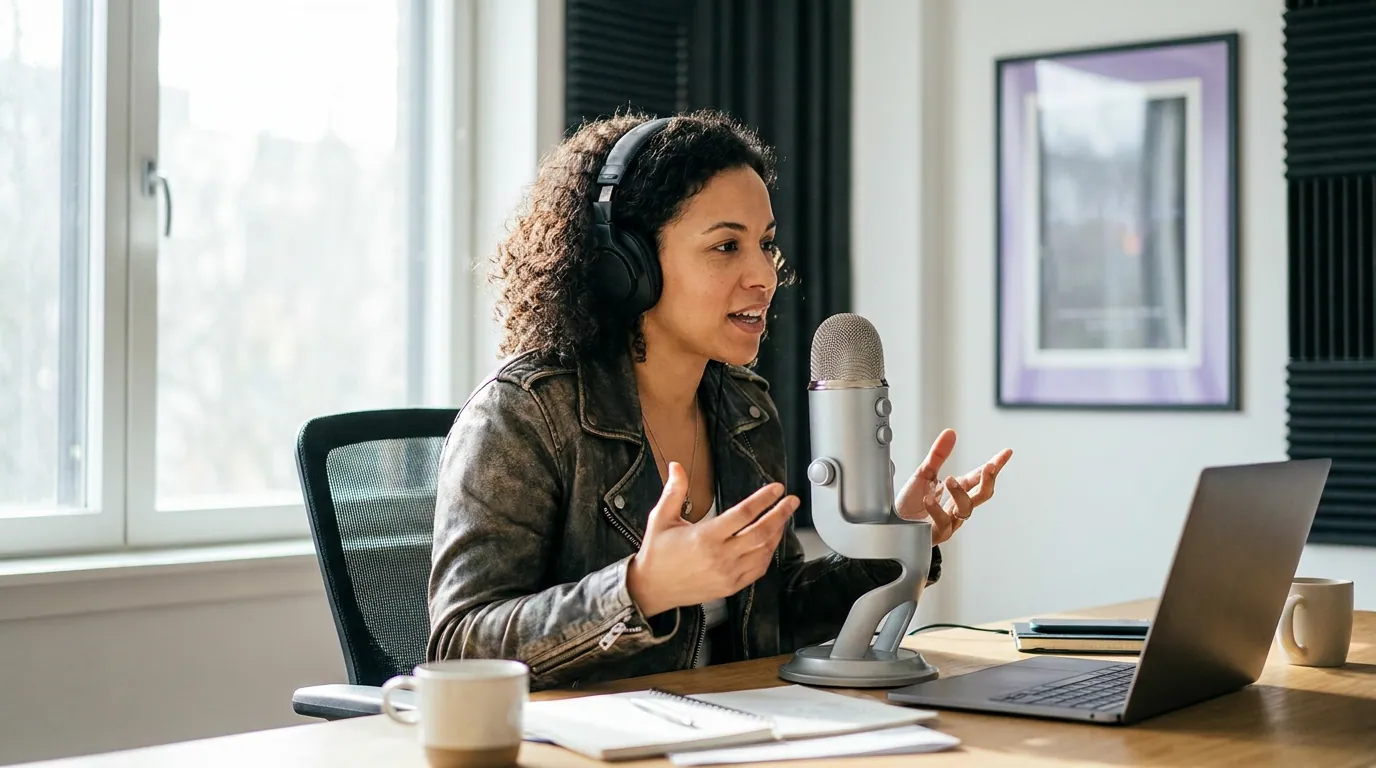
The five daily news shows worth studying
Here is the short list, each studied for the production choice it teaches. The table first, then what each one does that a new host should steal.
| Show | Structure & runtime | What to learn from it |
|---|---|---|
| The Daily (NYT) | Single story, 20–30 min, by 6 a.m. weekdays | The reporter-interview format and the closing headline read |
| Up First (NPR) | Roundup, 10–15 min, by ~6 a.m., 7 days | Ruthless story triage and the co-anchor handoff |
| Today Explained (Vox) | Single story, 25–30 min, afternoon | Picking the angle the news cycle skipped |
| The Journal (WSJ/Spotify) | Single story, 15–25 min, weekday afternoons | One beat done consistently (money, business, power) |
| What A Day (Crooked) | Hybrid, ~20 min, Mon–Fri | Personality without losing the brief |
The Daily is the benchmark for the single-story format. Hosted by Michael Barbaro, with Rachel Abrams and Natalie Kitroeff added as co-hosts in April 2025, it takes one story per weekday, built around an interview with the Times reporter who covered it, and closes with a quick summary of other headlines (The Daily, Wikipedia)). The structure is rigid on purpose: the same shape every day is what lets a team produce it overnight and ship "by 6 a.m." without reinventing the format under deadline pressure.
Up First is the masterclass in roundup. It covers the three biggest stories of the day in roughly 10–15 minutes, by around 6 a.m., seven days a week, with weekday hosts A Martínez, Steve Inskeep, Leila Fadel, and Michel Martin rotating (Up First, Wikipedia). It is a spinoff of NPR's Morning Edition broadcast, the opening segment of the live show, edited into a standalone feed, which is why its production cost is near-zero relative to its reach. The discipline to learn is triage: deciding what does not make the cut is harder than the read.
Today Explained from Vox is the single-story format with a twist on timing and angle. Hosted by Sean Rameswaram and Noel King, it runs about 25–30 minutes and publishes later in the day rather than at dawn, built for the commute home, not the commute in. Its editorial signature is picking the context the day's coverage skipped, which is a real lesson: a daily show does not have to be first; it can be the one that explains.
The Journal, co-produced by the Wall Street Journal and Spotify and hosted by Ryan Knutson and Jessica Mendoza, proves the value of a narrow beat. It runs 15–25 minutes on "money, business, and power," every weekday (The Journal, Wikipedia)). The lesson for a new host is focus: one beat, done daily, builds a clearer audience than a general-news show fighting The Daily for the same listener.
What A Day from Crooked Media, hosted by Jane Coaston, is the hybrid, about 20 minutes that covers the day's news with a point of view and some levity, "the fun stuff you might have missed" included (What A Day, Apple Podcasts). It teaches the hardest balance in the genre: personality that adds without burying the brief.
The host-as-anchor handoff
The skill that separates a polished daily news show from a hobby one is the handoff, the way hosts pass the read between each other and to reporters without dead air or stumbles. On a roundup like Up First, two anchors trade stories cleanly; on The Daily, the host hands off to a reporter and steers the interview back to the listener's question. This is anchoring, not chatting, and it is rehearsed.
Watch a single Up First episode for the seams and you will not find them: the co-anchor structure means one host introduces a story, a second carries the next, and the transitions are tight enough that the show feels like one continuous read. The Daily does the inverse, Barbaro's job is to be the listener's proxy, asking the reporter the obvious question so you do not have to. Both are the same underlying discipline: the host is an anchor moving the episode forward on a clock, not a conversationalist filling time.
For a new host, the practical takeaway is to script the handoffs, not just the content. Write the exact sentence that moves from story one to story two. Decide who says what. The shows that sound effortless at 6 a.m. sound that way because the transitions were the part they did not improvise.

The morning-publish constraint shapes the whole show
Every production decision in daily news bends to one fact: the episode is due before the morning commute. That deadline is why the formats are rigid, why the roundup exists, and why these shows are built as machines rather than as creative projects that finish when they are good. You cannot wait for inspiration when the file has to be live by 6 a.m.
The lesson generalizes past news. Most shows that fade in their first year do not run out of good ideas, they run out of the will to publish on a schedule, and daily news shows have removed that failure point by stripping out every per-episode decision they can. The format is a template. The handoffs are scripted. The publish time is non-negotiable. If you are starting any show, not just news, that is the model: make the format a machine so the only thing you invent each time is the content.
What the best daily news shows have in common
Strip away the publishers and the politics and the leaders share four traits. They commit to one structure and run it daily without redesigning it. They publish on a fixed clock the audience can rely on. They treat the host as an anchor moving the show forward, not a host filling time. And, the newest shared trait, they cut their best moments into clips, because that is now where new listeners come from.
Discovery has moved to the feed. 57% of listeners now rely on social media for podcast recommendations, the first time it has edged past friends and family (54%) in a survey of 1,000 US consumers by Coleman Insights and Amplifi Media, reported by InsideRadio. A daily news show is unusually rich in clippable moments, the sharpest line from a reporter interview, the one statistic that reframes a story, the clean 30-second explainer, and those travel far better than a link to a 25-minute episode.
The patterns shift by genre and country more than you would expect. The top US shows and the habits behind them lean on this same fixed-format discipline, while the UK top 10 looks nothing like the US. For adjacent craft lessons, business podcasts worth studying borrow the single-story interview structure, finance podcasts that teach hosts to explain money share The Journal's narrow-beat focus, what the best true crime hosts do differently goes deeper on host delivery, and comedy podcasts new hosts should steal from show the personality side that What A Day balances against the brief.
FAQ
What is the best daily news podcast to learn from as a new host?
Start with Up First if you want to learn structure on a budget, because its 10–15-minute roundup teaches story triage and the co-anchor handoff with the least production overhead (Up First, Wikipedia). Study The Daily for the single-story interview format once you can sustain a longer episode.
Should a daily news podcast be a single story or a roundup?
Pick by your resources. A roundup (10–15 minutes, a few stories) is faster to produce and easier to publish daily, the better choice for a small team. A single-story show (20–30 minutes, one reported topic, a reporter interview) needs more time and interview skill but builds a deeper connection. Match the format to what you can hold every weekday.
What time should a daily news podcast publish?
Most morning briefings publish by around 6 a.m. local time to catch the commute, as The Daily and Up First both do. Evening-oriented explainers like Today Explained publish in the afternoon for the commute home. Choose one window, then never miss it, the fixed clock is what makes a daily show reliable.
How long should a daily news episode be?
Roundups run 10–15 minutes; single-story shows run 20–30. There is no ideal number, the runtime follows the structure. A roundup that runs 30 minutes has lost its speed advantage, and a single-story show squeezed into 10 minutes cannot report anything in depth. Let the format set the length.
How do daily news podcasts grow their audience now?
Increasingly through social clips rather than chart placement. With 57% of listeners now relying on social media for podcast recommendations (Coleman Insights / Amplifi Media, via InsideRadio), the sharpest 30-second moment from a daily episode often reaches more new listeners than the full episode ever will.