
How the Best Daily Podcasts Keep the Streak

The best daily podcasts, The Daily, Up First, The Journal, Today Explained, keep a five-or-six-day streak because each one is a production system, not an act of willpower. Same-day turnaround, a fixed segment template that never changes, and a small standing team or an overnight shift do the heavy lifting. The show ships because the machine ships, not because someone felt inspired.
You can find a ranking of daily news shows on any review site. This page does the harder, more useful thing: it takes the daily leaders apart to show you the cadence machine inside each one, then rebuilds a smaller version you can actually run. The lesson is not "be The New York Times." It is "copy the assembly line, shrink it to fit."
What makes a daily podcast hard is the cadence, not the content
A daily podcast is hard for one reason: the deadline never moves. A weekly show forgives a slow day. A daily show punishes it the next morning, and the morning after that. Most new shows never even reach the territory where this bites, roughly 47% of podcasts stop at three episodes or fewer (Podcasting Tech, 2025), and the failure is almost always workload, not running out of things to say. The viral "90% quit by episode three" line circulates with no traceable source, so treat 47% as the conservative, better-supported figure rather than gospel.
So the question is not "what should a daily show be about." It is "how do you make episode 200 as easy to ship as episode two." The daily leaders answer that with three things, and none of them is talent. They turn the work around the same day, they pour every episode into the same mold, and they run a standing crew or shift that exists to feed the deadline. Take each apart in turn.
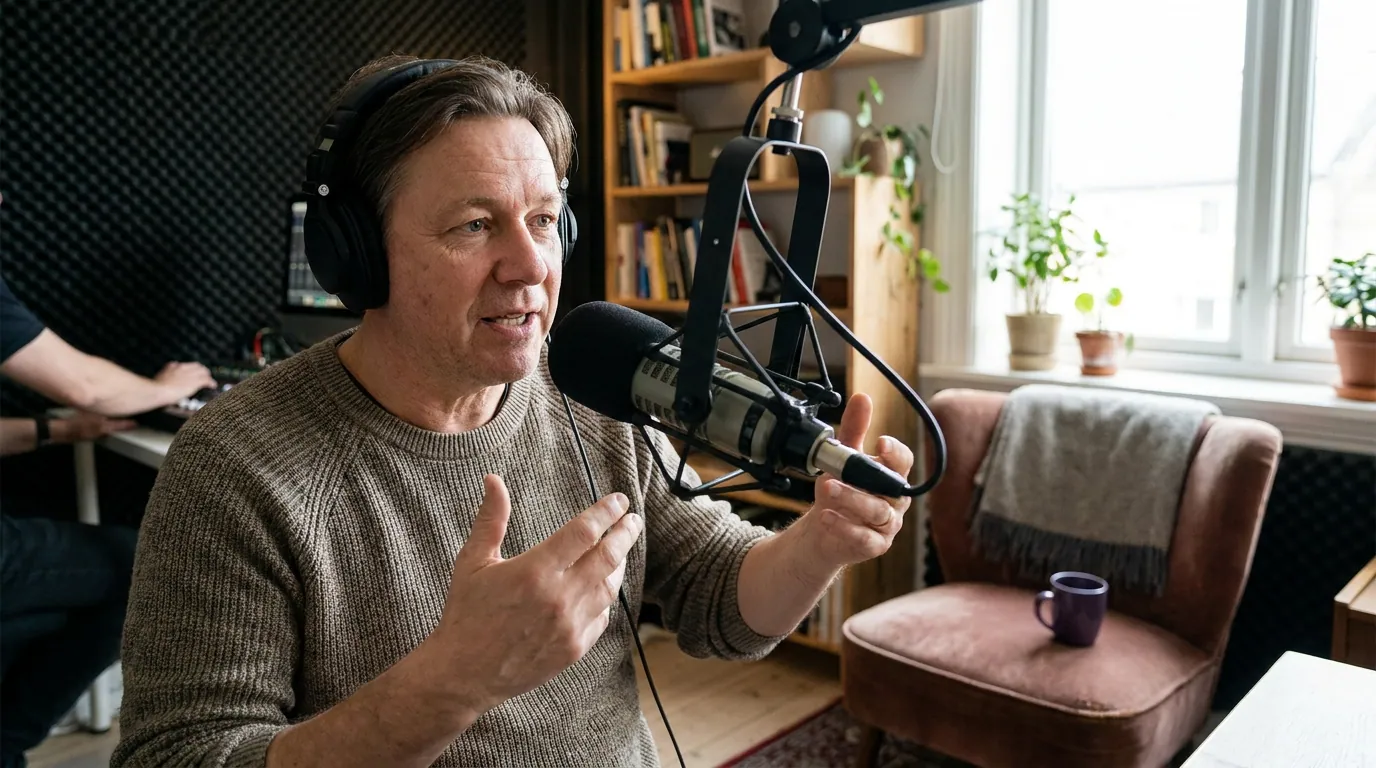
How does The Daily produce an episode in a single day?
The Daily runs an open loop that starts and ends within 24 hours. A producer learns the day's lead story at the 9:30 a.m. New York Times news meeting; producers and editors write and edit the script, book interviewees, and pull archival tape through the day; the show is taped in the afternoon; and last-minute post, final mastering, and packaging run into the night so the episode is in the feed by 6 a.m. (Toast Studio). It runs roughly 20–30 minutes, six days a week (The Daily, Wikipedia)).
The machine behind that is bigger than most people guess. At its growth-era scale The Daily was produced by a team of around 25 people for five episodes a week, seeded at launch by producers pulled from public radio and podcasting rather than the newspaper (Toast Studio). The unfair advantage is the newsroom: producers sit next to more than a thousand Times journalists, so story selection and sourcing are solved before the clock starts. You cannot copy the newsroom. You can copy the loop, a fixed daily moment when the topic gets locked, then a straight line from lock to publish with no decisions left to make.
Why the segment template is the real secret weapon
The thing that makes a daily cadence survivable is not speed, it is sameness. The leaders pour wildly different stories into an identical container every day, so nobody re-invents the structure under deadline. Up First markets a fixed promise: the three biggest stories of the day in about 10 minutes (Up First, NPR). Three stories, one shape, the template is the show. The reporting changes; the container never does.
That constraint is what lets a small crew move fast. When the format is locked, cold open, three beats, sign-off, the only open question each day is which facts go in which slot. Up First is built so directly on this that it is essentially carved out of NPR's Morning Edition: NPR takes roughly the first 10 minutes of the live broadcast and edits it into the podcast, with the team having already picked the three lead stories the night before (NPR Extra, 2019). One container, refilled daily.
For your show, the template is the single most consequential decision you will make. Pick three to four recurring segments, name them, and never deviate. A daily solo show might run: a 20-second cold open with the day's one line, one main story explained, one quick hit, and a fixed sign-off. Once that mold exists, your daily job shrinks from "make a show" to "fill four boxes", and four boxes is something you can do tired, on a bad day, for a year. For more on building reliable repeatable segments and a host script, see how the top US podcasts share the same production habits.
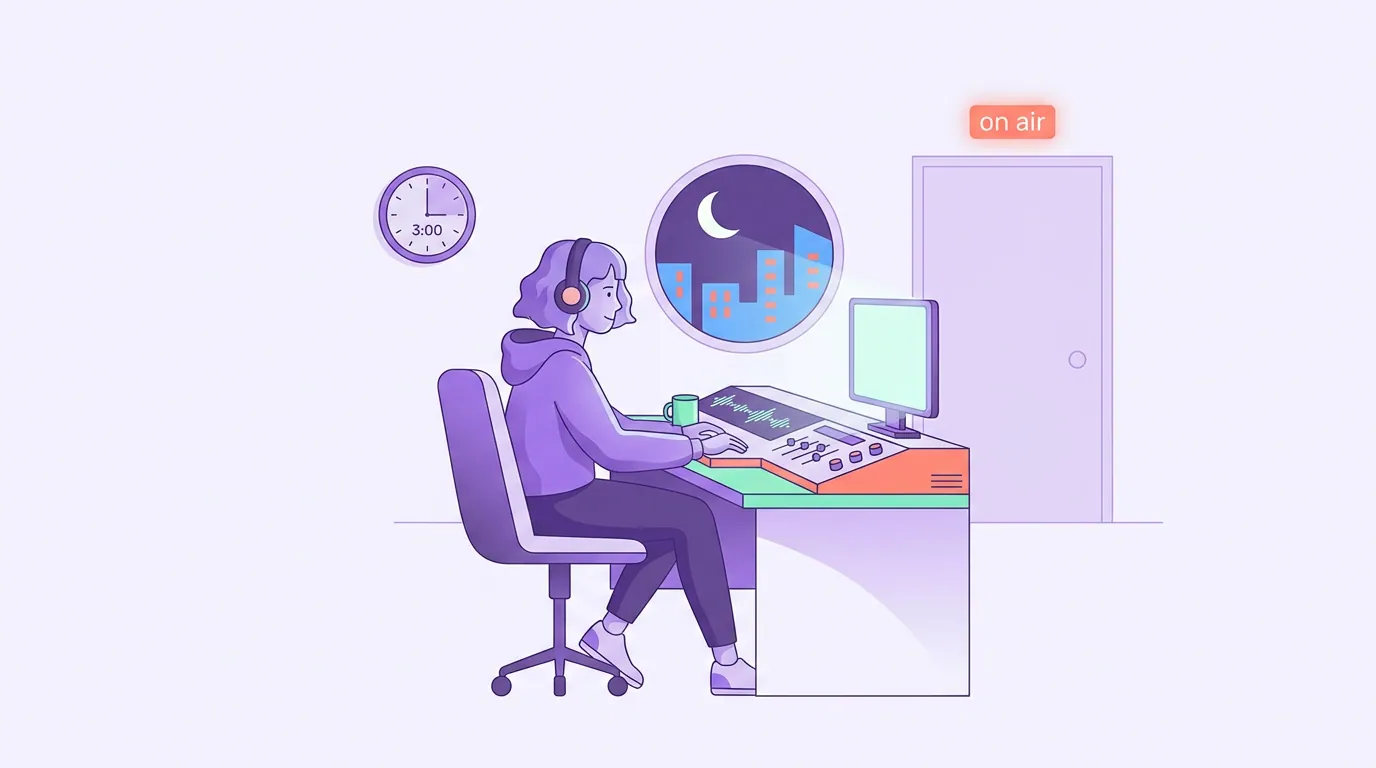
The team is smaller than you think, or it is an overnight shift
The detail most "be consistent!" advice skips is staffing. Daily shows do not run on the host's spare hours. They run on a standing role whose only job is the next episode. The Daily has its ~25-person team (Toast Studio). Up First runs leaner than you would guess: at 10:30 p.m. an overnight crew of one producer and one editor comes in, works through the small hours refining and re-cutting as stories break, and gets the episode into the feed about 40 minutes after the hosts record (NPR Extra, 2019). Two people and a clear handoff produce one of the most-listened daily shows in the country.
There is a buildable lesson in that bar chart: the shorter the episode, the leaner the machine. NPR News Now is five minutes and refreshes hourly; that brevity is what makes the cadence possible at all. A solo creator cannot staff an overnight desk, but can borrow the principle, keep the slot short enough that one person plus tooling can fill it on schedule. A 10-minute daily is a system. A 90-minute daily is a second job that ends in podfade.
Can a solo creator actually run a daily show?
Yes, but only by replacing the team with a system and the studio with a short, fixed format. The trade is simple: you cannot match a 25-person crew, so you shrink the slot, lock the template, and automate everything downstream of recording, editing, captions, clips, and posting. A 10-minute daily on a rigid four-segment mold, with the busywork handed to tooling, is sustainable. A long, hand-edited daily is not.
The honest math is on your side here. Doing every step by hand, editing, transcript, show notes, clips, posting, is what burns daily hosts out. The leaders solve it with staffing; a solo host solves it with automation that compresses the post-record work from hours to minutes. That is the whole game: keep the human part (the voice, the take, the judgment) and remove the mechanical part (the cutting, the captioning, the cross-posting). What you must not automate is the reason people listen.
The distribution side has its own system. The daily leaders do not just publish, they cut each episode into short, captioned clips that go out across YouTube Shorts, TikTok, Reels, and X, because that is now where discovery happens. 57% of listeners now rely on social media for podcast recommendations, the first time it outranked friends and family in the data, per Coleman Insights and Amplifi Media's 2025 study of 1,000 U.S. consumers (reported by InsideRadio, 2025). For a daily show, the clip pass cannot be a separate manual project on top of the episode; it has to be one button at the end of the same loop, or it will be the first thing to slip.
One caveat the streak-counters skip: clip volume without a strong hook is empty motion. A clip with a million views that sends nobody to the show is a vanity number, not growth. The point of the clip pass is reach for the show, not reach for its own sake, pick moments that stand alone and make a stranger curious.
The cadence blueprint: a daily show you can actually sustain
Here is the machine, shrunk to one person. It is the same three parts the leaders run, sized down.
- Lock a daily decision moment. Pick one fixed time each day when the topic gets chosen, your version of the 9:30 a.m. news meeting. After that moment, no more deciding what; only doing.
- Build a four-box template and never change it. Cold open (one line), main segment, one quick hit, fixed sign-off. Write the transitions once. Daily work becomes filling boxes, not designing a show.
- Keep the slot short. Aim for 8–15 minutes. Length is the variable that decides whether one person can hold the line. Short is not lesser; NPR News Now is five minutes and refreshes hourly.
- Automate everything after "stop recording." Editing, captions, transcript, clips, cross-posting. The human work is the take; the machine handles the rest. This is the staffing substitute.
- Make the clip pass part of the loop. Cut each episode into a few captioned vertical clips in the same session, because discovery now runs through social feeds, not directories.
- Bank a buffer. Record two or three evergreen episodes that can run on a sick day. The leaders have staff redundancy; you need a shelf. A buffer is the difference between a missed day and a broken streak.
That is the whole blueprint. None of it requires a newsroom, a studio, or a crew, it requires a loop, a mold, and the discipline to let tools do the mechanical part. The daily leaders are not more dedicated than you. They built a machine that ships whether or not anyone feels like it. So can you.
If you want the wider pattern, the habits the top US podcasts share overlap heavily with this, and the contrast with the UK's very different top 10 shows how format follows market. For genre-specific systems, see business podcasts worth studying and what the best true crime hosts do differently. Smaller markets run leaner machines by necessity, the Australian small-market playbook and the Canadian cross-border approach are both worth a look.
FAQ
What are the best daily podcasts right now? For daily news, the recurring names on critics' lists are The Daily (The New York Times), Up First (NPR), and Today Explained (Vox) for one-story depth (Podcast Review). Add The Journal (Wall Street Journal) for business and NPR News Now for five-minute hourly headlines. The Daily is the most-downloaded daily news show in the US.
How is The Daily made so fast? The Daily runs a same-day loop: a producer learns the lead story at the 9:30 a.m. Times news meeting, the team scripts and books through the day, the show is taped in the afternoon, and overnight post and mastering get it into the feed by 6 a.m. (Toast Studio). A roughly 25-person team and newsroom access make the speed possible.
How big is the team behind a daily podcast? It varies widely. The Daily has had around 25 people; Up First runs on an overnight crew of one producer and one editor, getting the episode out about 40 minutes after recording (NPR Extra, 2019). The common thread is a standing role dedicated to the next episode, not the host doing it in spare time.
Can one person run a daily podcast? Yes, by replacing the team with a system. Keep the episode short (8–15 minutes), lock a fixed segment template so you fill boxes instead of designing a show, automate everything after recording, and bank a buffer of evergreen episodes. The blocker is workload, roughly 47% of podcasts quit by episode three (Podcasting Tech, 2025), and automation is what makes the daily deadline survivable.
How long should a daily podcast episode be? Short enough to sustain. The leaders span five minutes (NPR News Now) to about 30 (The Daily), but the longer formats are backed by teams. For a solo or small-team daily, 8–15 minutes is the realistic ceiling, because episode length is the single biggest factor in whether you can hold the cadence for a year.