
Soundproofing vs Acoustic Treatment for Podcasters


Soundproofing and acoustic treatment are not the same thing, and acoustic foam is acoustic treatment, not soundproofing. Treatment absorbs sound inside a room to kill echo. Soundproofing blocks sound from passing through a wall to stop outside noise. They use different materials, and one costs roughly ten times the other. Most podcasters only need the cheap one.
The reason people waste money here is a single marketing word: "soundproof foam." Foam is porous, so sound passes right through it, it cannot block your neighbor's TV or street traffic no matter how much you glue to the wall (Acoustical Solutions). What foam does do is soak up the reflections bouncing around inside your room, which is the boxy, hollow echo that makes a recording sound amateur. Those are two different problems. This page tells you which one you actually have, what each really costs, and why the answer for most home podcasters is "neither product, just move your mic."
The fast verdict: which problem do you have?
Ask one question before you spend a dollar: is the problem sound coming from inside the room, or from outside it?
- Echo, reverb, a "recorded in a bathroom" hollowness, flutter between bare walls → that is sound inside your room. You need acoustic treatment (absorption). Cheap, easy, often free.
- A neighbor's TV, street traffic, a barking dog, kids in the next room, an air conditioner you can hear through the wall → that is sound coming through a barrier. You need soundproofing (isolation). Expensive, structural, often not worth it for a hobby show.
| What you hear in the recording | What it actually is | What fixes it |
|---|---|---|
| Boxy echo, hollow reverb, "tinny" room | Reflections bouncing inside the room | Acoustic treatment (absorption) |
| Traffic, neighbors, dog, HVAC bleeding in | Sound passing through walls, doors, windows | Soundproofing (isolation) |
| A bit of both | Both, but treat the echo first | Treatment now; selective sealing later |
Nine times out of ten, the recording problem a home podcaster hears is echo, not bleed-through. Echo is the cheap fix. If you only read one section, make it the next one.
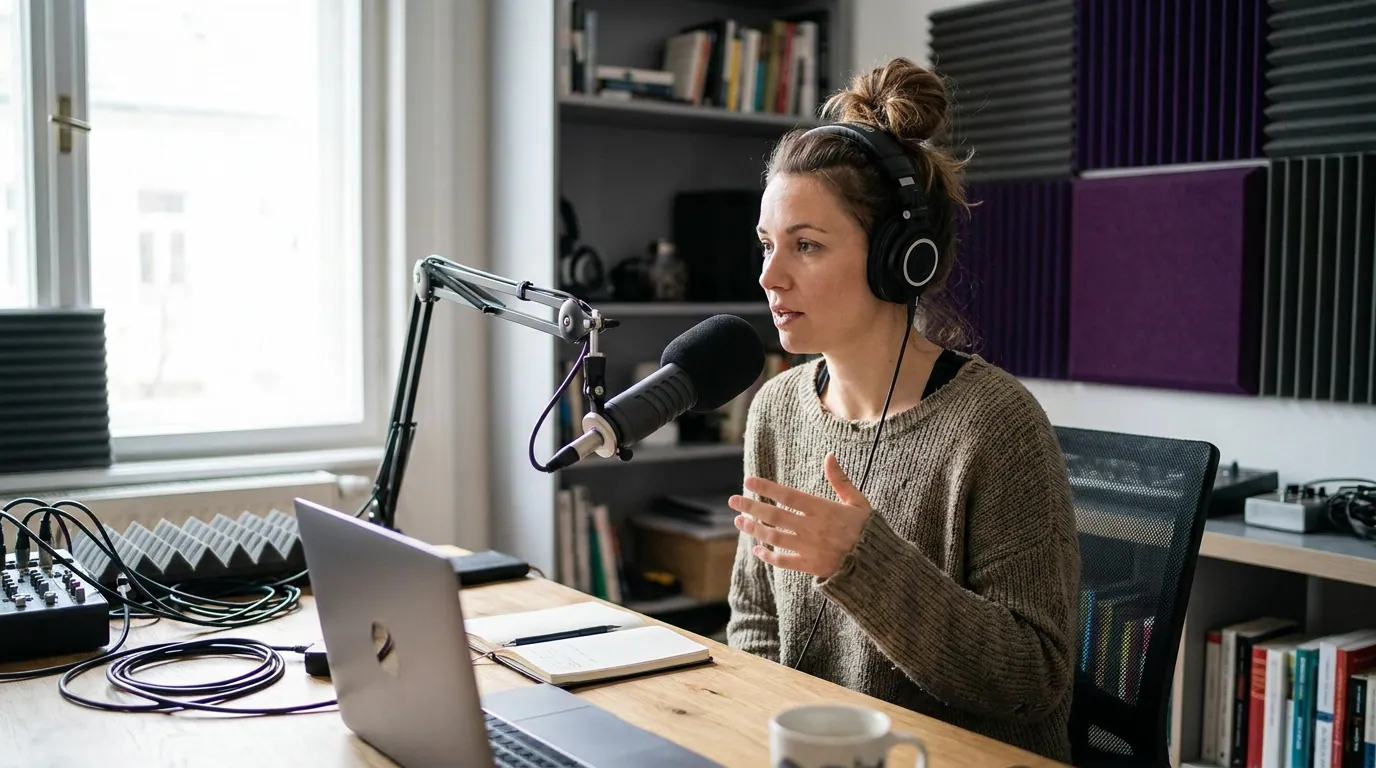
Why "soundproof foam" is the most expensive mistake in podcasting
The foam wedges you see in every studio photo are absorbers. They reduce reflections inside the room and do nothing measurable to stop sound passing through a wall. The metric that describes what foam does is NRC, Noise Reduction Coefficient, a 0-to-1 score of how much sound a surface absorbs rather than reflects (GLT Products). Foam scores well on NRC, which is exactly the point: it is built to soak up reflections, not to seal a room.
The metric for blocking is a different one entirely: STC, Sound Transmission Class, which rates how well a barrier stops sound from passing through it (GLT Products). Here is the part the foam listings bury: covering a wall with foam does not raise that wall's STC. The wall blocks exactly as much sound as it did before you spent the money. Foam is porous; sound walks straight through the pores (Acoustical Solutions).
A clean rule that holds every time you read a product page:
If the listing only shows an NRC rating, it only absorbs, it does not block, no matter what the marketing says. STC means blocking. NRC means absorbing.
So when someone glues two-inch foam over a shared apartment wall hoping to silence the neighbor's subwoofer, the foam does nothing for that problem, the bass passes through untouched (Soundproof Your Studio). The myth in one line: foam is an absorber, not a wall.
If your problem is echo: acoustic treatment, cheapest first
This is the common case, and the good news is that the cheapest fixes work best. Treatment is about adding soft, absorbent mass to the hard surfaces that reflect sound. You do not need to buy branded panels to start. Ranked by value:
- Record in the smallest, most furnished room you have. A bedroom with a bed, a wardrobe of clothes, and a rug already has more absorption than a bare living room. A clothes closet is the single best free vocal booth in most homes, soft on every side. Cost: nothing.
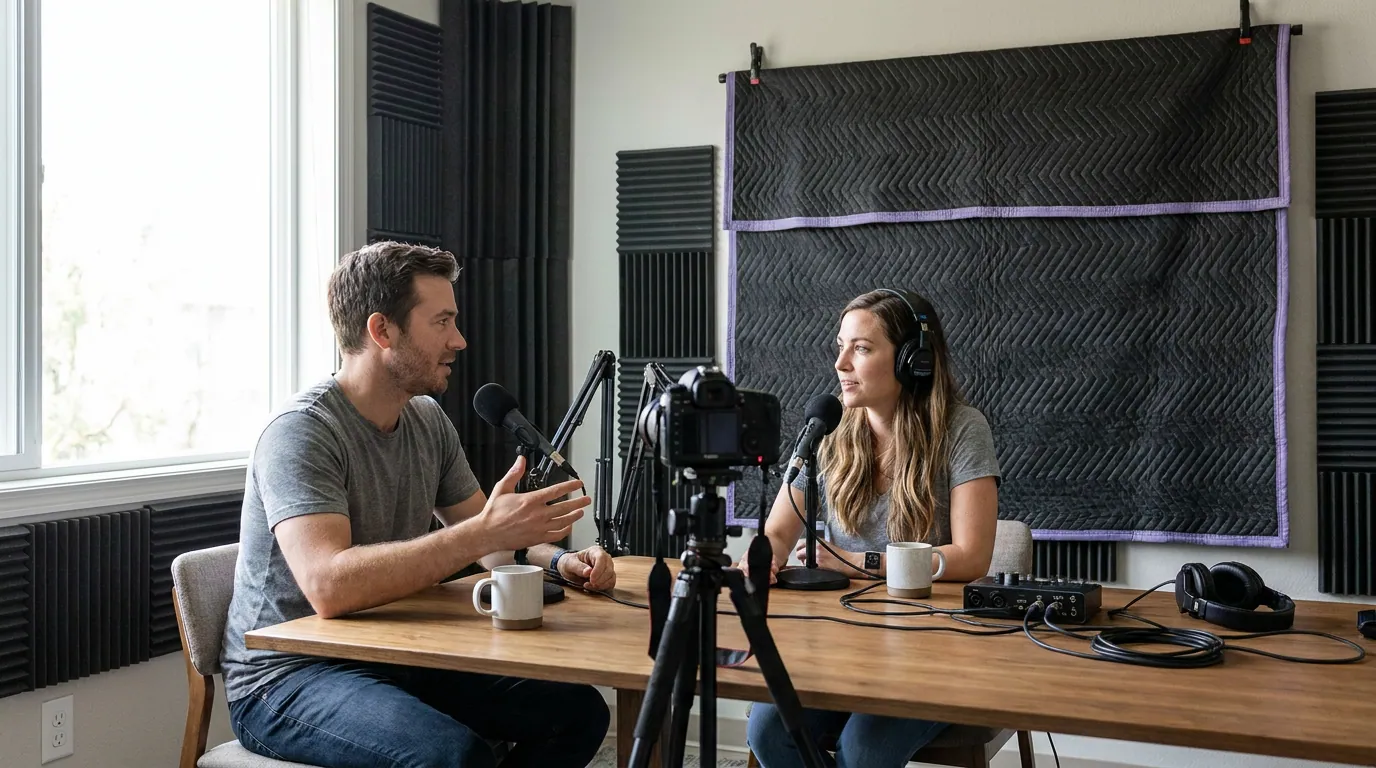
- Hang a thick moving blanket behind and in front of you. A heavy furniture blanket on a stand or a curtain rod kills reflections at the spot a microphone hears most. Two of them, front and back, beat a wall of thin foam. Cost: roughly the price of one foam pack, often less.
- Aim the soft stuff at the worst reflection. Bare walls, windows, and flat doors throw sound back. Put a bookshelf, a hung duvet, or an open wardrobe in the line of fire. Cost: nothing if you already own it.
- Then, if you want it tidy, buy real absorption. Fabric-wrapped mineral-wool or fiberglass panels absorb more than foam for the same thickness, and they handle the lower frequencies where voices live far better, foam needs to be much thicker to catch them (SoundAssured). If you buy foam anyway, buy it for looks and convenience, not because it is the best absorber per dollar.
A whole room's worth of echo control sits comfortably inside the $100–$350 one-time equipment tier Ausha pegs for launching a hobby podcast, mic included (Ausha), and the blanket-and-closet version of it costs nothing. Treatment is the rare problem where the free fix is also the right one.
The bigger lever than any of this, though, is the mic itself. A cardioid dynamic used close to your mouth hears your voice and ignores most of the room before any treatment touches it, which is why I treat the mic choice as part of the acoustics, not separate from it. The full breakdown is in the best podcast mic for a bare, untreated room, and the wider equipment map is in best podcast mics by budget tier.

If your problem is outside noise: soundproofing, and why it is hard
Blocking sound is a different game with different physics, and it is genuinely expensive. Isolation works through three things, and you need all three to matter: mass (heavy material resists sound pressure), decoupling (separating the surfaces so vibration cannot travel through the structure), and airtightness (closing every gap, because sound leaks through air like water) (Acoustical Surfaces). Skip any one and the other two underperform.
Two facts set realistic expectations before you spend:
- Mass-loaded vinyl (MLV), the most common DIY blocking product, only earns its keep when it hangs limp inside a wall assembly, ideally against the studs, then covered with drywall. Stapled or glued flat onto an existing wall, it loses the limp-mass behavior that does the work and reverts to plain mass, which can cut its effectiveness by more than half (Acoustical Solutions).
- The cost-effective serious upgrade is a second layer of 5/8-inch drywall with a damping compound like Green Glue between the layers, a constrained-layer build that takes a standard wall from around STC 40 to STC 52, enough to make normal speech largely inaudible through it (Green Glue Company). That is the difference between hearing a conversation through the wall and not hearing it. It is also drywall, screws, and a weekend of dust.
So the order of operations for real blocking, cheapest first:
- Seal the gaps. Doors, windows, outlets, vents. An acoustic door sweep, perimeter gaskets, and caulk around frames deliver the most blocking per dollar, because sound leaks straight through any unsealed opening, a wall is only as good as its airtightness, so a single gap undoes a lot of the barrier (Acoustical Surfaces). Start here every time.
- Add mass. A solid-core door instead of a hollow one, heavy curtains over a window, MLV layered into a wall. Mass is what physically resists the sound.
- Decouple, if you are committing. Resilient channels or isolation clips that separate the drywall from the studs. This is renovation, not a purchase.
Notice that step one of blocking, sealing gaps, is the only soundproofing move most podcasters should ever make. A sealed solid-core door and a heavy curtain handle the realistic noise (hallway chatter, a bit of street sound) for the price of a hardware-store run. Building a true isolation wall is for people recording next to a subway, and it is a contractor conversation, not a podcast accessory.
When to choose each (and when to choose neither)
- Choose treatment if your recordings sound hollow, boxy, or echoey but you do not actually hear the outside world bleeding in. This is most home podcasters. Do the free version first; only buy panels if the closet-and-blanket approach leaves a problem.
- Choose the cheap end of soundproofing, sealing and a solid door, if you genuinely hear consistent outside noise in your recordings: hallway traffic, a humming HVAC, neighbors through a thin wall.
- Choose serious soundproofing (MLV, double drywall, decoupling) only if you record next to real, loud, unavoidable noise and the show justifies a renovation. For a hobby or a new show, it almost never does.
- Choose neither product if you can record at a quiet time, in a small furnished room, with a dynamic mic held close. That covers a startling number of podcasts. The cheapest acoustic fix is scheduling around the noise and getting closer to a directional mic.
The honest summary: STC keeps the noise out, NRC keeps the noise from bouncing around inside (Acoustical Surfaces). Most podcasters are fighting the bouncing, not the bleeding, and that fight is won with soft surfaces and a closer mic, not a credit card.
How I sorted this
I separated the two problems by the only thing that matters, where the unwanted sound originates, then ranked fixes by cost-to-benefit, lowest first. Every absorption and blocking claim is sourced to a named acoustics reference, and the two metrics are real industry standards, not invented scores: NRC is measured per ASTM C423 on a 0-to-1 scale, STC per ASTM E90 (GLT Products). The dollar ranges are directional, framed against the $100–$350 beginner-setup tier Ausha publishes (Ausha), I avoided quoting product prices I could not tie to a named source, because soundproofing pricing swings hard by region and wall assembly. The one hard STC figure I do cite (a Green Glue wall reaching ~STC 52) comes straight from the manufacturer's published data. Where the right answer for a podcaster was "spend nothing," I said so, even though there is no affiliate link in "hang a blanket."
Frequently asked questions
Is acoustic foam soundproofing?
No. Acoustic foam is sound absorption, it reduces echo and reverb inside a room. It does not block sound from passing through a wall, because foam is porous and sound travels straight through it (Acoustical Solutions). If your goal is to stop a neighbor's noise, foam will not help; you need mass and sealing instead.
How do I block outside noise in my podcast room cheaply?
Seal the gaps first, they leak the most sound for the least money. Add an acoustic door sweep, gasket the door perimeter, and caulk around window frames, because a barrier blocks sound only if it is airtight (Acoustical Surfaces). A solid-core door and a heavy curtain handle most realistic home noise. Building a true blocking wall is a renovation, not an accessory.
Do I need acoustic treatment if I have a good microphone?
Often no. A cardioid dynamic mic used a fist's distance from your mouth records mostly your voice and very little room, which is most of what treatment would buy you. Treatment helps a bad room, but the mic and your distance from it do more, for less, see the best podcast mic for an untreated room.
What is the difference between NRC and STC?
NRC (Noise Reduction Coefficient) measures how much sound a material absorbs inside a room, on a 0-to-1 scale. STC (Sound Transmission Class) measures how well a barrier blocks sound from passing through it (GLT Products). If a product lists only NRC, it absorbs and does not block. If you need to keep noise out, look for STC.
Will treating my room limit my podcast's growth?
No. Audio quality has a floor, and a clean, echo-controlled recording clears it. Beyond that, growth comes from publishing consistently and being discoverable, not from a quieter room. Once your episodes record cleanly, spend your energy on a repeatable format and on getting clips in front of new people, see a repeatable episode structure that keeps listeners and, if you are planning your prep, scripting vs outlining for your show.