
Shure SM7B vs MV7+ vs Cheaper Alternatives


If you want the broadcast sound and you already own a decent audio interface, buy the SM7B, it lists at $439 and sells for around $399, and it may not need a preamp at all on a modern interface. If you want one box that records to your laptop today and to an interface later, buy the MV7+ at about $299. If you want most of that sound for the least money, the Elgato Wave DX at $99 is the honest value pick. The SM7B's real cost is the catch nobody puts on the sticker, and it's the whole reason this comparison exists.
Here's the trap. The SM7B is a low-output mic, its sensitivity is -59 dBV/Pa, and Shure's own user guide recommends at least 60 dB of clean gain for speech three inches from the grille (Shure SM7B specs). For years, the standard fix was a $150 Cloudlifter inline preamp, which quietly turned a roughly $400 mic into a ~$550 setup before you'd added a cable. That "real price" is what most SM7B-versus-MV7+ posts skip, and skipping it gets the recommendation wrong for a lot of people.
SM7B vs MV7+ vs alternatives: the all-in price table
The headline numbers below are mic-only sticker prices, verified in June 2026. The column that matters is the last one: the all-in cost once you add the gain or interface each mic actually needs to make a sound. Prices move; re-check before you buy.
| Mic | Mic-only price | Realistic all-in cost |
|---|---|---|
| Shure SM7B (XLR) | ~$399 (list $439) | ~$399–$589 (interface; +$150 if you add a Cloudlifter) |
| Shure SM7dB (XLR, built-in preamp) | ~$499 | ~$499 (no preamp needed; still needs an interface) |
| Shure MV7+ (USB-C + XLR) | ~$299 | ~$299 (USB to laptop, nothing else required) |
| Elgato Wave DX (XLR) | ~$99 | ~$199 (needs an interface; +$0 preamp on a good one) |
| Rode PodMic USB (USB-C + XLR) | ~$199 | ~$199 (USB, onboard processing) |
Sources: SM7B sells ~$399, list $439 (Sweetwater); SM7dB $499 MSRP (Shure); MV7+ ~$299 at Sweetwater ($319 list), discounted to ~$270 on sale (Sweetwater); Wave DX $99.99 (Elgato); Cloudlifter ~$150 (Musician Wave); Rode PodMic USB ~$199 list, often ~$180 street (Rode).
The thing the table shows that the spec sheets don't: the SM7B-versus-MV7+ gap is not a fixed $100. If you already own a capable interface, the SM7B is about $100 more; add a Cloudlifter and it costs nearly double the MV7+, depending entirely on what you already own and whether you fall for the Cloudlifter upsell.
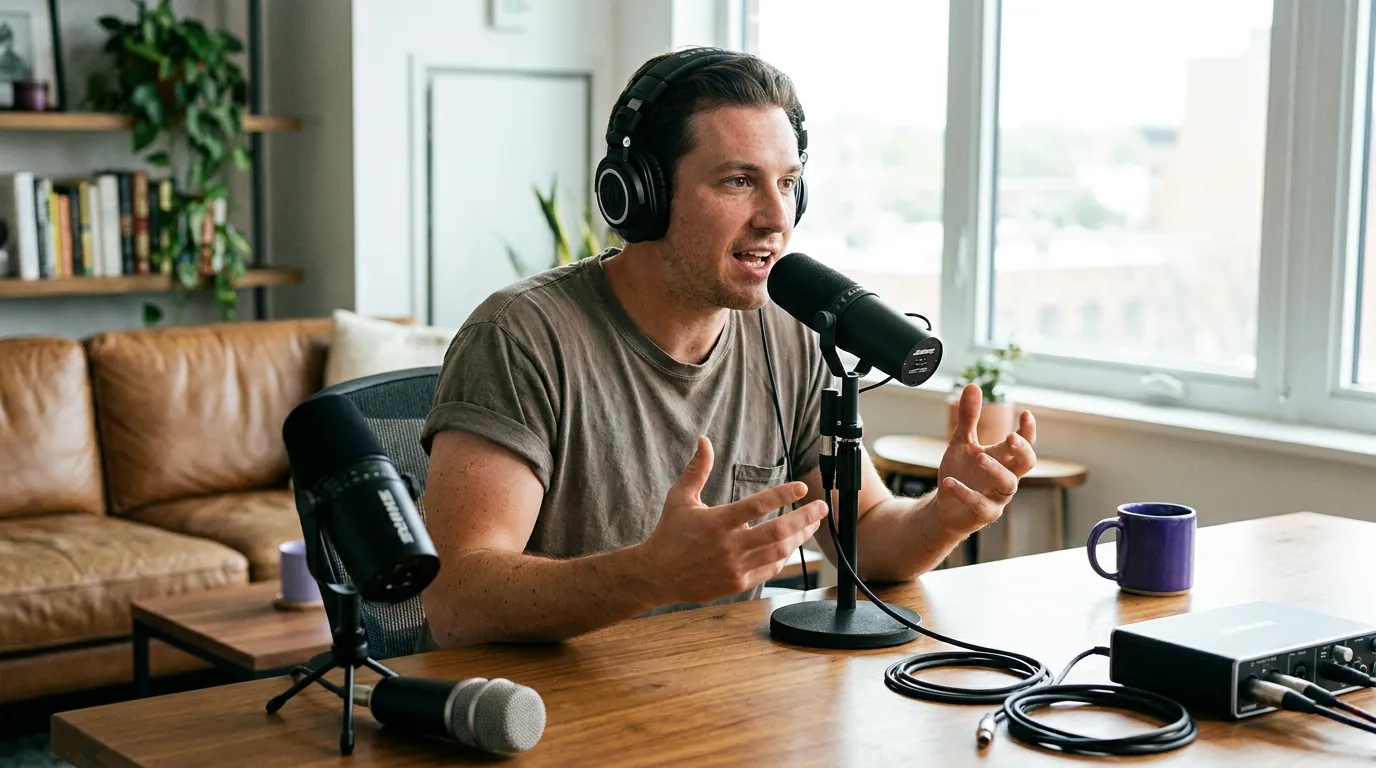
Do you actually need a Cloudlifter for the SM7B?
Probably not, if your audio interface was made after 2022 and cost more than about $150. The Cloudlifter solves one problem: weak preamps that can't deliver clean gain at the SM7B's high level. Most interfaces released in the last few years already provide 60+ dB of clean gain, which is enough on its own. The $150 preamp became a reflexive purchase long after the problem it fixes mostly went away.
Here is the honest test, drawn from how the SM7B's gain requirement actually works (AudioForge Pro, "the Cloudlifter trap"):
- Find your interface's max gain in its spec sheet. The SM7B needs roughly 60 dB of clean gain to reach a usable level, so check that your interface can deliver at least that much before the preamp starts hissing.
- If your interface is post-2022 and cost over ~$150, you almost certainly clear that bar. Plug the SM7B straight in, no preamp.
- If your interface is from 2018 or earlier, or an ultra-budget model, you'll be cranking gain into hiss. A Cloudlifter (~$150) or a smaller FetHead (~$75–$100) fixes it, the FetHead even mounts straight onto the mic, so you skip the second XLR cable (Musician Wave).
- Or skip the question entirely with the SM7dB, the same mic with a switchable +18/+28 dB preamp built in, for about $499. You pay once and never think about gain again, and it actually undercuts buying an SM7B and a Cloudlifter separately.
The contenders, reviewed honestly
Each entry gets a real con. A mic roundup with no downsides is an ad, not a review.
Shure SM7B, the icon, if you're already set up
Best for: podcasters who own a capable interface and want the broadcast standard.
The SM7B earned its reputation. It's the mic on a wall of famous studio podcasts, it rejects room noise beautifully thanks to its dynamic capsule and internal shock mount, and the foam-and-windscreen design forgives plosives. Up close, in a bare room, it sounds like radio. That's not marketing; that's what a low-sensitivity dynamic with good shielding does.
The con: the all-in cost and the gain dependency. On the wrong interface it sounds thin and hissy, and people blame the mic when it's the chain. You are also buying into XLR, you need an interface, two cables, and a boom arm strong enough to hold a heavy mic. None of that is plug-and-record. If you don't already have an interface you trust, the SM7B is the most expensive way into good sound on this list.
Shure SM7dB, the SM7B that fixed its own problem
Best for: people who want the SM7B sound with zero gain headaches and will keep it for years.
The SM7dB is the SM7B with a switchable preamp baked in (+18 or +28 dB, drawing standard 48V phantom power). It removes the single biggest friction point of the original, you can run it off almost any interface without a Cloudlifter or a noisy gain chain (Shure SM7dB). For its $499 MSRP, you've solved the gain question permanently and you're done shopping.
The con: $499 is real money, and it's still XLR-only. But if you were going to buy a Cloudlifter anyway, the SM7dB is the obvious spend, at $499 it costs less than an SM7B (~$399) plus a Cloudlifter (~$150), with fewer cables and a cleaner result. If your interface already drives a plain SM7B fine, the SM7dB is paying ~$100 to solve a problem you don't have.
Shure MV7+, the hybrid that grows with you
Best for: solo podcasters who want to record to a laptop today and to an interface later, from the same mic.
The MV7+ is the practical answer to the SM7B's friction. It's a dynamic mic with both USB-C and XLR outputs, so on day one you plug it into your laptop and record, no interface, no preamp, no gain math. It adds onboard DSP (auto-level, a real-time denoiser, a digital pop filter), a headphone jack for live monitoring, and an LED touch strip, all controllable from Shure's MOTIV Mix app (Sweetwater). At around $299 (and often near $270 on a sale) it's the lowest-friction path to Shure dynamic sound. For the trade-offs that come with any hybrid USB/XLR mic, it's worth understanding the connection type before you commit.
The con: it doesn't quite match the SM7B's top-end richness, and the DSP is a double-edged sword, auto-level and denoise are great until they over-process a quiet voice or pump on a loud laugh. Purists turn the processing off and treat it as a plain dynamic, at which point you're paying partly for software you don't use. It's an excellent mic; it is not the SM7B with a USB port.
Elgato Wave DX, the value pick that gets ignored
Best for: podcasters on a real budget who want dynamic sound and already have, or will buy, a basic interface.
At $99, the Wave DX is the honest value play this comparison is built to surface. It's a dynamic XLR cardioid mic with a capsule developed with Lewitt Audio, a built-in pop filter, and, critically, enough output that it needs no signal booster on a normal interface (Elgato). It rejects room noise like a good dynamic should and sells for a third of the SM7B's price. For an untreated bedroom or office, it punches far above its cost.
The con: it's XLR-only and ships nearly bare, no cable in the standard box, no stand, no interface. So the "$99 mic" is really a ~$199 setup once you add the interface and cable it requires, which is still the cheapest dynamic path here but not the $99 the listing implies. It also doesn't carry the SM7B's resale value or studio cachet, if those matter to you.
Rode PodMic USB, the other hybrid worth knowing
Best for: podcasters who want hybrid USB/XLR and onboard processing for under $200.
The PodMic USB is Rode's answer to the MV7+: USB-C and XLR outputs, an internal pop filter and shock mount, and APHEX DSP (noise gate, compressor, high-pass, Aural Exciter) running on the mic's own chip via Rode Central (Rode). At ~$199 list, it undercuts the MV7+'s $299 by $100 while offering the same record-to-laptop-or-interface flexibility.
The con: the processing lives in software you have to set up once, and the in-box accessory situation is leaner than budget rivals. It's a strong mic, but it sits in the MV7+'s shadow on brand recognition, and for a first-time buyer the MV7+'s app polish is a touch friendlier.

How we evaluated
We compared these mics on the factors that change a first-time buyer's outcome, not the ones that fill a spec sheet:
- All-in cost to a working signal, not mic-only sticker price, the central lens of this guide.
- Gain dependency: does it need a preamp, an interface, or nothing, and what does that add?
- Connection type and day-one friction: can you record to a laptop, or do you need a full chain first?
- Room forgiveness: all five are dynamic mics, so all reject background noise well, that's why they're the shortlist for the untreated rooms most podcasters record in.
- Honest downside: every entry names a real con.
We verified pricing in June 2026 against Sweetwater, Shure, Elgato, and Rode, plus the gain sources cited inline; hardware list prices hold steadier than software subscriptions, but retail discounts move, so confirm before buying. The audio-quality judgments reflect the consensus across the cited reviews plus the physics of dynamic capsules, not a blind A/B we'd ask you to take on faith. A useful frame from the equipment literature: the gap between a $150 and a $1,500 setup is smaller than the gap between bad mic technique in a noisy room and good technique in a treated one (Ausha).
Is the SM7B worth it for podcasting?
Worth it for the right buyer, overkill for most beginners. If you already own a capable interface, want the broadcast sound, and plan to record for years, the SM7B at ~$399 is a justifiable, durable buy, and on a modern interface you can skip the Cloudlifter entirely. If you're starting out, don't own an interface, and want to be recording this week, the SM7B's all-in cost and setup make it the wrong first mic. The MV7+ or Wave DX gets you 90% of the result for a fraction of the friction.
The mic matters less than what you do after you press record. Shows that publish on a steady schedule tend to outlast shows that chase perfect audio, and a setup you fight every week is a setup you abandon. Buy the mic that makes recording boring and repeatable, then put your energy into a repeatable episode structure and the right prep, scripting or outlining for your show.
Verdict: who should buy what
- Already own a good interface, want the icon: SM7B (~$399, often no preamp needed).
- Want the SM7B sound with zero gain hassle: SM7dB (~$499, cheaper than SM7B + Cloudlifter).
- Solo host who wants to record today and grow into XLR: MV7+ (~$299).
- Tightest budget, willing to add a basic interface: Elgato Wave DX (~$199 all-in).
- Want a hybrid for under $200 with onboard processing: Rode PodMic USB (~$199).
Match the mic to your budget and your room with our mics-by-budget-tier guide, or if you're weighing the connection itself, read USB vs XLR, which to buy and when to switch. The "best" mic on this list is the one that fits the chain you already have.
FAQ
Is the Shure SM7B worth it over the MV7+?
Only if you already own a capable audio interface and want the broadcast sound for the long haul. The SM7B costs ~$399 mic-only and needs an interface; the MV7+ costs $299 and records to a laptop with nothing else. For most new podcasters, the MV7+'s lower friction wins. The SM7B's edge is a richer top end, not a night-and-day gap.
Do I really need a Cloudlifter with the SM7B?
Usually not anymore. If your audio interface is from after 2022 and cost more than about $150, it almost certainly provides the 60+ dB of clean gain the SM7B needs on its own (AudioForge Pro). A Cloudlifter (~$150) or smaller FetHead (~$75–$100) only earns its place on older or ultra-budget interfaces that run out of clean gain.
What's the cheapest mic that sounds close to the SM7B?
The Elgato Wave DX at $99 is the strongest value pick. It's a dynamic XLR mic developed with Lewitt Audio that needs no signal booster on a normal interface (Elgato). Budget the full setup, though, with an interface and cable it's about $199, still the cheapest dynamic path on this list.
Does the MV7+ need an audio interface?
No. The MV7+ has a USB-C output, so you plug it straight into a computer and record with no interface, no preamp, and no extra cables. It also has an XLR output, so you can move it onto an interface later without buying a new mic, that flexibility is the whole point of a hybrid.
Will a better mic make my podcast clips sound better on social?
It improves your source audio, which survives platform compression better, but room and technique matter more. A close-mic'd dynamic in a quiet spot beats an expensive mic in an echoey room every time. Clean source audio gives you cleaner clips for social, and clips are how most new listeners find a show in the first place.