
Do Podcast Transcripts Help SEO? What Actually Indexes

Transcripts help SEO, but only when they live on a web page you control and you treat them as content, not a dump. A crawler can't hear audio, text is the only part of your episode it can read. Two catches most guides skip: the transcript inside Apple or Spotify does nothing for Google, and a raw, unedited dump loses to a cleaned one on the exact signals that decide rankings.
That last point is where almost every "add a transcript and rank higher" post goes wrong. More words is not the lever. A transcript only earns rankings when it reads like a page a human would want to stay on. Below is what each platform actually does with your transcript, the three separate jobs a transcript does (only one of which is Google SEO), and a tested way to publish one that helps instead of quietly hurting.
Do podcast transcripts help SEO?
Yes, a transcript on your own episode page gives Google thousands of crawlable words it would otherwise never see, letting a 30-minute episode rank for long-tail phrases your title could never cover. But it has to sit on an indexable HTML page, structured like content and cleaned of filler. A raw dump under a player rarely ranks.
The mechanism is simple once you separate it from the hype. Search engines index text, not sound. Your episode might contain the single best explanation on the internet of a niche question, and Google has no idea, because the answer is locked inside a 45-minute audio file (Descript). A transcript exposes that text, but where you put it, and how you format it, decides whether it does anything.
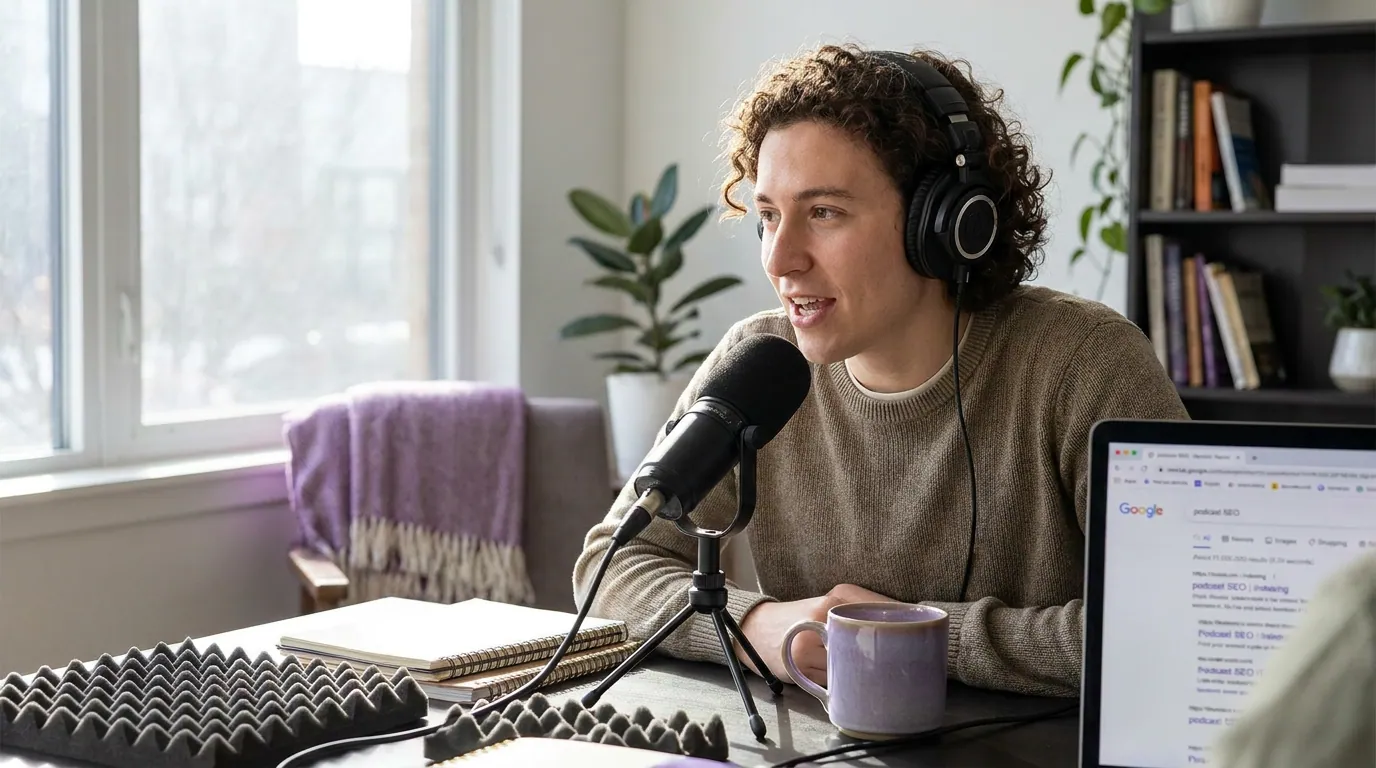
The three jobs a transcript does, and only one is Google SEO
Here is the distinction that fixes most confusion. A transcript can land in three completely different systems, and they have nothing to do with each other. Most "transcripts for SEO" advice blurs all three into one promise. They are separate engines with separate rules.
1. Google's web index (this is SEO). A transcript on a page you own, your site, your episode page, is crawlable text Google can rank. This is the only one of the three that affects your search rankings, and it only works if the page is indexable and readable. Get this right and a single episode can surface for dozens of spoken phrases.
2. Spotify's internal index (discovery, not SEO). Spotify auto-generates a transcript for new episodes and uses it to understand what your show is about. In Spotify's own words, transcripts "help Spotify understand and catalog your content at a deeper level," powering recommendations that match listeners to "the hyper-relevant topics and moments inside your episodes, not just the title and description" (Spotify for Creators). That helps you get recommended inside Spotify. It does nothing for Google. Spotify never mentions external search.
3. Accessibility. A transcript lets Deaf and hard-of-hearing listeners read your episode, and lets anyone Ctrl+F a moment they half-remember. This is a real audience and a real reason to publish, separate from any ranking benefit. Treat it as the baseline reason, not a bonus.
The practical takeaway: if your only transcript lives inside Spotify or Apple, you have job #2 and #3 covered and zero Google SEO. To get the SEO, the words have to be on a page Google can crawl.
How to publish a transcript that actually ranks
A transcript helps Google only when the page passes the same bar as any other content. These are the steps in order, and most of the work is in the last three.
- Put it on a dedicated episode page on a domain you own. Not a hosting platform's auto-page, not buried in a podcast app, a real URL with its own title, meta description, and show notes (Descript). One episode, one page, one keyword focus.
- Render the text in the HTML, not behind a click. If the transcript only loads when someone taps "expand," or only appears via JavaScript after the page loads, a crawler may never see it. Show meaningful transcript text by default; use collapsible sections cautiously and make sure the words exist in the page's source (Descript).
- Structure it like an article. Break the wall of text into sections under H2/H3 subheadings that match how people search. Add paragraphs, the occasional bolded takeaway, and timestamps. A structured page is one Google can parse and a human will actually read.
- Clean it before you publish. Remove "um," "uh," "you know," fix the proper nouns the AI mangled, and cut repeated intro/outro boilerplate that would otherwise read as duplicate content across every episode. This is the step the next section is built around, because it is the one that decides whether the page helps or hurts.
- Link it into your site. Connect each episode page to related episodes and to your pillar pages so the transcript isn't a dead-end. Internal links are how Google understands a transcript page is part of a topic, not an orphan.
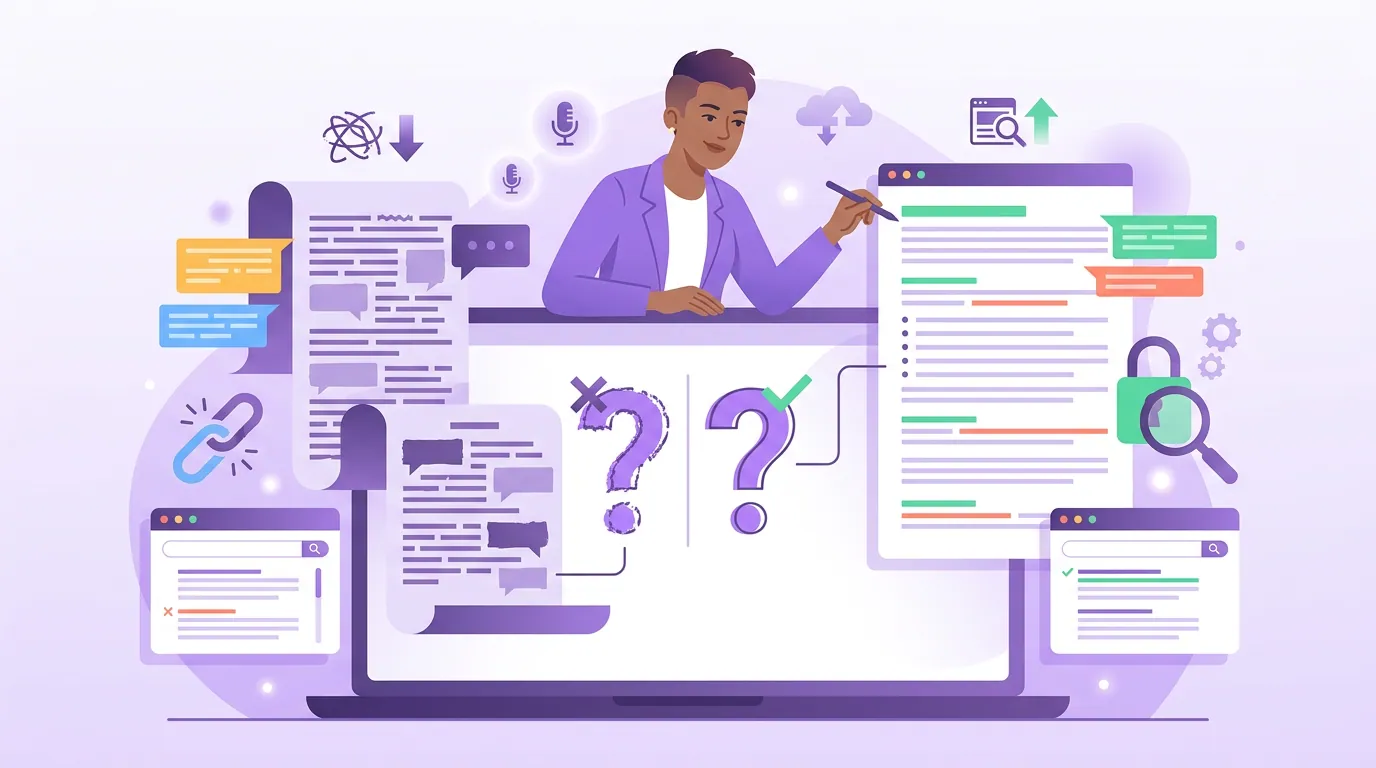
The myth: does a raw transcript dump rank better than an edited one?
No. The opposite is usually true. The "more words = more keywords = better rankings" logic ignores that Google measures behavior, not word count. A raw dump full of filler, errors, and unbroken text creates a page people leave fast, and that short dwell time tells Google the page didn't help, which pushes it down (Speechpad).
Three concrete reasons the raw dump underperforms an edited page:
- Filler pollutes your keywords. Spontaneous speech runs roughly 4–10% filler, "um," "uh," "like" (Stanford GSB), and an auto-transcript prints every one of them. Someone searching "best CRM for startups" won't match a page that reads "um the best like CRM uh for you know startups"; the filler turns clean phrases into nonsense long-tail strings nobody queries (Speechpad).
- Errors damage credibility and confuse the page. Auto-transcription still misfires on jargon, names, and brands, "cease the data" for "seize the data," "A Refs" for "Ahrefs." Left in, those wrong words introduce irrelevant keywords and make the page read as careless (Speechpad).
- A wall of text kills dwell time. Eight thousand words with no headers, no paragraphs, no formatting is something people bounce off in seconds. Readable structure keeps them on the page, and that is a signal Google rewards (Speechpad).
The honest caveat: you don't need a publishable-essay edit. A light cleanup, strip filler, fix names, add headers, captures most of the benefit. Reserve heavy editing for evergreen episodes you expect to pull search traffic for years. For a back catalog of fifty episodes, "good enough and structured" beats "perfect on three pages and nothing on the rest."
One more thing worth saying plainly: AI-generated transcripts are fine. Google does not penalize content for being machine-produced, it judges intent and value, and the March 2024 scaled-content-abuse policy targets pages made at scale with no value, not the tool that made them. A cleaned AI transcript on a useful page is value. A thousand raw dumps published to game search is the pattern that gets deindexed.
Common mistakes that waste the effort
Most transcript-SEO failures come from one of these five. Each has a one-line fix.
- Transcript lives only in Apple or Spotify. That's discovery and accessibility, not Google SEO. Fix: publish the words on your own episode page too.
- Pasting the raw export. Filler and errors drag the page down. Fix: a 10-minute cleanup pass before publishing.
- No structure. A text block with no headings is unreadable and unrankable. Fix: H2/H3 sections that match search phrasing, plus timestamps.
- Same boilerplate intro/outro on every page. Identical openings across episodes read as duplicate content. Fix: vary them or exclude boilerplate from the indexed text.
- The transcript is the whole page. A transcript with no title, no meta description, no internal links, and no show notes that rank on Google is a media player, not an SEO page. Fix: build the page like any other piece of content.
Where transcripts fit in your wider discovery plan
Transcripts are a long-tail, evergreen play, they win slow, ranking for the specific spoken phrases nobody else targets. They pair with the faster discovery levers rather than replacing them. The titles people click and the topics platforms surface still do the heavy lifting up front: get the episode titles that get found right, then let the transcript catch the searches your title can't.
Match the transcript to where you're trying to be found. For Google web search, the on-page transcript is the engine. For Spotify's own search and recommendations, lean into Spotify podcast SEO and turn its auto-transcripts and topic tags on. For the in-app charts, neither transcript helps much, how Apple Podcasts search ranking actually works runs on follows and listening velocity, not text. Three engines, three plays.
And the people who eventually find a transcript page are worth keeping. A reader who searched a niche phrase and landed on your episode is a high-intent visitor, give them a reason to stay. Put a podcast email list capture on the page and a welcome sequence behind it, so a one-time search visit turns into a subscriber instead of a bounce.
FAQ
Do podcast transcripts help you rank on Google? Only when the transcript is published on a crawlable web page you own, structured like an article, and cleaned of filler. A transcript that lives only inside Apple or Spotify gives you zero Google ranking benefit, Google can't crawl those apps (Descript).
Does adding a transcript to Spotify help SEO? Not Google SEO. Spotify uses transcripts for its own internal recommendation engine, to understand your topics and guests and surface you to the right listeners on the platform (Spotify for Creators). That's valuable for Spotify discovery, but it's a separate system from web search.
Is a raw auto-transcript good enough, or do I need to edit it? Edit it, at least lightly. Raw transcripts print every filler word and carry name and jargon errors, which pollute your keywords and hurt dwell time, both of which lower rankings (Speechpad). A 10-minute cleanup plus headers captures most of the SEO benefit.
Will Google penalize an AI-generated transcript? No. Google judges intent and value, not the tool. The scaled-content-abuse policy targets mass-produced, value-less pages, not AI assistance (Google spam policies). A cleaned AI transcript on a genuinely useful episode page is fine.
How long should I spend editing each transcript? For most episodes, 10–15 minutes: strip filler, fix names, add subheadings and timestamps. Reserve a heavier edit for evergreen episodes you expect to pull search traffic for years. Don't perfect three pages while fifty stay untouched.
Can listeners find anything by searching a transcript? On your own page, yes, readers can Ctrl+F the text. Inside Spotify, the in-app transcript search is limited; the usable workaround is the web player plus your browser's find function. Either way, that's an accessibility and listener-experience win, separate from ranking.