
Making a Podcast Trailer That Actually Converts


A podcast trailer that converts does one job: it makes a stranger tap Follow or Play in the next sixty seconds. It does that by selling the listening experience, the feeling, the payoff, the specific thing they'll get, not by reciting the show's name, host, and category. Build it on four beats: promise, proof, taste, ask. Keep it to 30–60 seconds. Lead with the most arresting moment you have.
Most trailers do the opposite. They open with "Welcome to the show," explain who the host is, describe the format, and end with a polite "available wherever you get your podcasts." That's a table of contents, not a pitch. A stranger who hears it learns about your show and feels no urgency to actually press play. The fix is a structure that treats the trailer as a sales argument with a sound design.
What makes a podcast trailer convert?
A trailer converts when it gives a stranger a concrete reason to commit before they get bored, usually within the first 5 to 10 seconds. That reason comes from one clear promise, fast proof you can deliver it, a real taste of the show at its best, and a single specific ask. Everything else costs you the tap.
The distinction that matters: describing the show is about you; selling the listen is about them. "We talk to founders about building companies" is a description. "If you've ever wondered why a profitable company can still run out of cash, the next episode breaks it down in twelve minutes" is a sell, it names the listener's question and promises the payoff. Same show. Completely different conversion rate.
This matters more than it used to because discovery has moved to feeds. 57% of listeners now rely on social media for podcast recommendations, just ahead of friends and family at 54% (InsideRadio, "The State of Video Podcasting 2025"). Your trailer rarely plays inside a quiet podcast app anymore. It plays as a clip mid-scroll, competing with everything else on the feed, where the first three seconds decide whether anyone hears the fourth, castmagic calls those opening seconds "absolutely critical for social media success" (castmagic).
The four-part conversion structure: promise, proof, taste, ask
Build every trailer on these four beats in order. Each has a job, and skipping one is where trailers leak listeners.
1. Promise (first 5–10 seconds). Open on the single most compelling thing your show offers a listener, stated as their benefit. Not "this is a podcast about marketing", instead, "every week, one marketing experiment that worked, broken down so you can copy it by Monday." Lead with a real clip of tension or a sharp line if you have one; a cold open beats narration. This beat alone decides whether the rest gets heard.
2. Proof (5–10 seconds). Give one fast reason to believe the promise. A named guest, a credential, a number, or a specific result. "Guests have included a YC founder and a former Google PM" or "we've shipped 80 episodes and never once padded for time." Proof doesn't need to be impressive in the abstract, it needs to be specific enough to feel true.
3. Taste (10–20 seconds). Play an actual moment from the show at its sharpest: a laugh, a surprising fact, a moment of genuine tension. This is the test drive. Scripted narration can't sell a listening experience the way 12 seconds of the real thing can. Pull the best 10–20 seconds you've ever recorded; if you're pre-launch, record one strong exchange specifically for this.
4. Ask (around 5 seconds). One action, stated plainly. "Follow [show] in your podcast app so the first episode lands automatically." Not three options. Not "rate, review, subscribe, and tell a friend." Decision fatigue kills conversion, pick the single next step that matters most (for a new show, that's Follow) and ask for only that.
Why most trailers fail: they describe instead of sell
Most trailers fail because they're written as an introduction to a host rather than a pitch to a stranger. They answer "what is this show?" when the listener is silently asking "why should I give you my time?" Those are different questions, and the second one is the only one that converts.
Here's the same trailer written both ways, line by line.
Three patterns separate the columns. The describe version opens with a greeting; the sell version opens with the listener's question. The describe version talks about the host; the sell version talks about what the listener gets. And the describe version offers a passive availability note; the sell version asks for one concrete action with a reason attached. Steal those three moves and your trailer is already most of the way there.
How long should a podcast trailer be?
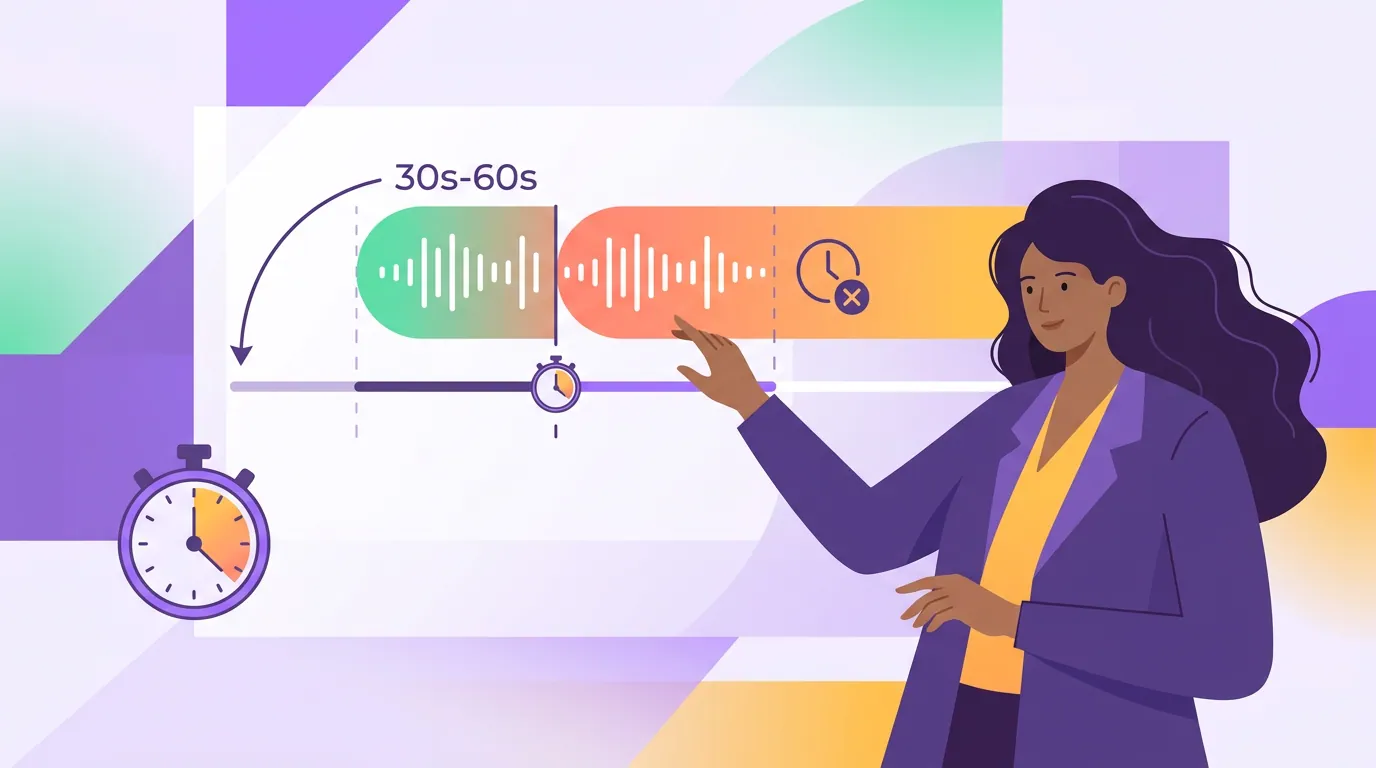
Aim for 30–60 seconds, and treat 90 seconds as a hard ceiling. That band is long enough to land all four beats and short enough to finish before attention drops. For a trailer posted to a social feed, where most discovery now happens, bias toward the shorter end, since feed audiences bail faster than app browsers.
One caveat worth saying out loud: this is an editorial guideline, not a measured benchmark. There's no public dataset that proves "57-second trailers convert 12% better." The 30–60 range comes from how attention behaves on feeds, where the opening seconds are decisive (castmagic), not from a study you can cite. If your show is narrative or atmospheric, a slightly longer trailer that's genuinely gripping beats a rushed 30-second one. Length serves the four beats; it isn't a rule for its own sake.
The fill-in trailer script
Use this template to draft your first trailer in one sitting. Read it aloud and time it; if you're over 60 seconds, cut the proof line first, then tighten the taste.
[Promise, open cold, no greeting] "[Name the listener's exact question or the tension your show resolves.]" [Bridge, one line] "On [show name], [what the show does for them, stated as their benefit]." [Proof, pick one] "[A named guest / a number / a specific credential or result.]" [Taste, a real recorded clip] [Drop in the single best 10–20 seconds you've recorded: a laugh, a surprising fact, a sharp exchange. Don't narrate over it.] [Ask, one action, with a reason] "Follow [show name] now so the first episode lands automatically on [day]."
A worked example for a business show, around 45 seconds: "Why do profitable companies run out of cash? On The Margin, we break down one money decision a week so you can spot the trap before it hits you. Last episode, a founder walked through the month payroll almost didn't clear, [12 seconds of that clip], Follow The Margin now; the next breakdown drops Tuesday." Four beats, one ask, under a minute.
Common trailer mistakes (and the fix)
- Opening with a greeting. "Hey everyone, welcome" is dead air on a feed. Fix: open on the promise or a cold clip; introduce yourself only if the proof beat needs it.
- Stacking the ask. "Rate, review, subscribe, share, join the newsletter" splits attention and converts none of it. Fix: ask for one action. For a new show, make it Follow.
- Narrating instead of showing. Telling a stranger the show is "funny and insightful" proves nothing. Fix: play 12 seconds that are funny and insightful. Let the taste do the work.
- Burying the trailer. A great trailer that only lives in your feed's "trailer" slot reaches almost no one, and social is now where most listeners find shows (57% rely on it for recommendations). Fix: cut it into a captioned vertical clip and post it where discovery happens. Burn the captions in, a feed-scrolled trailer is often heard with the sound off, and a silent trailer with no words on screen sells nothing.
- Treating it as one-and-done. A trailer isn't a launch artifact you record once. Fix: refresh it every quarter or when you land a standout guest, and run two openings against each other to see which earns more follows.
FAQ
How long should a podcast trailer be? Aim for 30 to 60 seconds, with 90 as a hard ceiling. That's enough time to land a promise, proof, taste, and ask without losing the listener. For trailers posted to social feeds, bias shorter, feed attention drops faster than it does inside a podcast app.
What should a podcast trailer include? Four beats in order: a promise that names the listener's payoff in the first 5–10 seconds, fast proof you can deliver it, a real recorded taste of the show at its best, and one clear ask. Skip the greeting, the format rundown, and the multi-part call to action.
Do I need a trailer before I launch? Yes, a trailer published a week or two before episode one lets early followers' apps auto-download your first episode the moment it drops, which front-loads your launch-day numbers. Even a 40-second trailer beats launching cold with nothing for people to follow.
Should the trailer be the same as my intro? No. Your episode intro orients existing listeners; the trailer pitches strangers. The intro can be warm and a little slow; the trailer has to earn the next tap in seconds. Write them separately.
Where should I share the podcast trailer? Set it as the trailer in Apple and Spotify, then cut it into a captioned vertical clip for your social feeds, where most new listeners now discover shows. If you're spending on promotion, the trailer clip is usually what you put behind it, see when paid podcast promotion is actually worth it and what it costs to buy a podcast listener before you boost anything.
Where the trailer fits in your growth plan
A trailer is the conversion step at the end of every discovery channel. People find you through a clip, a cross-promo, a guest spot, or an ad, and the trailer is what turns that attention into a follow. Get the four beats right and the rest of your growth spend works harder, because the thing it points to actually converts.
That's why it pays to wire the trailer into the channels around it. Use it inside feed cross-promotion with other shows, put it where browsers find you on Overcast and other apps, and route new followers toward something you own by starting a podcast email list from zero and greeting them with a five-email welcome sequence. The trailer earns the tap; those channels make the tap compound.