
Podcast Guesting as a Lead Generation Channel


Podcast guesting becomes a lead channel only when you can trace a closed client back to a specific appearance. Build the loop: give one memorable spoken call to action, send listeners to a per-show landing page you can measure, score which shows produce buyers versus listeners, and compare your cost-per-lead against the ads you'd otherwise run. Without that loop, guesting is brand awareness you can't bill against.
Most founders treat a guest spot as a win the moment the episode publishes. It feels productive. But "I was on a podcast" is not a lead, and a download count is not a buyer. The channels that survive a budget review are the ones with a number next to them. This guide is about putting that number next to guesting, the measurement scaffolding, the qualification rule, and the math, so you can decide whether it earns a place in your pipeline or not.
Why guesting works as a channel at all
Guesting borrows the host's trust. When someone who already has the audience's attention hands you the mic for 40 minutes, you arrive pre-endorsed in a way no ad creative can match. That matters more than it used to, because discovery has moved to the exact surfaces where a guest spot lives: 57% of listeners now rely on social media for podcast recommendations, more than friends and family (Inside Radio). A clip of your best answer keeps working long after the episode drops.
There's also a fit between guesting and how B2B buyers actually decide. The audiences for niche business shows are small but dense, exactly the people you'd pay a premium to reach with ads. And listeners do act on what they hear: in one survey, 28% of people made a purchase after hearing a brand on a podcast (Veritonic 2024, via The Podcast Host). The catch is that the channel only pays out if the listener has somewhere obvious to go, and you can see them go there.
The guesting-to-lead funnel
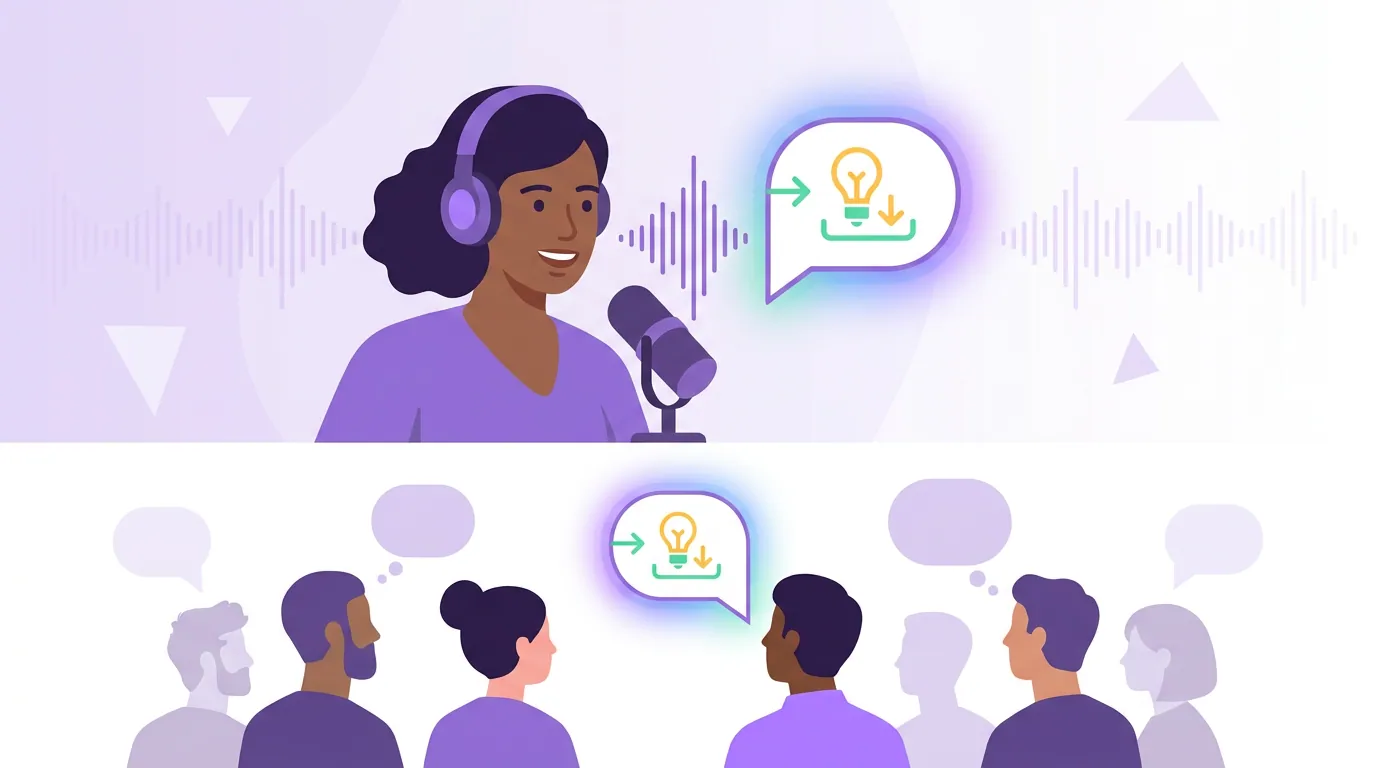
A guest appearance moves a stranger through five stages: they hear you, they remember one action, they take it, they enter your list or inbox, and some fraction become clients. Each stage leaks. The stage almost no founder instruments is the second-to-last one, the jump from "heard the CTA" to "landed on a page you can see."
Get the show booked first, that's its own funnel, covered in how to get booked on podcasts as a guest. This guide picks up the moment you're confirmed and asks: what do you do on and after the episode so the appearance produces traceable leads?
Step 1: Build a trackable path before you record
You cannot retrofit measurement onto a guest spot. Set it up before the recording, because the spoken CTA and the destination have to match.
- Create a per-show landing page or unique URL. Not your homepage. Make a short, sayable path,
yoursite.com/showname, that redirects to one page built for that audience. The slug is the tracker: every visit to it came from that episode. - Put one offer on that page. A lead magnet that solves the exact problem you discussed on air, or a single "book a call" button. Not your full nav, not five options. One.
- Tag the traffic. Add UTM parameters on the redirect so the visit shows up in your analytics as
source=podcast,campaign=showname. Now the path from episode to email is a line in a report, not a guess.
This is the piece that turns guesting from awareness into a channel. A vanity-URL redirect is also more measurable than telling people to "Google my name", and far more likely to be acted on, because it's short enough to remember while driving.
Step 2: Land one spoken CTA the audience can remember
People listen with their hands full. A listener who's commuting or running will not type a long URL or memorize three offers, so give them exactly one, say it twice, and make it concrete. "Go to acme.co/sharpshow for the one-page checklist I just described" beats "you can find more on my website or follow me on socials."
A spoken CTA that converts does three things:
- Names the destination you built, the short, per-show URL, said slowly and once more near the end.
- Promises the specific thing discussed in the episode, not a generic "learn more."
- Asks for a low-commitment first step, a free download, not "hire me." TOFU listeners are not ready to buy; they're ready to trade an email for something useful.
The mechanics of saying it well, timing, phrasing, not sounding salesy, are worth getting right; see the podcast guest call to action that actually converts. And hold the hard sell: hosts and audiences both punish guests who pitch too early, which is part of basic guest etiquette.
Step 3: Qualify which shows produce buyers, not just listeners
Not every guest spot is worth your prep time. A show with 50,000 downloads and the wrong audience produces applause; a show with 1,200 of the right listeners produces calls. Before you commit an hour to prepping, score the show on five factors, zero to two each. Below seven out of ten, pass or deprioritize.
The two factors you should never compromise on are audience fit and CTA freedom. If your buyers don't listen, downloads are irrelevant. And if the host won't let you point listeners anywhere, some networks strip guest URLs from the notes, you've lost your funnel before you started. The other three are about quality and reach: a host people trust, a format with enough room for you to demonstrate expertise, and whether the show cuts clips that extend the episode's life. Use this alongside the broader sourcing method in how to find podcasts that will actually book you, and make sure you can reach a decision-maker, which starts with finding the host's real email.
Step 4: Run the cost-per-lead math against ads
The question a budget owner will ask is simple: what does a lead from guesting cost versus a lead from ads? Guesting has almost no media spend, its cost is your hours. So the honest comparison is your loaded hourly rate times the time per appearance, divided by the leads that appearance produced.
The model below is illustrative, not a benchmark, your numbers will differ, and your own per-show landing-page data (from Step 1) is what makes it real. The point is the shape: paid channels charge dollars per lead up front; guesting charges hours, and the cost-per-lead falls every time you reuse the recording as clips.
Two honest caveats. First, guesting doesn't scale linearly the way an ad budget does, you can't double appearances by doubling spend, because each one needs a booking and an hour on mic. Second, the effort cost is real; if your hourly rate is high and a show produced two leads, guesting can cost more per lead than ads. The scorecard in Step 3 is what keeps you out of those shows. Where guesting wins is durability and trust: a clip from a good appearance can drive traffic for months at zero marginal cost, which an ad never does once you stop paying.
Step 5: Extend each appearance with clips
One appearance is a single broadcast. Clips turn it into a campaign. Pull three to five short, captioned segments of your sharpest answers, post them to your own audience with the host tagged, and point them at the same per-show URL. This does three jobs: it promotes the episode (which the host appreciates and remembers), it reaches people who'll never hear the full show, and it keeps the landing page getting traffic long after the episode falls off the feed.
There's a discovery dividend too. Because most podcast recommendations now travel through social, a clip is often how a new listener finds the show in the first place, and your name rides along with it. The clip is the cheapest, longest-lived part of the whole funnel, and it's why the cost-per-lead from a guest spot keeps dropping after the recording is done.
Common mistakes that kill the channel
- Sending listeners to your homepage. Untrackable and overwhelming. Build a per-show URL with one offer, or you can't measure anything.
- Optimizing for download count. A big-but-wrong audience produces zero buyers. Score for fit, not reach.
- A vague verbal CTA. "Check out my website" gets nobody. Name one short URL, say it twice, promise one specific thing.
- No follow-up offer for TOFU listeners. "Book a call" asks too much of a stranger. Lead with a free download, then nurture.
- Recording once and forgetting it. Skipping clips throws away the most durable, lowest-cost part of the channel.
Frequently asked questions
Does podcast guesting actually generate B2B leads? Yes, when the show's audience matches your buyer and you give a single trackable CTA. Guesting borrows the host's trust and reaches dense niche audiences that are expensive to buy with ads. But the leads only count if you instrument the path, a per-show landing page with UTM tags, so signups attribute to a specific appearance.
How do you track leads from a podcast appearance? Before recording, build a per-show landing page at a short, memorable URL and add UTM parameters (source=podcast, campaign=showname). Say that exact URL on air. Every visit and opt-in then shows up in your analytics tied to that episode, turning "I was on a podcast" into a countable line in your pipeline report.
Is guesting cheaper than paid ads for leads? Often, but not always. Guesting has almost no media spend, its cost is your hours per appearance divided by the leads it produced. For dense B2B niches it can beat LinkedIn or Google ads, especially once clips drive traffic for free. But it doesn't scale with budget, and a poorly chosen show can cost more per lead.
How many podcasts should you guest on to see leads? There's no fixed number, but consistency is what compounds. A handful of well-fit shows with proper tracking will teach you which audiences convert faster than a scattershot run of mismatched ones. Use the show-fit scorecard to concentrate effort, then double down on the shows that produced actual calls.
Related guesting guides
- How to get booked on podcasts as a guest, the booking funnel that feeds this one.
- How to find podcasts that will actually book you, sourcing shows your buyers actually listen to.
- The podcast guest call to action that converts, landing the spoken CTA without sounding salesy.