
Should You Pay to Be a Podcast Guest?


Usually no, and almost never as a beginner. Paying to be a podcast guest is a real, legal marketing tactic, not automatically a scam, but it only pays off when verified audience data shows the numbers work. Pay when the math justifies it. Pass when the host won't share listener data, rushes you, or asks for crypto. Those last two are the scam, not the strategy.
The trouble is that "pay-to-play" guesting, legitimate booking agencies, and outright fraud all arrive in your inbox looking nearly identical, a flattering email, a "producer," a fee. This guide separates the three, gives you a decision rule for the legitimate case, and shows you the exact red flags of the dangerous one. Every price here comes from a named 2026 source.
Is paying to be on a podcast a scam?
Not by itself. Some podcasts genuinely charge an appearance fee, the way they'd sell ad time, defensible when disclosed. The scam is a separate thing wearing the same costume: an email that offers to pay you thousands, then steals your accounts during a fake "tech check." Treat paid placement and fraud as two decisions, because they are.
The honest split looks like this. A legitimate paid placement is a transparent ad buy, you know the show, you've seen the numbers, money moves one way for a defined deliverable. The fraud version reverses the flow (they pay you) or rushes it (pay a "production fee" in crypto today), and it ends with a stranger inside your social accounts. Hold those apart and most of the confusion dissolves.
What do paid podcast guest placements actually cost?
Real numbers, from people who paid them. In a February 2026 survey of 12 founders and marketers, RSS.com reported niche shows charging $200–$500, regional shows $750–$2,000, and top shows well over $20,000 for one appearance (RSS.com, Feb 2026). EOFire was cited around $3,500. Most pay-to-play requests, though, come from far smaller shows in the low four figures.
Booking agencies are a separate spend. Most charge a monthly retainer, Podseeker's 2026 data puts the common range at $1,500–$3,000/month for three to five placements, with premium campaigns running $5,000+ (Podseeker, 2026). ExpertBookers publishes entry pricing starting at $700/month on a retainer model (ExpertBookers, 2026). Note the incentive trap Podseeker flags: pay-per-placement deals can nudge an agency toward booking you on weak "pay-to-play" shows just to hit a quota.
When paying to be a guest actually makes sense
When the audience math clears the fee, and only then. The deciding factor is never the host's pitch, it's the spreadsheet you build before you reply. Here's the QuickReel worked example, using only inputs a legitimate host will give you: a four-year-old show in your category that shares 12,000 verified downloads per episode and a buyer-matched audience, charging $1,600, roughly what one founder in the RSS.com survey paid. Assume a conservative 0.5% purchase rate on a $50 product: 60 sales, or $3,000 from $1,600, a 1.9× return. Bump the audience to 30,000 downloads and the same inputs return $7,500, a 4.7×. The fee isn't the variable that matters; verified reach and fit are. Run it before the invoice, not after.
Two honest caveats from the same survey. First, almost nobody reported an immediate flood of leads, the people who felt good about their spend used the episode as a reusable credibility asset for months. Second, the wins clustered around tight audience fit; a SaaS founder who paid $350 for an off-fit show got "zero new customers," and one guest paid in crypto in 2018 for an episode the host never even published. Fit and a paper trail decide the outcome.
So paying can be reasonable when: the show is verified and established, the audience overlaps your buyer precisely, you've seen real numbers, the math returns more than the fee, and you'll repurpose the episode hard afterward. Outside that box, your money buys you more by going into the unpaid route, sharper targeting, a better pitch, and your existing network, which books the most guests anyway. The full playbook is in how to get booked on podcasts as a guest.
The scam version: when "we'll pay you" means "we'll rob you"
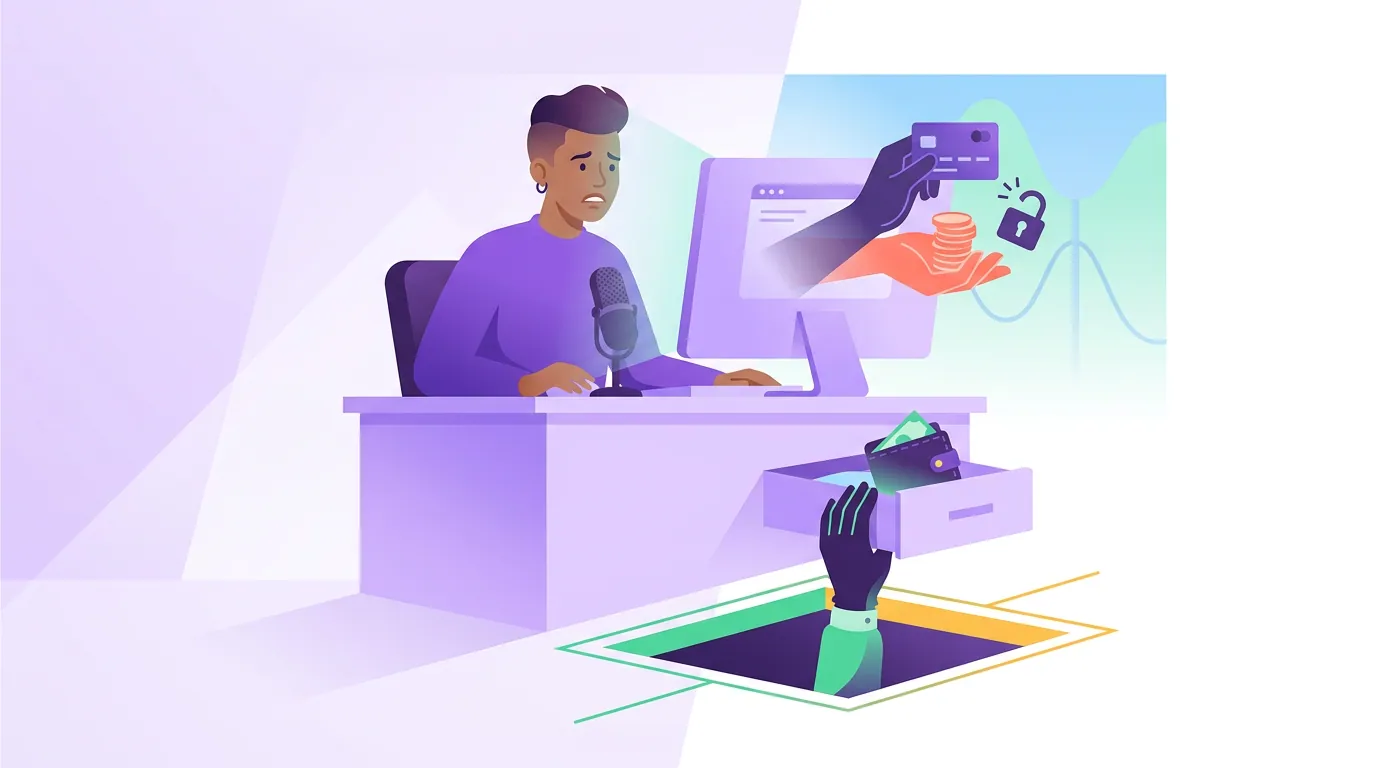
Reverse the money flow and you've found the fraud. The most common podcast-guest scam doesn't ask you to pay, it offers to pay you $2,000–$3,000 to appear, then springs the trap during a fake "tech check." On that call they ask you to share your screen, download "special software," or change a Facebook setting, and the moment you do, they lock you out and take over your accounts (RSS.com, Feb 2026). It hits savvy people: writers, marketers, and public figures have all been caught.
There's a money-out variant too, you're "invited," then told to pay a production or editing fee up front, often in crypto, before a show that may not exist. And a milder cousin: the "free" interview that's really a sales call, where a generically named show records you briefly, then pitches you a product. None of these are the legitimate paid-placement model. They're cons borrowing its vocabulary.
The 7-point vetting checklist before you pay a dollar
Run all seven. If any one fails, stop.
- Find the show independently. It must have real, recent episodes on Apple Podcasts, Spotify, or ListenNotes, not a single YouTube upload. Google the show name plus "scam."
- Demand audience data in writing. Downloads per episode, completion rate, and demographics, ideally a dashboard screenshot from Spotify for Creators or Apple Podcasts Connect. No data, no payment, this is the single most-cited rule (RSS.com, Feb 2026).
- Run the ROI math first. Realistic conversion rate × audience × customer value, compared against the fee. If it doesn't beat the cost on conservative inputs, pass.
- Reject urgency and crypto. Pressure to decide today, or to pay in cryptocurrency, is a fraud signal, not a discount.
- Never share your screen or change account settings on a prep call. No legitimate booking requires it. This is exactly how the credential-theft scam executes (RSS.com, Feb 2026).
- Verify the human. Real domain email, a findable LinkedIn, a recent guest list you can spot-check. Free-email "producers" with generic praise are a tell.
- Confirm it'll be disclosed as paid. US law treats a paid guest spot as a material connection that must be disclosed clearly, both spoken in the episode and in writing near the top of the show notes (FTC Endorsement Guides). A host who hides it is risking your reputation alongside theirs.
That last point is genuine information, not legalese. Inc. has argued you should never pay to be on a podcast precisely because an undisclosed paid spot reads as an ad masquerading as a recommendation (Inc., 2025). You don't have to share that absolutist view to take the practical lesson: insist on disclosure, in both formats, before you agree.
Paid vs earned guesting, side by side
| Factor | Paid placement / agency | Earned guesting (pitch + network) |
|---|---|---|
| Up-front cost | $200–$2,000+ per show; $700–$3,000/mo agency | Your time; near-zero cash |
| Speed | Faster, predictable slots | Slower; depends on replies |
| Audience fit control | High if you vet the data | High; you choose who to pitch |
| Credibility signal | Strong show, weak if undisclosed | Strong; an earned yes |
| Main risk | Off-fit shows, scams, no leads | Slow start, low reply rates |
Most guests should exhaust the earned route first. Get sharp at finding shows that fit, reaching the host's real inbox, and writing a pitch that gets replies. Spend on placement only after you've proven you can fill the slots you book, and once you're on, the etiquette that earns rebookings does more for your pipeline than any invoice.
Frequently asked questions
Do podcasts pay their guests, or do guests pay them? Both happen, and neither is the norm. Most shows pay nothing and charge nothing, the value exchange is the host's audience for your expertise. A minority of shows sell paid guest spots like ad slots, and a small set of agencies charge you to book placements. Any unsolicited email offering to pay you thousands is almost always a scam.
How much does it cost to be a guest on a podcast? For paid placements, RSS.com's 2026 survey reported $200–$500 on niche shows, $750–$2,000 on regional ones, and $20,000+ on top shows. Booking agencies run roughly $700–$3,000 a month for a few placements (Podseeker, ExpertBookers, 2026). Treat any single figure as that one show's price, not a market rate.
Is it worth paying a podcast booking agency? It can be, if you'd otherwise leave money on the table by not appearing and you don't have time to pitch. Prefer a retainer that targets the right shows over pay-per-placement, which Podseeker notes can incentivize booking you on weak pay-to-play shows to hit a quota. Vet the agency's actual placements before signing.
Do I have to disclose that I paid to be on a podcast? Yes. The FTC treats a paid guest appearance as a material connection requiring a clear, conspicuous disclosure, spoken in the episode and written near the top of the show notes, in plain language (FTC Endorsement Guides). A vague mention at the very end doesn't meet the standard, and both you and the host can be liable.
Related guesting guides
- How to get booked on podcasts as a guest, the full earned-route funnel.
- The podcast guest pitch email that gets replies, the message that books you for free.
- Host etiquette: making guests comfortable on mic, the other side of the table.