
Podcast Calls-to-Action That Listeners Actually Follow

The podcast calls-to-action that actually get followed share one trait: there is only one of them per episode. Make a single, specific ask at the point of highest goodwill, usually the outro, name exactly what to do, then stop. Stacking asks ("subscribe, review, and join my Discord") splits attention in a medium where hands and eyes are already busy, and split attention converts almost no one.
Most hosts know their CTA is weak. The fix they reach for is usually wrong: a longer ask, a more clever script, a guilt trip about the algorithm. The real problem is rarely the words. It is that you asked for four things, in a format the listener cannot click, while they were driving. This guide gives you the discipline (one ask), the map (where it goes), and the calendar (how to rotate asks across episodes so each one still lands).
Why does one CTA per episode beat several?
One CTA per episode wins because audio is a hands-busy medium with no click target. A listener walking or driving cannot tap a button the moment you ask, they have to remember it and act later. Every extra request lowers the odds they act on any of it. One clear instruction survives that gap; a list of four evaporates.
This is the part most CTA advice skips. On a webpage, a stacked menu of options is fine, the reader scans and picks. In an episode, there is no scanning. The ask arrives once, in sequence, and then it is gone. Cognitive load is the enemy: the more choices you offer, the more likely the listener defaults to the easiest choice of all, which is doing nothing. "Subscribe, leave a review, follow me on Instagram, and check the link in the description" is not four chances to convert. It is one diluted chance, four ways.
There is a survival angle too. Nearly half of all podcasts stop at three episodes or fewer Amplifi Media, and the shows that last are the ones that build a direct relationship with listeners instead of hoping to be re-discovered each week. A single, repeated, well-placed ask, usually toward email or subscription, the two channels you actually own, is how that relationship compounds. Scattering effort across five platforms you do not control is how it leaks.

Where should the call to action go? (the placement map)
Put your one real ask at the outro, after the value is delivered and goodwill peaks. Use the pre-roll only for a single soft line ("follow so the next one finds you"), never your main ask. Skip mid-roll growth CTAs entirely, mid-roll is for paid sponsors, and a growth ask there interrupts the moment a listener is most engaged.
The logic behind the map is about who is listening when. At the pre-roll, you have everyone, including people who will bounce in thirty seconds. A heavy ask there spends your best moment on your coldest audience, so keep it to one soft line and get into the content. By the outro, the only people left are the ones who heard the whole thing. They are the warmest lead you will ever have, and they are the ones worth asking. A spoken outro ask reaches people who never read your show notes, which is most of them.
Two placement rules that matter more than the script:
- Say it, then write it. The spoken ask catches listeners; the same ask repeated as the first line of your show notes (and your link-in-bio) catches the ones who go looking later. Spoken-only asks vanish; notes-only asks reach almost no one. You need both, and they should match word for word.
- Make the action survivable. "Search my name on Apple Podcasts and tap follow" is a lot to remember while driving. "Hit follow in whatever app you're in right now" is one motion. Lower the effort of the action to the floor, because the listener is rarely at a desk.
Which CTA should you pick? (match the ask to the episode)
The single CTA you make should match what that episode is for. A deep solo teaching episode earns an email-signup ask; the listener wants more of your thinking. An interview with a big guest earns a share ask; the guest's audience is the growth lever. Pick the one ask that fits the episode's job, and let the others wait in the rotation.
A few honest notes on these. The email-signup ask is the highest-value one for most shows, because the inbox is the only audience a platform cannot throttle, that is the whole reason it is worth building a podcast email list from zero. It also needs a real reason to exist: nobody signs up for "my newsletter," so pair it with a specific lead magnet that earns the signup. The review ask is the easiest to bungle by being vague; a script that names the platform and the desired length ("one line on Apple Podcasts") converts far better than "please rate and review," and our review ask scripts cover the wording. The share ask is the only one that recruits strangers, which is why it belongs on your strongest, most guest-driven episodes.
The rotation calendar (so no ask wears out)
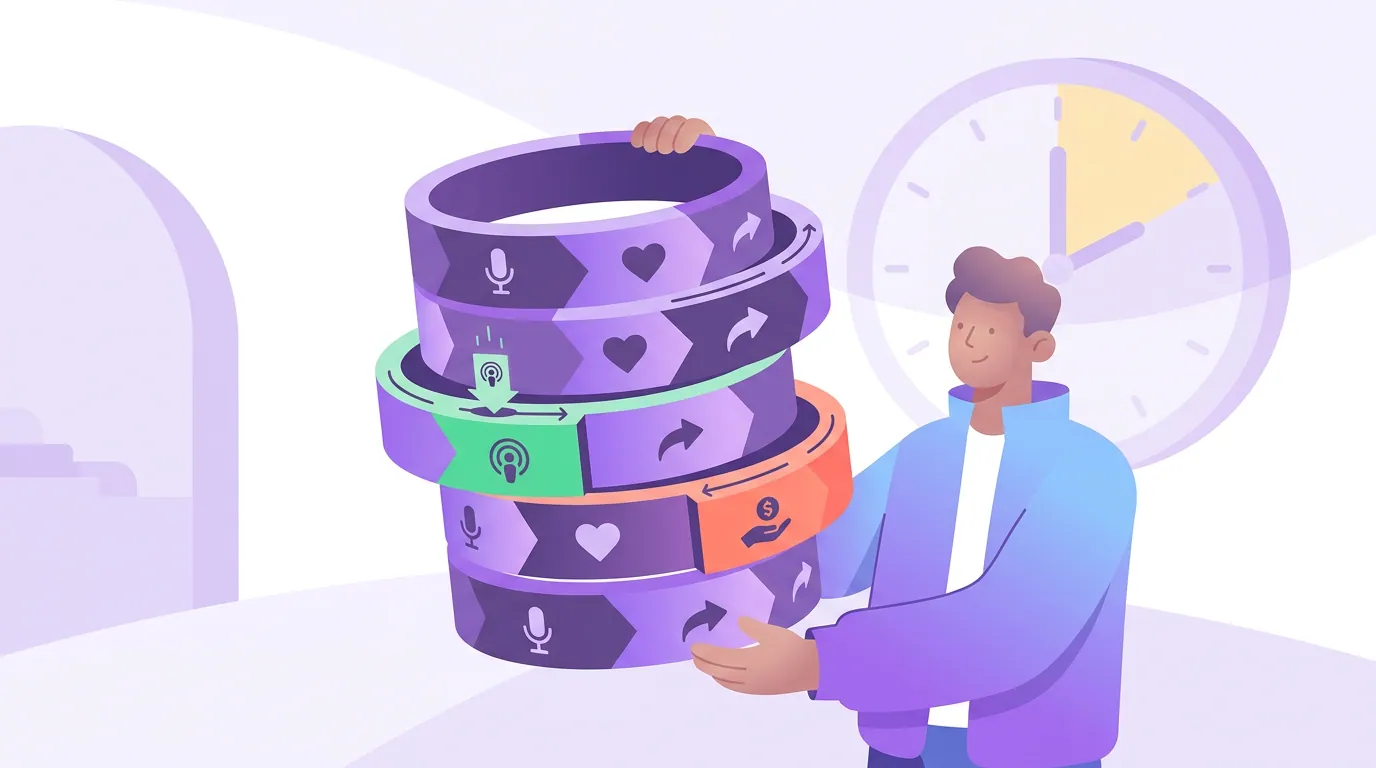
Rotate one CTA per episode on a simple cycle so every ask gets airtime without any single one wearing out its welcome. A four-episode loop, subscribe, email, review, share, means a regular listener hears each ask once a month rather than four asks every week. Repetition within a single episode annoys; repetition across a rotation compounds.
Bend the rotation when an episode demands it. A milestone episode is the right time to break pattern and ask for a review (the goodwill is real). A blockbuster guest episode should always run the share ask, regardless of where you are in the cycle, that audience is the point. The rotation is a default that stops you defaulting to "ask for everything," not a law. Tag which ask each episode ran so that after a quarter you can see which one actually moved its number, and weight the rotation toward what works.
| Rotation rule | Why it works | The catch |
|---|---|---|
| One ask per episode, four-week loop | Each ask returns monthly, never stacked | Needs you to track which episode ran which ask |
| Break pattern for big guests (share) | The guest's audience is the growth lever | Only on genuinely large guests, or it loses meaning |
| Break pattern at milestones (review) | Goodwill peaks; reviews come easier | Do not force a milestone that listeners do not feel |
Common mistakes that kill a podcast CTA
- Stacking asks. The single most common mistake, and the reason this whole guide exists. Three asks in one outro is zero asks the listener remembers. Cut to one.
- Burying it in a 30-second outro speech. If your CTA is sentence nine of a rambling goodbye, it is gone. Lead the outro with the ask, in one clear sentence, then sign off.
- Asking for the unmeasurable or unactionable. "Support the show" gives the listener nothing to do. Name the action, the platform, and the one-tap version of it.
- Spoken-only or notes-only. Say the ask and write it identically in the show notes and link-in-bio. Each placement catches a listener the other misses.
- Never pointing strangers at the ask. Your outro reaches existing listeners. New people find you through clips on social, and they land on your profile, not your show notes, which is why the link-in-bio your CTA points to needs to be the destination your clips drive traffic to. Social clips now fuel discovery more than personal referrals: 57% of listeners rely on social media for recommendations versus 54% on friends and family (InsideRadio, "The State of Video Podcasting 2025"), and posting clips consistently can lift discovery reach 2 to 5x (Podcast Studio Glasgow).
FAQ
What is a good podcast call to action example? A good one is single, specific, and low-effort: "If this helped, hit follow in whatever app you're listening in, that's how the next episode finds you." It names the action, makes it one tap, and asks for exactly one thing. Compare that to "subscribe, review, and follow me everywhere," which asks for four and lands none.
How many CTAs should a podcast episode have? One real ask per episode. You can add a single soft pre-roll line ("follow so the next one finds you"), but the main CTA, the one you script and repeat in the show notes, should be the only one. More than one ask splits the listener's attention in a medium where they cannot click, and split attention converts almost no one.
Where should the call to action go in a podcast episode? At the outro, after you have delivered the value. The listeners still there are your warmest leads, and a spoken ask reaches the majority who never open show notes. Keep the pre-roll to one soft line, and reserve mid-roll for paid sponsors, a growth ask mid-episode interrupts the moment a listener is most engaged.
Should I ask for reviews or email signups? Pick by what the episode is for, and rotate across episodes. Email signups build the audience you own outright and tend to be the highest-value ask over time; review asks build credibility and help discovery on Apple and Spotify. Run each on its own episode rather than asking for both at once, the review ask scripts and the welcome sequence that follows a signup handle the specifics of each.
Do calls to action even work in audio? Yes, but only when they are single and survivable. Audio is a hands-busy medium, so the listener has to remember your ask and act later, a clear one-tap action survives that gap, while a list of four does not. If community rather than conversion is your goal, the same discipline applies to a single ask to join your Discord.