
What to Do When You Blank Out Mid-Interview


When you blank mid-interview, stop talking and breathe, silence is the cure, not the enemy. Then run one of three moves: buy time with a deliberate bridge phrase, reroute to a point you do remember, or simply ask the host to repeat the question. On a recording, the blank itself is editable, so the only real mistake is panicking out loud.
Almost every guest's instinct is the worst possible one: keep the mouth running while the brain reboots. That produces a spiral of "um, so, yeah, like I was saying, um" that an editor cannot rescue. The blank wasn't the damage. The panic-talking was.
This guide gives you a decision rule for picking the right recovery in the moment, the exact bridge phrases that sound thoughtful instead of stalled, two scripts for asking the host to repeat the question without losing face, and the editing truth that should lower your heart rate before you ever hit record.
Why blanking out feels worse than it is
A blank feels like a five-alarm event because of an asymmetry in how time passes. Inside your head, a two-second silence stretches into a humiliating eternity. To the listener, two seconds of someone gathering a thought reads as exactly that, gathering a thought. The gap between your experience and theirs is the whole problem, and it's why the fix is mostly about not believing the panic.
It matters more on a podcast than in a meeting for one reason: a meeting evaporates, but an interview gets edited, clipped, and posted. Clips are now how most people find shows, 57% of listeners rely on social media for podcast recommendations, the first time it surpassed friends and family (InsideRadio, 2025). That sounds like extra pressure. It's actually the source of your relief: because the episode is edited before anyone hears it, a clean pause where you blanked never makes the final cut.
The goal here isn't to never blank. Everyone blanks, your brain runs ahead of your mouth and sometimes the thought drops. The goal is to make your recovery boring, because a boring recovery is an invisible one.
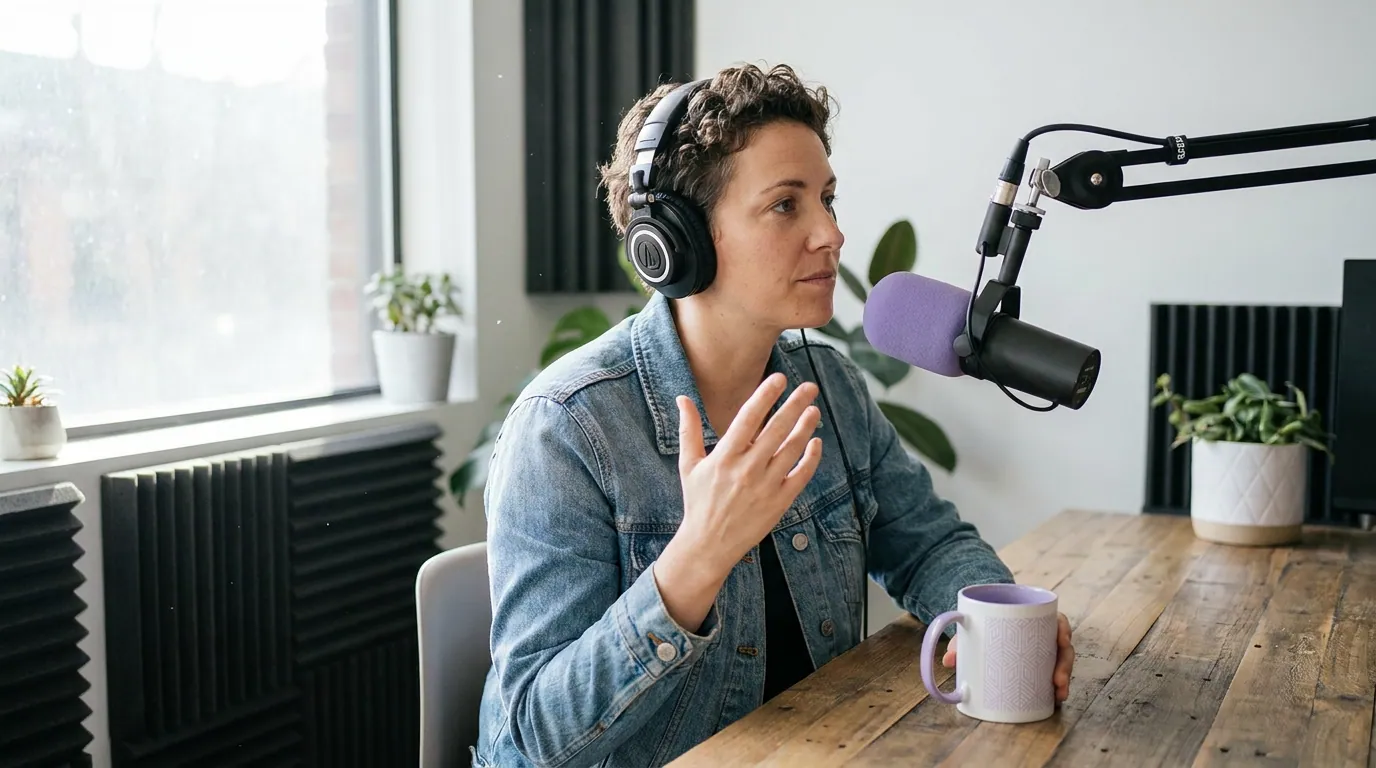
The recovery decision rule: name what you lost
Before you can pick a move, label what actually went missing. Almost every mid-interview blank is one of three things, and which one it is tells you exactly what to do. This is the part panicked guests skip, they treat all three the same and reach for whatever comes out first.
Lost the word is the smallest blank: you know exactly where you're going, but one specific term, name, or number won't surface. You don't need a rescue, you need three seconds. Use Move 1.
Lost the thread is the middle one: you started a point, took a detour, and now have no idea where the sentence was heading. Chasing the original thought wastes tape. Use Move 2 and reroute.
Lost the question is the full blank: someone asked you something thirty seconds ago and it's gone. Don't guess at it and answer a question they didn't ask. Use Move 3 and ask.
Move 1: Buy time with a bridge phrase
When you've only lost a word, the fix is a short, calm phrase that fills the air with something deliberate while your brain finishes loading. The trick is that a bridge phrase is a complete, confident sentence, not a trailing "um." It sounds like a speaker choosing their words, because that's literally what's happening.
Keep three or four of these loaded before any interview. Say them slowly. The slowness is the point: it signals control and buys more time than rushing does.
| Bridge phrase | What it buys you |
|---|---|
| "That's a good question, let me think about it for a second." | A full, guilt-free pause; resets your pace |
| "There are really two parts to this." | Time, plus a structure to fill in |
| "The honest answer is, it depends, and here's on what." | Time, plus permission to be specific |
| "Let me give you the concrete example first." | Skips the abstraction you blanked on |
Pair the phrase with a breath in through your nose. A breath physically cannot coexist with a panicked "um," and it slows your heart rate, which is what actually unsticks the word. If the word still won't come, describe around it, "the tool, the one everyone uses for X", and keep going. An editor can fix a fumbled word. They can't fix you stopping the show to find it.
One caution: bridge phrases are a tool, not a tic. If "that's a great question" lands before every answer, it becomes its own filler problem. Rotate them, and only deploy one when you genuinely need the beat. If you find yourself leaning on them constantly, the deeper issue is usually filler-word habit, which has its own diagnostic and fix.
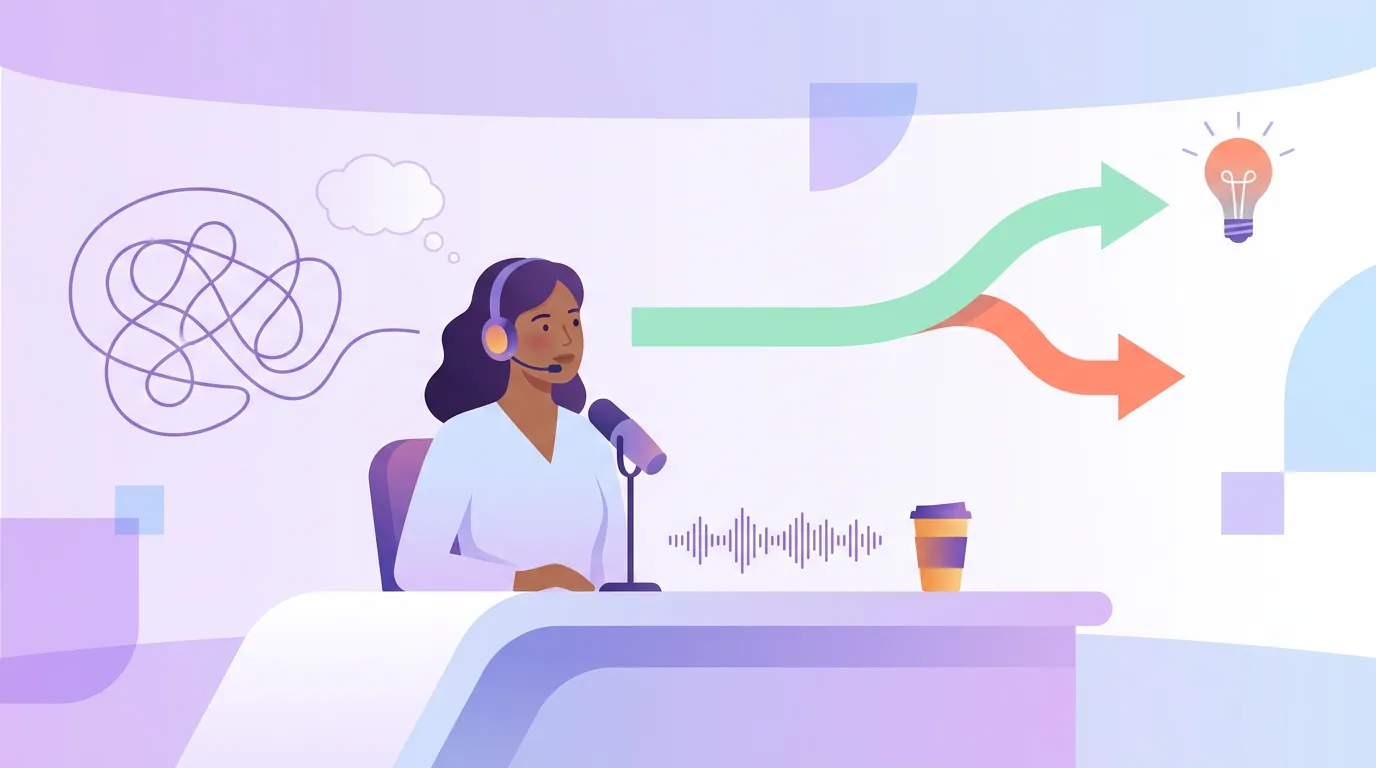
Move 2: Reroute instead of chasing the lost thread
When you've lost where a point was going, do not try to retrace your steps in real time. Searching backward for the thread is what produces the long, mumbling spiral. Instead, abandon the dropped thought cleanly and jump to a point you do have ready.
The move is a single confident sentence that pivots without apology:
- "Actually, the more useful way to say this is, " then go somewhere you know.
- "Let me back up, because the real point is, " then deliver your strongest related idea.
- "The simplest version: [your one-line takeaway]." Short. Lands. Done.
Two things make this work. First, you never announce that you got lost, "sorry, I totally forgot what I was saying" hands the listener a reason to feel awkward. You just redirect, and the audience follows the new direction without ever knowing there was an old one. Second, your reroute target should be your pre-written soundbite for that topic. If you prepped two or three crisp lines before the interview, you always have a safe place to land.
This is why preparation matters more than memorization. You're not trying to recall a script word-for-word, that's brittle and it's exactly what shatters when nerves hit. You're keeping a short list of points you can reach for in any order, so a dropped thread is just a cue to grab the next one.
Move 3: Ask the host to repeat the question, gracefully
When the question itself is gone, the worst option is guessing and answering something adjacent. Hosts can tell, and it derails the conversation. The best option is to hand it back, and good hosts expect this and will happily repeat. Most hosts are actively trying to make you comfortable, so asking is doing them a favor, not imposing on them.
You just need a script that asks without sounding rattled:
- The clean version: "Can you run that by me one more time? I want to give you a real answer, not a half one." This frames the ask as care, not a freeze.
- The honest-and-charming version: "I got so into thinking about the first part that I lost the question, what was the second half?" Self-aware, warm, and it tells the host exactly which piece to repeat.
Avoid the apology spiral. "Oh god, sorry, I'm so sorry, I completely blanked, this is embarrassing" makes a two-second moment into a ten-second one and drags the room's energy down. One light sentence, then you're back. And remember the editing reality: the whole exchange, your ask, the host's repeat, gets cut, so it never reaches a single listener.
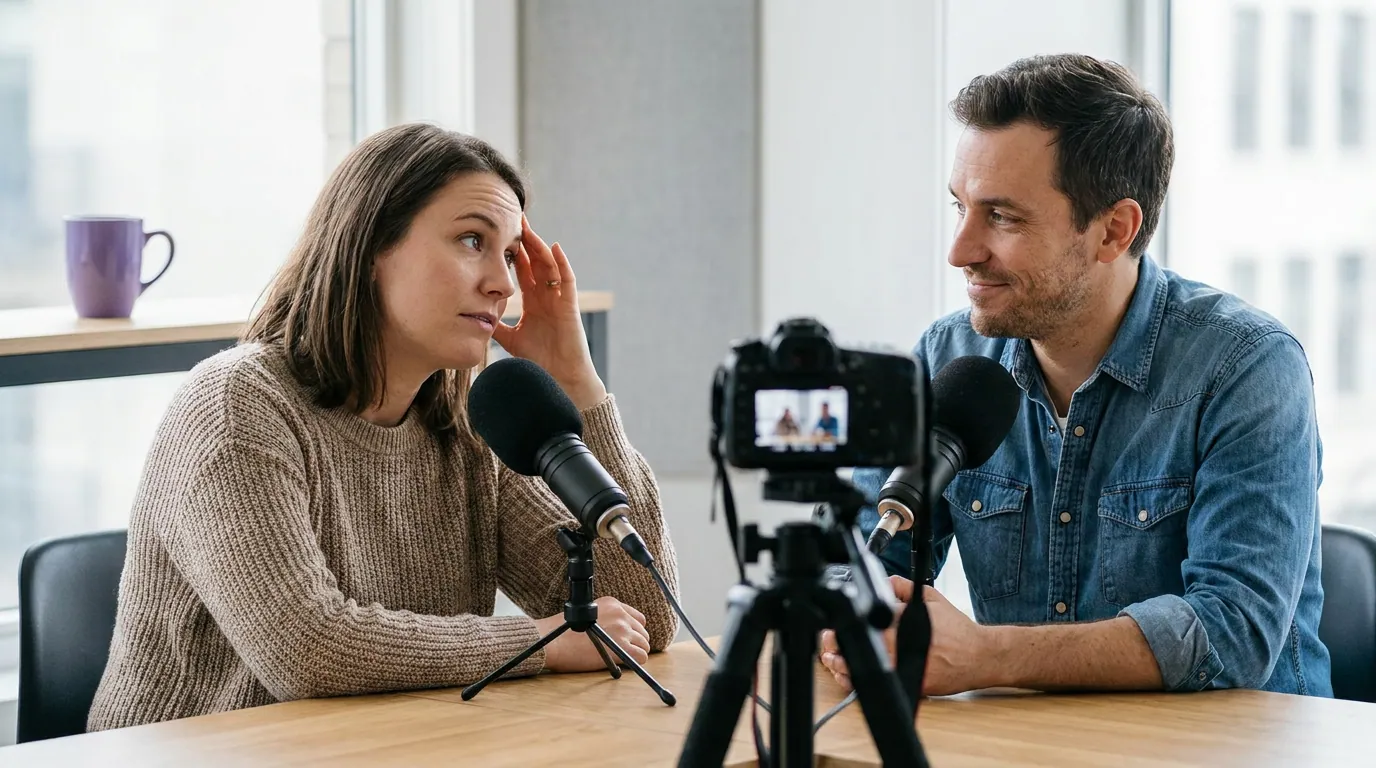
Why blanking is editable (so stop panicking)
Here's the fact that should change how you feel before every recording: a clean pause edits to nothing. When you blank and go quiet, you leave the editor a silent gap they can trim to zero, like it was never there. When you blank and panic-talk, you leave them tangled audio that's either unusable or has to be awkwardly cut mid-sentence. The clean pause is the gift.
This is the single most calming thing to internalize, and it's true for every recorded format. Live radio is the rare exception. For a podcast, you are not performing flawlessly in one take, you're feeding raw material to an edit. A good editor can cut around almost anything except a mess you talked yourself into. Knowing the pause is safe is, paradoxically, what stops you from needing it: guests who trust the edit relax, and relaxed guests blank less. The same calm shows up on camera as confidence, which is the visual half of the same skill.
Common mistakes when you blank
- Talking through the gap. The reflex to keep the mouth moving is the actual damage. Stop. Breathe. The silence is editable; the spiral isn't.
- Over-apologizing. "Sorry, I blanked, that's so embarrassing" turns a two-second pause into a ten-second one and lowers the room. One light sentence, then move.
- Guessing the question. Answering something close-but-wrong derails the host and wastes a question. Ask for the repeat, it gets edited out anyway.
- Memorizing a script. Word-for-word answers shatter under nerves. Keep a short list of points you can reach in any order so a dropped thread has somewhere to land.
- Skipping the warm-up. A cold mouth and an unsettled nervous system blank more in the first few minutes. Five minutes of vocal warm-up before you record measurably steadies your opening.
FAQ
What do you do if you blank during an interview? Stop talking and take a breath, silence reads as thinking, not failure. Then pick one move: buy time with a calm bridge phrase if you only lost a word, reroute to a point you remember if you lost the thread, or ask the host to repeat the question if you lost it entirely. On a recording, the pause gets edited out.
Is it okay to ask the host to repeat the question? Yes, and good hosts expect it. Frame it as care, "Can you run that by me again? I want to give you a real answer." The whole exchange is edited out before anyone hears the episode, so there's no downside. Guessing at a question you don't remember is the actual mistake.
How do I stop my mind from going blank when speaking? You can't fully prevent it, so prepare to recover instead of trying to be perfect. Keep three or four bridge phrases and a short list of go-to points ready, warm up your voice first, and slow your opening answer by about 20%, most blanks happen in the nervy first few minutes before you settle.
Will blanking ruin my podcast appearance? Almost never. Podcasts are edited, so a clean pause where you blanked can be trimmed to nothing, and a question-repeat is cut entirely. The only version that hurts is panic-talking, which leaves audio an editor can't fix. Recover quietly and your blank disappears from the final cut.
What's a good bridge phrase to buy time? "That's a good question, let me think about it for a second" is the most reliable, because it's a complete, confident sentence that grants you a guilt-free pause. "There are really two parts to this" also works and hands you a structure to fill. Say it slowly and breathe; rushing wastes the time you just bought.
Keep building the rest of your on-mic toolkit: look confident on camera as a first-time guest, cut the um and like that creep in when you stall, and learn where to look on a video podcast, camera vs. the host. A quick read of the unwritten guest etiquette rules helps too.