
How to Grow a Podcast on Facebook in 2026


Grow a podcast on Facebook by giving its three surfaces three different jobs: a Group to build community and earn real organic reach, Reels to reach people who don't follow you yet, and a Page mostly as an ad-buying and search home. Don't treat Facebook like TikTok. Its audience is older, slower to react, and rewards conversation over speed.
That last point is the whole game, and it's why most podcasters quietly write Facebook off. They post the same vertical clip that worked on TikTok, watch it die, and conclude the platform is dead. It isn't. It's just built for a different person watching at a different pace.
Is it still worth growing a podcast on Facebook in 2026?
Yes, if your audience skews 30 and up. Facebook still has roughly 3.07 billion monthly active users and 2.11 billion daily (Backlinko, April 2026), and in the US about 57% of users are 35 or older (Statista via Hootsuite, 2026). For a show about parenting, finance, faith, health, or local life, that's the most reachable audience anywhere.
The catch is who Facebook is not for. If your show targets people under 25, you'll find them faster on TikTok and Instagram. On Facebook, 18-to-24-year-olds spend about 22 minutes a day; the 55-to-64 group spends 45 (demandsage / eMarketer, 2026). The platform's heaviest, most loyal users are exactly the people the rest of social media keeps overlooking.
Why Facebook rewards different content than TikTok
Two mechanics make Facebook its own animal: reach is split sharply across surfaces, and the feed rewards comments more than instant scroll-speed.
On TikTok, a cold clip can reach a million strangers in a day. On Facebook, a Page post reaches almost no one organically. Average Facebook Page organic reach now sits around 1-5% of followers, and many business Pages see closer to 1-2% (2026 agency benchmarks; Socialinsider puts the median Facebook engagement rate at 0.15%). A Group post is a different story: well-run, active Groups commonly reach 20-40% of members, because Facebook reads Group activity as the "meaningful interactions" its 2018 algorithm change set out to favor. That's roughly a 10x gap on the same audience, and the single best reason to lead with a Group.
The other difference is pace. Facebook weighs engagement velocity, how fast a post gathers comments in its first 30 to 60 minutes. A post that earns ten genuine comments in half an hour gets pushed to far more people than the same post that takes a day to get there. Likes barely move it; comments, saves, and shares do. Socialinsider's 2026 benchmarks back the format side of this: Reels were the only Facebook content type to post an engagement uplift heading into 2026. So the content that wins isn't the fastest hook, it's the clip or post that makes someone over 40 stop and type a reply.
The steps: a Facebook growth plan for podcasters
1. Decide which surface leads, Group, Reels, or Page
Don't do all three at once. Pick the surface that matches where your show is and what you can sustain.
- Lead with a Group if your show has a clear shared identity people would join a room for, a niche, a city, a profession, a belief. Groups are the strongest organic channel Facebook has left.
- Lead with Reels if your show produces strong visual moments and you want to reach strangers, not just nurture existing fans. Reels are the only format reliably shown to non-followers, and Meta has made them the default: as of June 2025, every video uploaded to Facebook is published as a Reel, with length and format limits removed (Meta newsroom, June 2025).
- Keep a Page, but expect little organic from it. Its real jobs are running ads, owning your show's name in Facebook search, and hosting a pinned trailer. Treat Page reach as a bonus, not a strategy.
2. Post Reels as native uploads, not cross-posts
Upload the video file straight to Facebook. Don't paste a TikTok link, and avoid clips with a TikTok or other watermark, Facebook's recommendation system suppresses recycled, watermarked content, and the audience here can spot it. The format itself is the same vertical 9:16 you already make, so the work is small: re-export clean.
The first frame and the on-screen text matter more on Facebook because the audience is older and reads. Lead with a readable hook line in the caption area and burn captions into the clip, most social video is watched on mute (Verizon Media/Sharethrough put it near 75%; Digiday reported ~85% of Facebook video muted, both publisher-reported and directional). For an older audience squinting at a phone, larger caption text and higher contrast aren't optional.
3. Build the Group around a question, not your show
A Group named "[My Show] Fans" stays empty. A Group named for the problem your show solves fills up. Frame it around the audience's identity, "Midlife Career Changers," "Indie Horror Readers," "Sober & Social", and seed it with one real question every couple of days. Your episodes become the answer, not the pitch.
Post your clips inside the Group, ask one genuine question under each, and reply to every early comment yourself. That early back-and-forth is what triggers the velocity the algorithm rewards. Treat the Group as a place you host a conversation, and the episode link is something you earn the right to drop, not the reason the room exists.
4. Match the rhythm: fewer posts, more replies
Three to five native Reels a week plus daily presence in your Group beats ten drive-by posts. Facebook's audience checks in steadily through the day rather than doom-scrolling in bursts, so spacing posts out and actually answering comments does more than volume. If you also post to short-form elsewhere, your TikTok posting cadence is a useful baseline to adapt down, not copy.
5. Send people somewhere you own
Views on Facebook are rented. The followers, the Group, the reach, Meta controls all of it. Use the attention to move people onto a channel you keep: a podcast email list. Pin a simple offer (a checklist, a best-of episode) to your Group and Page, link it from Reel captions, and greet new subscribers with a welcome email sequence. Social media is now where most listeners say they discover shows, 57% rely on it for recommendations (Inside Radio, 2025), but discovery on a rented platform only compounds if you capture it.
Common mistakes that stall Facebook growth
- Treating the Page as the strategy. A Page with 1-5% organic reach can't grow you. Build the Group, run ads through the Page, and stop expecting Page posts to travel.
- Cross-posting watermarked clips. A visible TikTok logo signals recycled content and the older audience reads it as lazy. Re-export clean every time.
- Posting and leaving. Skipping the first-hour replies kills the velocity that decides reach. Answer comments the moment they land.
- Copying TikTok's pace and tone. Frantic, fast-cut clips that crush it with 20-year-olds confuse a 50-year-old viewer. Slower, clearer, caption-forward edits perform better here.
- Never asking a question. Link-only posts get the lowest engagement of any format on Facebook. Lead with something a person wants to answer; the link can wait.
Tools that fit Facebook's workflow
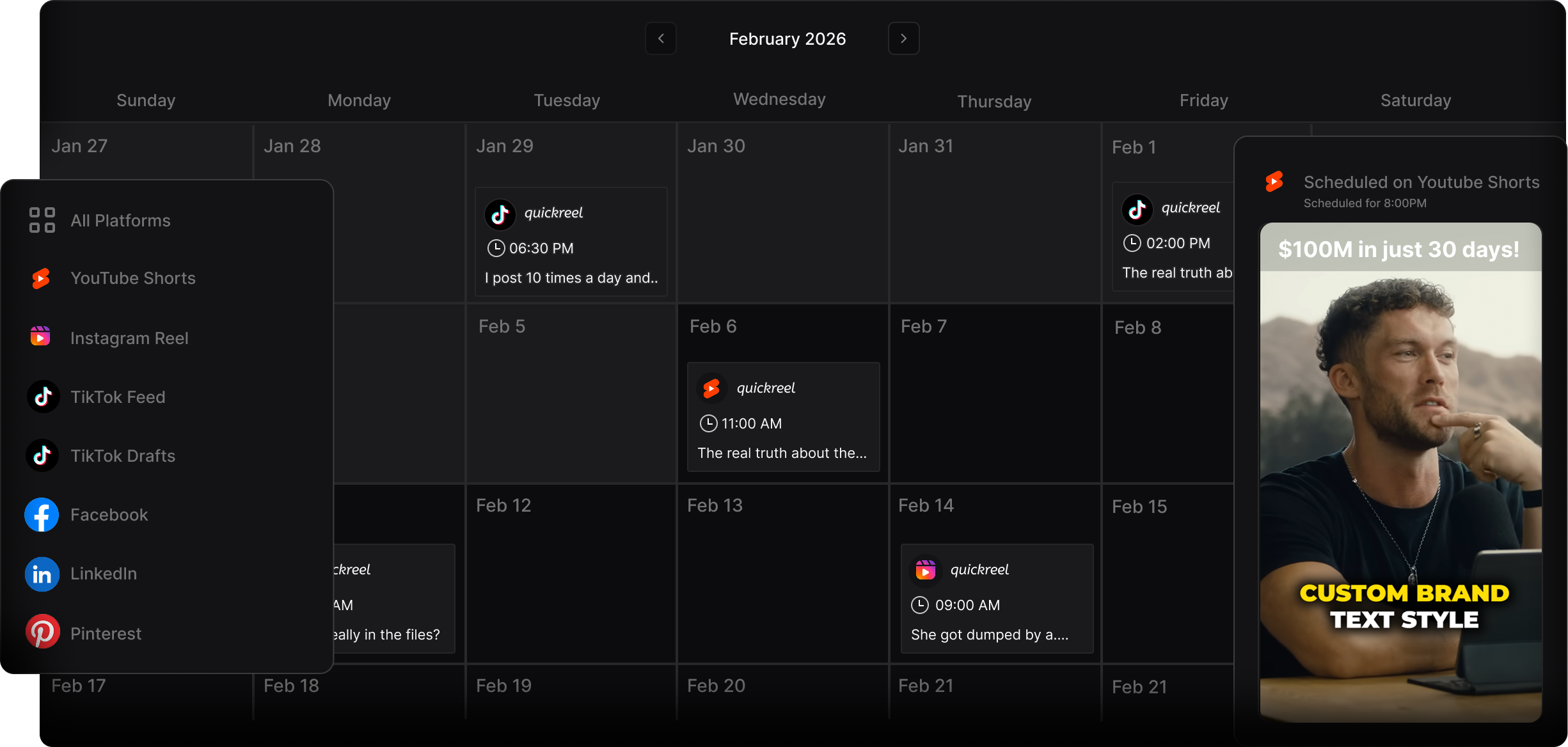
You need two things: a clean way to make vertical, captioned clips, and a way to schedule them without a watermark. Meta's own Business Suite schedules Reels and Page posts for free, which is enough for many shows. For the clips, any modern AI clipper that exports watermark-free vertical video with burned-in captions works, QuickReel does this from a YouTube URL and supports multi-platform scheduling, but be honest with yourself that every AI clipper still needs roughly 20-40% human review before a clip is good enough to post. The tool finds the moment; you sharpen the hook and fix the caption.
FAQ
Should podcasters use a Facebook Page or Group? Use both, for different jobs. A Group is where organic growth happens, active Groups reach roughly 20-40% of members versus 1-5% for a Page (2026 agency benchmarks). A Page is for running ads, owning your show's name in search, and hosting a pinned trailer. Lead with the Group; keep the Page running quietly.
Do Facebook Reels work for podcasts? Yes, Reels are the only Facebook format reliably shown to people who don't follow you, and since June 2025 every Facebook video uploads as a Reel (Meta newsroom, 2025). Upload native, vertical, watermark-free clips with burned-in captions, since most viewers watch on mute.
How often should I post to grow a podcast on Facebook? Three to five native Reels a week, plus daily presence and replies inside your Group. Facebook rewards comment velocity in the first hour over raw volume, so answering comments matters more than posting more.
Is Facebook better than TikTok for podcasts? It depends on your audience's age. Facebook's US base skews 57% over 35 (Hootsuite, 2026); TikTok skews younger. For a 30-plus topic, Facebook reaches your people more directly. For a Gen Z show, lead with TikTok and treat Facebook as secondary.
Why is my podcast Page getting no reach on Facebook? Because Page organic reach is structurally low, often 1-2% for business Pages in 2026, with Socialinsider's 2026 benchmarks putting median Facebook engagement at just 0.15%. It's not a penalty on your show; it's how Facebook routes attention toward Groups and Reels. Move your effort to a Group and to native Reels.