
From 0 to 10 Downloads an Episode: The Honest Start

Ten downloads an episode means ten real decisions to press play, and at the very start, that is normal, not failing. The median podcast episode clears just 28 downloads in its first week (Buzzsprout global stats, via The Podcast Host), so single digits put you near the middle of the pack, not at the bottom of it. The real work now is not the number. It is finding the next ten people and building the habit of publishing again.
Single digits feel like a verdict. They are a starting line. Almost every show you admire sat exactly here, with a download count it could have read in one glance, before anything compounded. This page is the reset: what 10 actually means, why the raw number is messier than it looks, and the five free things that move it.
What does 10 downloads per episode actually mean?
Ten downloads means roughly ten people, or fewer, chose to listen, and that is a foothold, not a failure. On real first-week benchmarks the median episode gets about 28 downloads and the top half starts at 28+ (Buzzsprout, via The Podcast Host), so 10 sits just under the midpoint of all shows that bother to measure. You are not behind the field. You are inside it, early.
Here is the context that should take the sting out. About 47% of podcasts stop at three episodes or fewer (Amplifi Media analysis), and most that quit do so before they ever had an audience to lose. If you are reading download numbers at all, you have already outlasted a huge share of shows that launched the same month you did. The number is small because the show is young, not because the show is bad.

The caveat nobody tells you: not every download is a human
Before you judge the number, know what the number is, because a "download" is a much rougher count than the word suggests. Under the IAB Tech Lab Podcast Measurement guidelines (the industry standard most hosts hear at the same time as their listeners), a request only counts as a qualified download after it survives several filters: at least 60 seconds of audio actually transferred, known bots stripped out, and duplicate pulls collapsed within a 24-hour window (IAB Tech Lab, Podcast Measurement v2.2).
That cuts both ways, and both directions matter when you have ten. If your host is not IAB-compliant, your raw number can be inflated by automatic prefetches and bot traffic, apps and crawlers that grab the file without a person ever listening. If your host is compliant, your number is more honest but smaller, because those phantom pulls get filtered out (Acast, explaining its IAB 2.2 process). So two shows with the "same" ten downloads can mean very different things. Ten qualified, de-duplicated, bot-filtered downloads is ten humans-ish. Ten raw requests might be three.
Two practical takeaways. First, check whether your host reports IAB-certified numbers, Buzzsprout, Acast, Captivate and most major hosts do. If yours does, trust your ten more, not less. Second, stop comparing your filtered number to a friend's unfiltered one. That comparison is the fastest way to feel behind for no reason.
What 10 downloads does not mean
It does not mean the show is bad. Download count at this stage measures distribution, how many people were told the show exists, far more than it measures quality. A genuinely great episode heard by ten people is a distribution problem, not a content problem, and distribution is the fixable one.
It also does not mean nobody is listening well. Ten people who finish every episode beat a hundred who tap once and bounce. Early on, the metric that predicts survival is not downloads, it is whether you publish the next episode. Consistency is the single strongest signal that a show will still exist in a year. Ten downloads with a weekly streak is a healthier place than 200 downloads on an episode you are too burned out to follow.
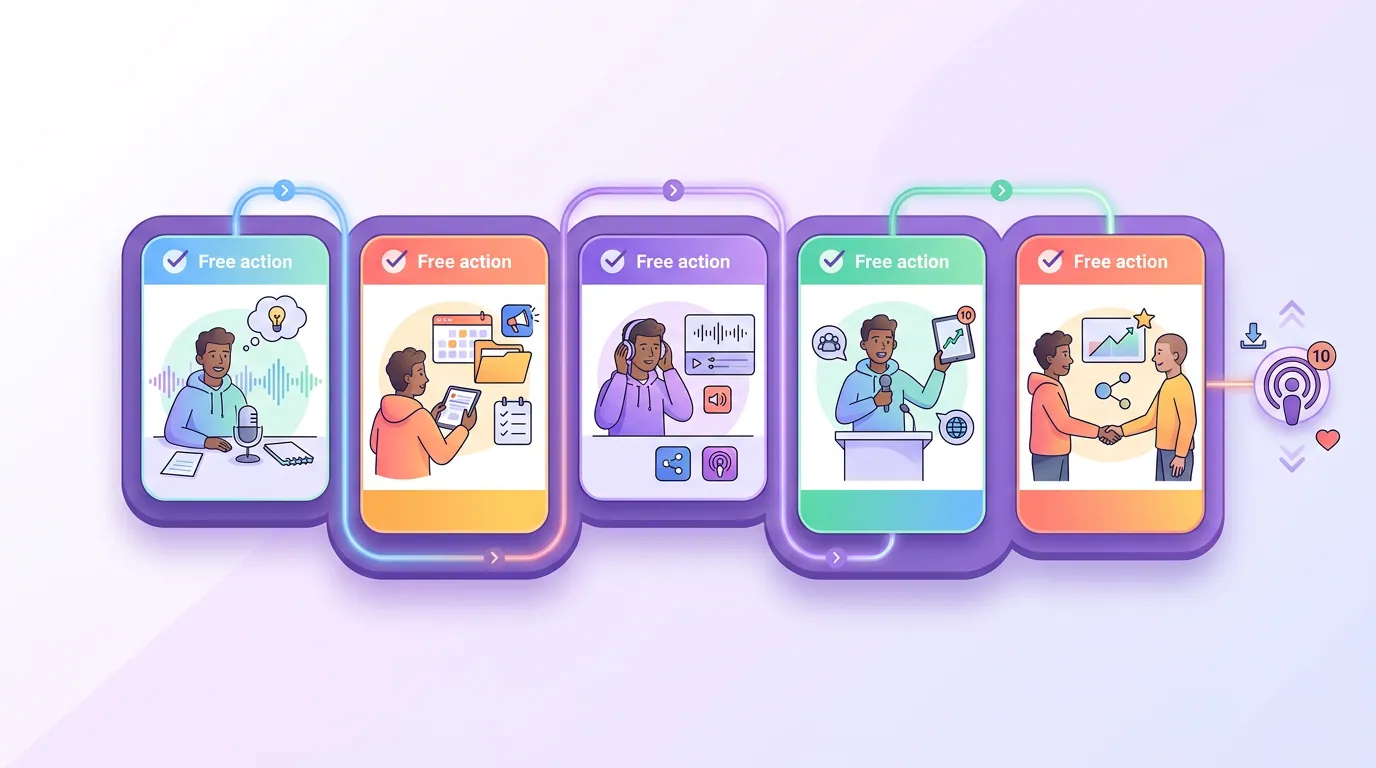
The break-10 checklist: five free actions, in order
You do not need to buy ads or "hack" anything to clear ten. You need distribution you can do by hand and one channel that scales past your reach. Work these in order.
- Ask ten specific people by name. Not a broadcast post, ten individual messages, each naming the one reason that person would care about this episode. "I made 14 minutes on [the exact thing you mentioned last week]" converts; "check out my podcast" does not.
- Post three captioned clips from the episode. Pull three short, vertical, captioned moments and put them where your topic already gathers. Social clips now rival personal recommendations as a discovery channel, with social media and friends-and-family running neck and neck among the ways listeners find new shows (InsideRadio). A clip is the only move on this list that reaches strangers. Caption it: most feed video plays on mute, so a silent clip says nothing.
- Share it in one real community. A subreddit, Discord, Slack, or group you genuinely participate in. Contribute first, link second, and only where the episode is on-topic. One well-placed share in the right room beats ten in rooms that will ignore (or remove) it.
- Start capturing emails today. A follower or a tap can disappear; an email address is yours. Even five subscribers is a base you can publish to directly, see how to start a podcast email list from zero, then put new subscribers through a 5-email welcome sequence so the first thing they get is your best episode, not silence.
- Publish the next episode. This is the one that actually compounds. The number moves slowly; the streak is what keeps you in the game long enough for the number to matter.
When 10 becomes 100
Double digits are not the goal, they are proof the system works. Once a clip pulls in someone you never messaged, you have evidence that distribution, not luck, moved the number. From there the path is the same play run wider: more clips, more communities, more named asks. The first 100 listeners guide lays out the outreach math for the next stretch, and hitting 500 weekly listeners covers the channels that start to compound after that. Eventually the road to 1,000 listeners becomes about retention, not just reach.
Mark this milestone honestly. Single digits are not a verdict on your show, they are the receipt that you started, kept your file online, and read the number instead of hiding from it. That is rarer than ten downloads. Most shows never get this far.
FAQ
Is 10 downloads per episode bad for a new podcast? No. The median podcast episode gets about 28 downloads in its first week and the bottom half is below that (Buzzsprout, via The Podcast Host), so ten puts a brand-new show near the middle of the field. Single digits at the start reflect distribution, not quality. The fix is reaching more people, not making a "better" show.
Why is my podcast only getting a few downloads? Almost always because few people have been told it exists, not because the episodes are weak. New shows get little algorithmic help, so listeners come from people you ask by hand and from clips that travel. If you have not personally messaged ten people and posted captioned clips where your topic already lives, the audience simply has not heard about the show yet.
Are my download numbers real, or inflated by bots? It depends on your host. IAB-compliant hosts (Buzzsprout, Acast, Captivate and most majors) filter out bots, count only requests that pulled 60+ seconds of audio, and de-duplicate within 24 hours (IAB Tech Lab Podcast Measurement v2.2). Non-compliant counts can be inflated by prefetches and crawlers. Check whether your host reports IAB-certified numbers before comparing yourself to anyone.
How do I get more downloads without paying for ads? Run the five free moves in order: ask ten people by name, post three captioned clips, share in one community you belong to, capture emails, and publish again. Clips are the only channel that reaches people beyond your direct network, which is exactly what a single-digit show is missing.