
Elgato Key Light vs Softbox for Podcasts


For a video podcast, an Elgato Key Light wins if your camera sits on a desk in a tight room and you want app or Stream Deck control. A softbox kit wins if you have floor space for a stand and want the softest light per dollar. One softbox usually beats two panels for a home setup.
Below is the reasoning, the June 2026 prices, and a decision rule so you don't buy the wrong thing twice.
Lighting is the cheapest upgrade that moves a video podcast the furthest, and it matters more now than it used to. **53% of new US weekly listeners say they prefer to watch a podcast, up from 30% in April 2022** (Cumulus Media / Signal Hill, via Backlinko). If people are watching, the light on your face is doing real work, and a flat, hard, badly placed light reads as amateur faster than a cheap mic does.
Elgato Key Light vs softbox: which is better for a podcast?
Neither wins outright. A panel like the Elgato Key Light is an app-controlled fixture that clamps to your desk and takes zero floor space. A softbox is a large diffused light on a stand that gives a softer look and more brightness per dollar. Choose the panel for tight desks and control; choose the softbox for image quality and budget.
The single piece of physics that decides the look: the bigger the light source relative to your face, the softer the shadows. A phone flash is a hard point; a 24-inch softbox is a window. Softness is what reads as "professional" on camera, it's the difference between harsh under-eye shadows and an even, wrap-around glow. A bare panel is a smaller source than a softbox of the same wattage, so out of the box a softbox is the softer light.
There's a catch worth knowing before you shop Elgato: two of the three Key Lights are now listed as discontinued on Elgato's own store, the Key Light Air ($129.99) and the battery-powered Key Light Mini ($59.99) both carry a "discontinued / no longer available" note as of mid-2026 (Elgato). The full-size Key Light is still sold at $179.99 (Elgato). That changes the math: the cheap, flexible panels that made the line attractive to beginners are drying up, while the priciest one remains. Buy a discontinued model only from a reputable seller with returns.
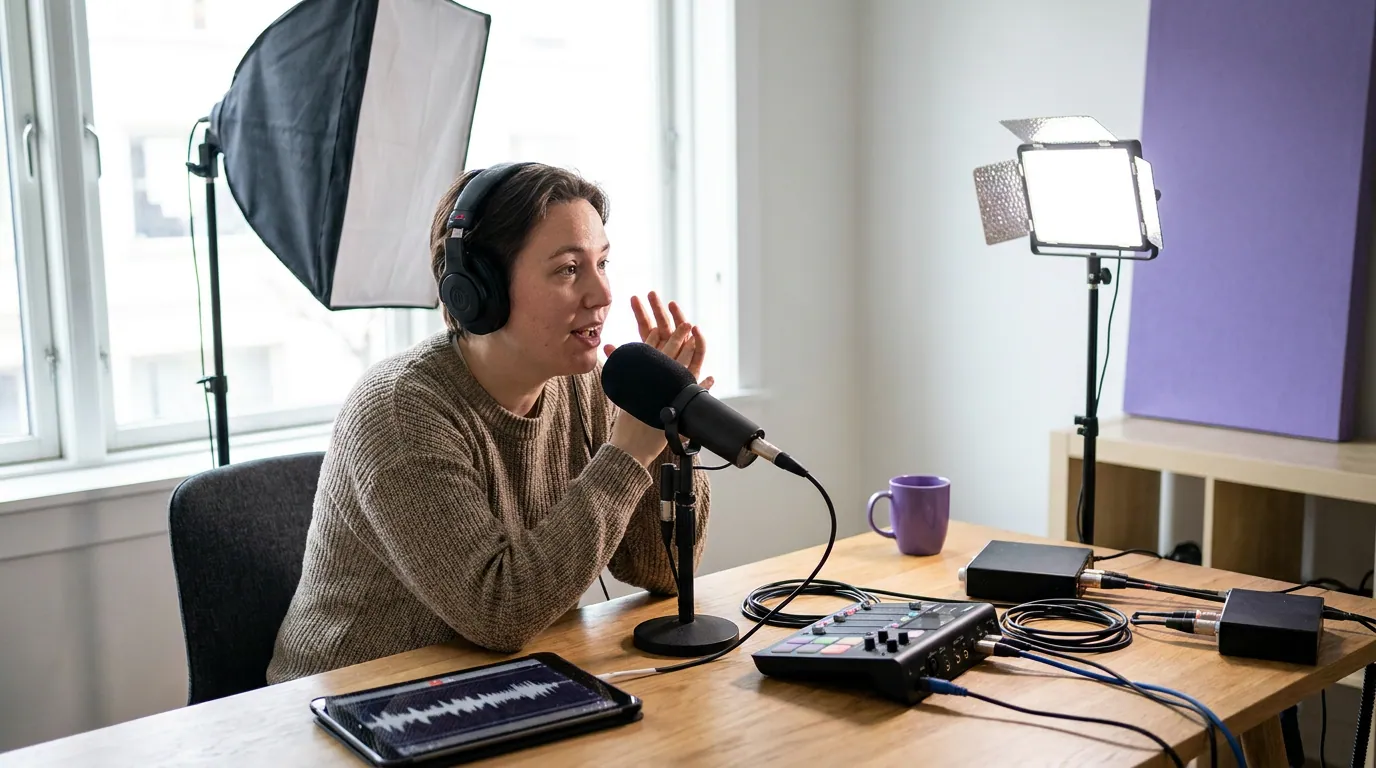
The two contenders, reviewed honestly
Elgato Key Light (LED panel), $179.99
The Key Light is a slim, edge-lit panel that puts out 2,800 lumens across a 2900–7000K range from 160 OSRAM LEDs, mounted on a telescopic pole with a padded desk clamp (Elgato specs). It has no physical buttons. You set brightness and color temperature from the Elgato app or, the real reason streamers love it, from a Stream Deck, one tap to dim for a darker segment, one tap to warm it for a moody intro.
What it's genuinely good at: the desk footprint and the control. The clamp means it floats above your desk and gives back all your surface area, which matters in a small room where a stand would be in shot. App and Stream Deck control is real and reliable, and the color is clean and consistent.
Where it falls short: the price per lumen is high, and a bare panel is a harder light than a softbox. You can soften it with a stick-on diffuser, but you're paying flagship money for a single source that a ~$120 two-softbox kit out-softens on day one. The clamp also needs a desk edge with a flat lip, it won't sit on a shelf or the floor.
Best for: a one-person desk-cam setup in a tight room, especially if you already run a Stream Deck.
Softbox kit (Neewer 700W-equivalent / Godox SL60), ~$120–$140
A softbox kit is a light bulb or COB fixture inside a fabric box that diffuses the output into a large, soft source. The popular beginner pick, the Neewer 700W-equivalent (NK200) kit, includes two 24-inch softboxes, two 35W 5700K LED bulbs rated around 3,150 lumens each (CRI 93), two 83-inch stands, and a bag, listed at $119.99 on sale / $139.99 regular (Neewer; Amazon listing). Step up and a Godox SL60W COB body runs around $130, CRI 95+ at a fixed 5600K (Godox). Amazon coupons and sales swing these by $20–$40, so a kit dips lower if you catch a deal, but don't bank on it.
What it's genuinely good at: softness and value. You get two large, flattering sources for less than one Key Light, which is enough to do real key-and-fill lighting. Adding a third for a backlight is cheap. The look is closer to a studio than any bare panel.
Where it falls short: it eats floor space, stands have legs that splay, and they show up in wide shots. Most cheap kits have no app; you adjust on the unit, and the budget bulb versions aren't dimmable at all. COB fixtures like the SL60W have a cooling fan that can be audible if it sits near your mic (Keith Knittel review), a real concern for a podcast. Bi-color or fan-free versions cost more.
Best for: anyone with a few feet of floor space who wants the best image for the money, or a two-host setup that needs to light two faces.
Side-by-side: Key Light vs softbox kit
Prices verified June 2026; lighting gear goes on sale often, so re-check before you buy.
| Factor | Elgato Key Light | Softbox kit (2-light) |
|---|---|---|
| Price | $179.99 (one light) | ~$120–$140 (two lights) |
| Light quality | Clean, harder source | Softer, more flattering |
| Desk / floor | Clamps to desk, no floor | Needs stands + floor space |
| Control | App + Stream Deck | On-unit; cheap kits not dimmable |
| Noise | Silent (no fan) | COB models can have fan noise |
| Best for | Tight desk, solo, Stream Deck | Best look per dollar, 2 hosts |
Two things this table hides. First, the Key Light's $179.99 buys one light; to do proper key-and-fill you'd buy two, putting you near $360, versus ~$120–$140 for a two-softbox pair that already does key-and-fill. Second, "control" cuts both ways: the panel's app dependence is a feature until your Wi-Fi drops mid-record and you can't dim it, whereas a knob on a softbox always works.
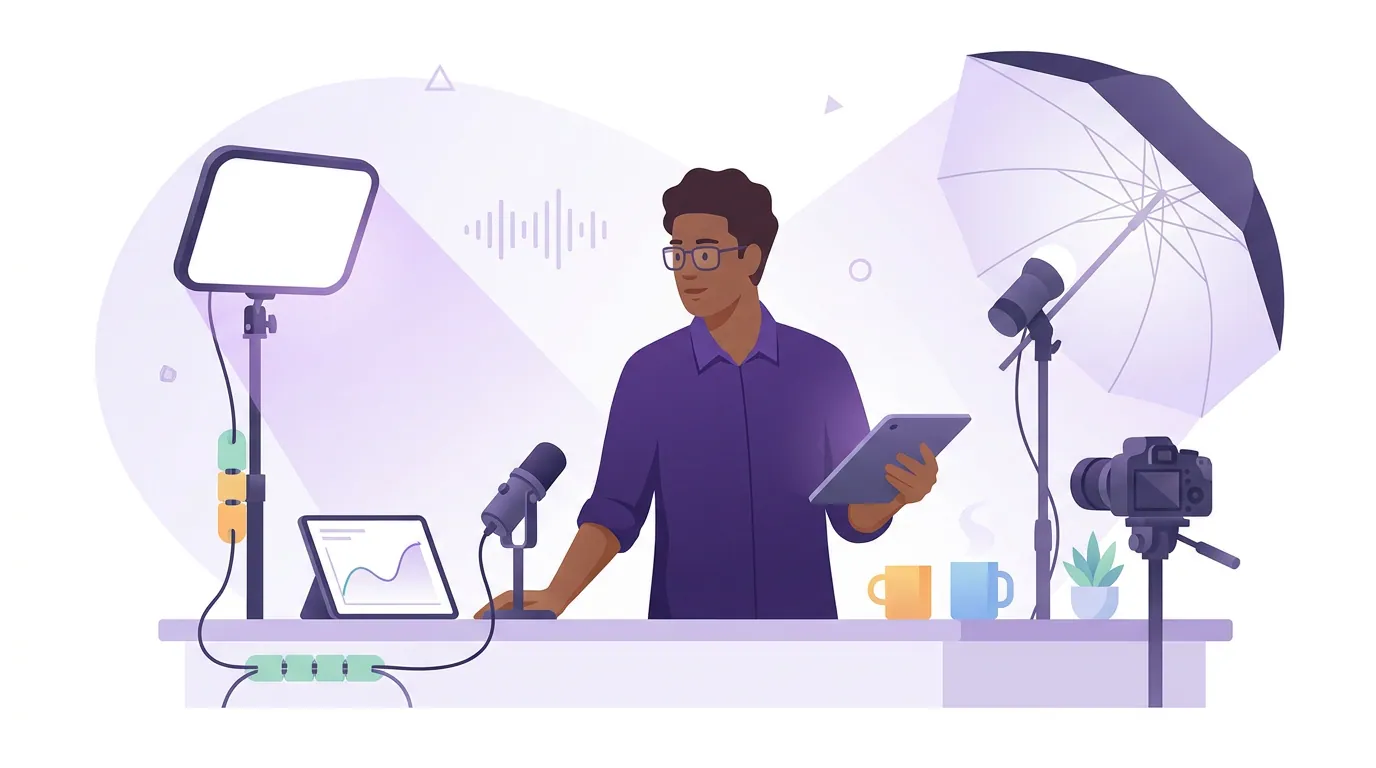
How we evaluated
This is a parts-and-physics comparison, not a torture test. The verdicts come from setting up home and studio rigs on budgets from $150 to $5,000 and from the specs and prices published by each maker, verified in June 2026. Every number here is sourced inline. We weighted three things a podcaster actually feels day to day: softness (how flattering the light is on camera), footprint (does it steal desk or floor you don't have), and control (how fast you can change it mid-record). We did not test long-term LED degradation or color drift over years.
Keep the cost in proportion. Every option priced here lands between roughly $60 and $360, a single Key Light ($179.99), a two-softbox kit (~$120–$140), or a Godox COB body (~$130). That tracks the wider beginner-podcast math, where most home setups stay under a few hundred dollars total (Ausha). Spending past that on lights, before you've fixed mic technique and framing, is rarely where the next jump in quality comes from.
The decision rule
Don't pick by brand. Pick by your room and how often you move the rig.
- Tight room, camera on the desk, one host, you own a Stream Deck. Buy the Key Light. The clamp and tap-to-dim control earn their price here, and you don't have floor space for a stand anyway.
- You have a few feet of floor and want the best image for the money. Buy a two-softbox kit. You'll get softer, more flattering light from two sources for less than the price of a single panel, and room to add a backlight.
- Two hosts side by side. Softboxes, almost always. Lighting two faces evenly wants two large sources on stands, and a pair of softboxes is cheaper than a pair of panels.
- You travel or record in different rooms. A portable battery panel was the answer, but with the Key Light Mini discontinued, look at current battery panels from Aputure or Ulanzi, or a collapsible softbox you can break down.
- Your mic is close to your light. Avoid fan-cooled COB softboxes; pick a fanless panel or a fan-free LED, or your room tone picks up a hum.
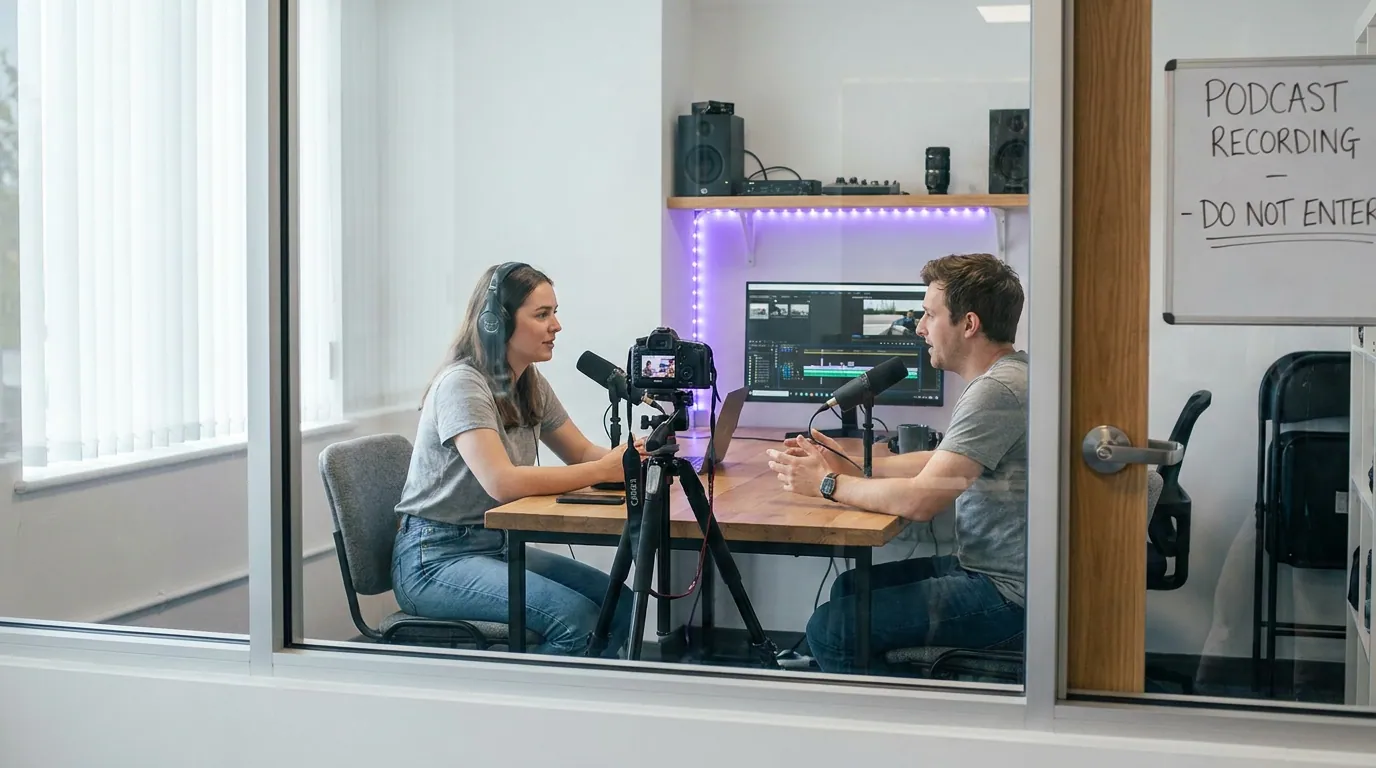
What matters more than the light you buy
Three placement moves beat any spec upgrade, and they cost nothing:
- Put the key light at roughly 45 degrees to your face and slightly above eye level. Dead-on flat lighting from a ring light or a panel directly behind the camera is the most common look that screams "first episode."
- Get the source close. A light two feet from your face is a much larger, softer source than the same light eight feet away. Proximity is free softness, it's why a small panel held close can rival a softbox set far back.
- Kill the overhead room light or push it warm. Mixing a cool key with a warm ceiling bulb gives you two colors of light on one face, which no fixture fixes.
Once the light is right, lighting is one rig decision you make once. The recurring work in a video podcast is everything after, recording cleanly, then turning each episode into the clips that bring new people to the show. Most of the hours go there, and so should most of your gear-shopping energy: get the mic right for your budget and a repeatable episode structure before you obsess over a second key light.
FAQ
Is an Elgato Key Light worth it for a podcast?
If your camera is on your desk in a small room and you want app or Stream Deck control, yes, the $179.99 Key Light (Elgato) earns its price on footprint and convenience. If you have floor space, a two-softbox kit gives a softer, more flattering look for less, so the Key Light is the worse value there.
Why is a softbox softer than an LED panel?
Shadow softness depends on the size of the light source relative to your face. A 24-inch softbox is physically larger than a bare 9-inch panel, so its light wraps around you and the shadows fade gently instead of cutting hard. You can soften any panel by adding a diffuser or moving it closer.
Are Elgato Key Lights discontinued?
Partly. As of mid-2026, the Key Light Air and the battery-powered Key Light Mini are both marked "discontinued / no longer available" on Elgato's own store (Elgato), while the full-size Key Light remains on sale at $179.99. Buy a discontinued model only from a seller that accepts returns.
Do I need two lights for a video podcast?
For one host, a single well-placed key light plus a window or a bounce is enough to look good. A second light (a fill) softens the shadow on the dark side of your face, and a third (a backlight) separates you from the background. A two-softbox kit gives you key-and-fill out of the box.
Will a softbox fan be picked up by my mic?
It can. COB softbox fixtures like the Godox SL60W have a cooling fan that's audible up close (Keith Knittel review). If your light sits near your mic, choose a fanless LED panel or a fan-free softbox, or position the light far enough away that the fan drops below your room noise.
Related reading: USB vs XLR mics and when to switch, hybrid USB/XLR mics that grow with your show, the best podcast mic under $100 by use case, and scripting vs outlining for your show.