
Pop Filter vs Windscreen vs Built-In Foam


Most indoor podcasters need a pop filter, not a windscreen, and a few don't need either, because their mic already ships with built-in foam that handles plosives. A pop filter is the strongest fix for the "P" and "B" pops that ruin a take. A foam windscreen is weaker indoors and exists mainly to block outdoor wind. The right call comes down to two things: which mic you bought, and where you record.
The trade most guides skip is this: a $10 part can fix a problem that no $400 mic fixes on its own, and the part you need depends entirely on your situation. So before naming products, this guide gives you a decision rule. Score your setup, then buy the one thing it points to, or save your money.
What's the difference between a pop filter, a windscreen, and built-in foam?
A pop filter is a mesh or nylon screen on a gooseneck that sits a few inches in front of the mic and breaks up the air blast from plosive consonants before it hits the capsule. A windscreen is foam that slips over the mic to block outdoor wind. Built-in foam is the pop protection already inside many broadcast dynamic mics.
They solve overlapping problems with different strength:
- Pop filter (mesh or nylon): the most effective at stopping plosive pops indoors. Sits in the gap between you and the mic, so it doesn't muffle your sound. Best for spoken voice at close range.
- Foam windscreen: slips over the mic, blocks outdoor wind and stray breath, gives partial plosive protection. Convenient and cheap, but can dull high frequencies and is weaker on hard plosives than a pop filter.
- Built-in foam: the internal wind/pop screen inside many podcast dynamics. For some mics it's enough on its own; for sensitive condensers it usually isn't.
Plosives, the puff of air on "P," "B," and "T", are the single most common avoidable flaw in a beginner recording. They're not a volume problem you can turn down; they're a blast of air hitting the capsule, and the fix is physical, not a knob.
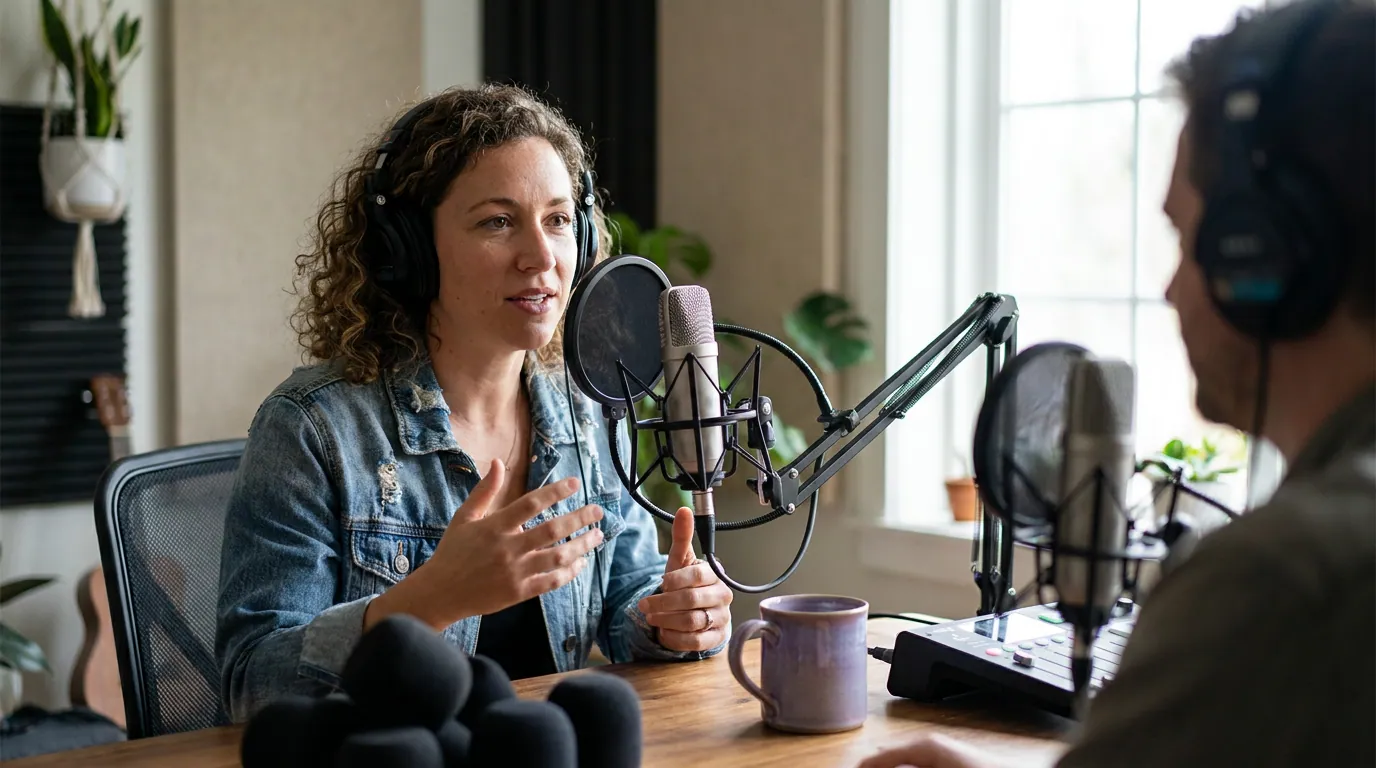
Do you actually need a pop filter? (the decision rule)
Buy a pop filter if you record close on a sensitive condenser or already hear pops on your "P" and "B" words. Buy foam instead if wind or a fan is the problem. Buy neither if you run a forgiving dynamic slightly off-axis and hear no pops. Score the five questions below to find your case in a minute.
- Is your mic a sensitive condenser (large-diaphragm, side-address)? Yes = +2 toward a pop filter.
- Do you record close, within about 4 inches of the mic? Yes = +1 toward a pop filter.
- Have you ever heard a "puff" or thump on your "P" and "B" words in a playback? Yes = +2 toward a pop filter.
- Do you record outdoors, near an open window, or with a fan blowing across the mic? Yes = +2 toward a windscreen (foam) instead.
- Is your mic a broadcast dynamic with heavy built-in foam, and you sit slightly off-axis (just past the front)? Yes = -1 (you may need nothing).
Score it. 2 or more points toward a pop filter and no outdoor factor: buy a pop filter. 2 or more toward a windscreen: you have a wind problem, buy foam. A score that nets to zero or below, a forgiving dynamic, off-axis, no audible pops, means you can skip both and re-test after recording an episode. The honest version: most indoor podcasters score toward the pop filter, because close miking plus plosives is the normal case.
Which mics already handle plosives, and which need help
Broadcast dynamics with deep built-in foam often handle plosives off-axis with no add-on. Lighter-foam dynamics still pop at close range. Large-diaphragm condensers, sensitive, side-address, recorded close, almost always need a pop filter. USB beginner mics vary, so check the box. The rule: the more exposed the capsule, the more you need a screen.
- Broadcast dynamics with deep built-in foam are the most forgiving. Their internal windscreen plus an end-address design (you talk into the top, not the side) means a slight off-axis angle often handles plosives without any add-on. Many big video podcasts run these bare or with just a windscreen.
- End-address dynamics with lighter foam still pop on hard "P" and "B" sounds at close range. They benefit from a pop filter for spoken voice.
- Large-diaphragm condensers are the most exposed. Side-address, sensitive, and usually recorded close, they catch plosives readily and almost always want a pop filter. This is the mic type where skipping one shows up in every episode.
- USB mics aimed at beginners vary. Some bundle a basic windscreen; few include a true pop filter. Check what's in the box before buying a second one.
If you don't yet know which camp your mic is in, our mics-by-budget-tier guide and the best picks under $100 note which models are forgiving on plosives and which need a screen. The short version: the more sensitive and exposed the capsule, the more you need a pop filter, and condensers sit at the top of that list.
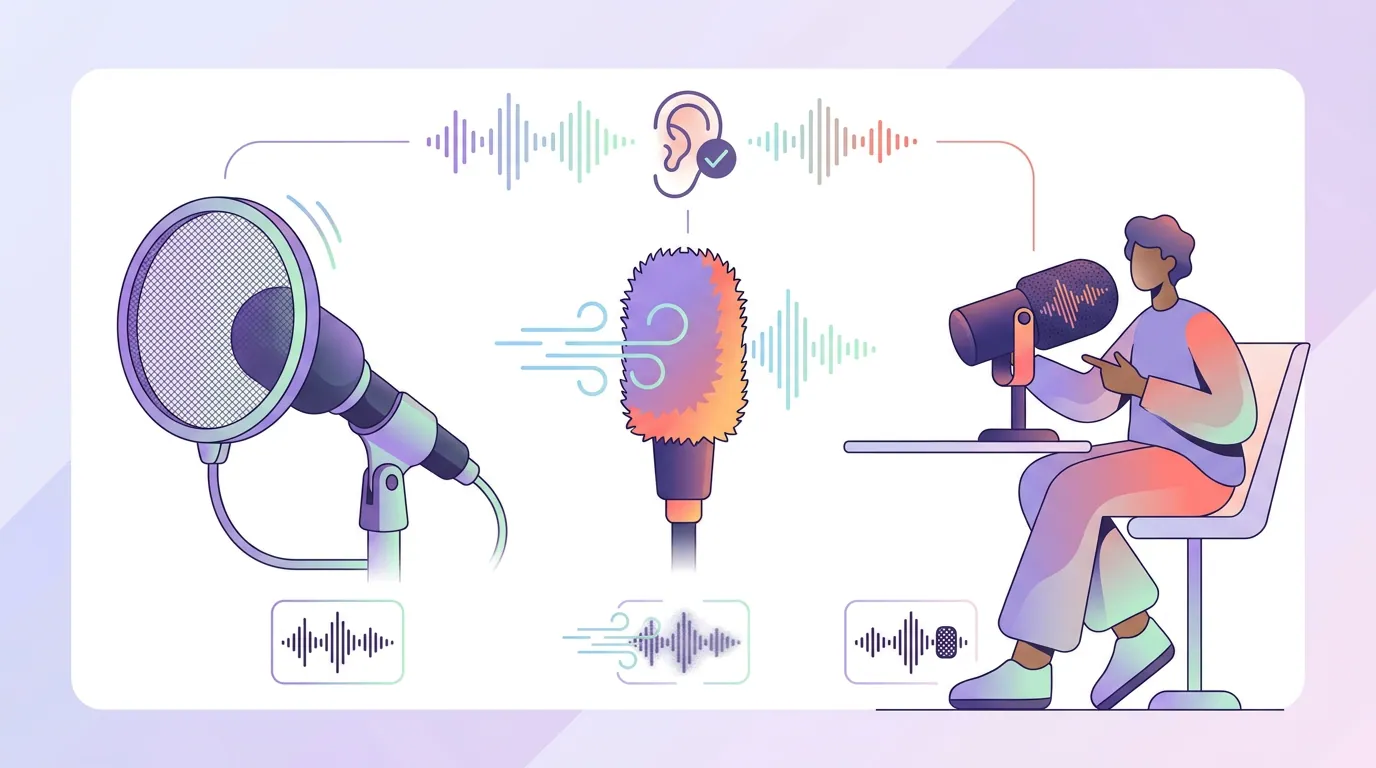
Pop filter vs windscreen vs built-in foam: the side-by-side
Read this after you've scored your setup, not before. It compares the three by what they actually fix and roughly what they cost.
| Factor | Pop filter (mesh/nylon) | Foam windscreen | Built-in foam |
|---|---|---|---|
| Best at | Indoor plosive pops | Outdoor wind, stray breath | Whatever the mic includes |
| Plosive protection | Strongest | Partial | Varies by mic |
| Effect on sound | Minimal (sits off the mic) | Can slightly dull highs | None added |
| Where it sits | A few inches in front | Over the mic | Inside the mic |
| Typical price | ~$10–25 | ~$5–15 | $0 (included) |
| Best for | Condensers, close miking | Field recording, vocal "huff" | Forgiving dynamics |
Two notes on price, because accessories are where guides quietly inflate the budget. A pop filter and a windscreen are both cheap, a rounding error against the $100–350 one-time equipment spend Ausha pegs for a hobby setup (podcast cost guide). You almost never need both at once: one solves indoor pops, the other solves outdoor wind, and most podcasters only have the first problem.
Nylon vs metal pop filters: which to buy
Buy nylon if you want the cheapest screen that stops pops well; buy metal if you want one that stays crisp, wipes clean, and survives years of use. Both kill plosives effectively. Nylon runs about $10–20 and metal from roughly $15 up to $40–70 for studio standards, so you pay for durability, not sound. The trade-offs in detail below.
- Nylon (the classic double-layer screen): cheapest, very effective at stopping pops, and slightly warmer because the fabric absorbs a touch of high end. Good dual-layer screens sit around $10–20 (the Auray PFSS-55 and Nady MPF-6 run about $19). The downside is it can sound marginally less crisp, and the fabric ages, it sags and yellows over a couple of years, so you replace it.
- Metal mesh: sips less high frequency, so it stays crisp, wipes clean, and lasts for years. Budget metal screens start around $15–25, but the studio standards cost more, the Avantone PS-1 is about $39 and the Stedman Proscreen XL about $69. It can be marginally less aggressive on the very hardest plosives than a dense nylon screen. You pay for longevity, not louder pop reduction.
One caution: don't treat the pricier screen as an audio upgrade. Neither material buys you sound quality your audience can hear on a clip, both fix the same plosive, and the pop, not the mesh, is the only thing a listener would ever have noticed.
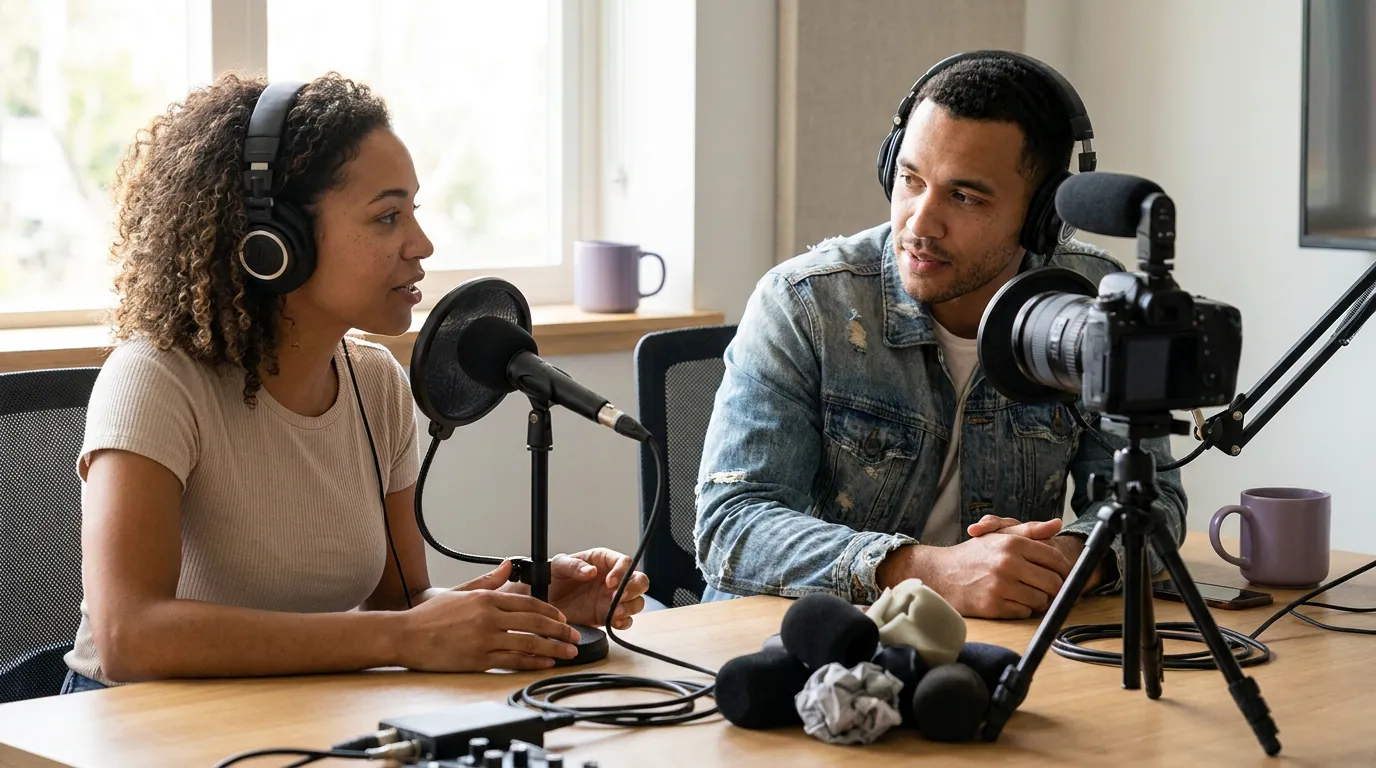
When you can skip both
You can record bare in three honest cases. First, a forgiving broadcast dynamic with heavy built-in foam, talked into slightly off-axis so the plosive air shoots past the capsule. Second, a singer's trick that works for voice too, angle the mic so your breath crosses it rather than hitting it head-on. Third, when you record far enough back that plosives lose their punch, though that usually trades the pop problem for a room-noise problem.
If you record bare and never hear a pop, you don't need an accessory. Don't buy one for a problem you don't have. The point of the decision rule is to stop you from spending on a metal pop filter your dynamic mic never needed, and to make sure a condenser owner doesn't try to fix plosives in software take after take.
Common mistakes that waste the accessory
The screen matters less than how you use it. In rough order of damage:
- Mounting the pop filter touching the mic. It needs a gap, roughly 2–4 inches between you and the screen, and the screen a couple of inches off the mic. Pressed flat against the capsule, it barely works.
- Buying a windscreen to fix indoor pops. Foam is a wind tool. It helps a little with plosives but isn't the right fix; a pop filter is. Wrong tool, mediocre result.
- Owning both and using neither correctly. Pick the one your situation calls for. Stacking both rarely helps and can dull your sound.
- Ignoring mic angle. A slight off-axis tilt does half the work for free, on any mic. Many "I need a better pop filter" problems are really "talk slightly across the mic" problems.
- Treating the screen as a fix for a bad room. A pop filter stops plosives; it does nothing for echo or background noise. Those are room and mic-type problems.
Why sweat a $10 part at all? Because the flaws that make a recording sound amateur are mostly small, fixable ones, and consistency is what keeps a show alive. Nearly half of all podcasts never make it past their first three episodes Amplifi Mediaon podcast failure rates). A recording you don't cringe at is a recording you'll keep making. Pair clean audio with a repeatable episode structure and the right prep, scripting or outlining, and the gear stops being the thing you think about.
FAQ
Do I really need a pop filter for podcasting?
If you record close on a condenser or hear pops on your "P" and "B" words, yes, a pop filter is the most effective fix and costs about $10–25. If you use a forgiving broadcast dynamic with heavy built-in foam and sit slightly off-axis, you may not need one. Record a test and listen for plosives before deciding.
What's the difference between a pop filter and a windscreen?
A pop filter is a mesh or nylon screen that sits a few inches in front of the mic and is the strongest fix for indoor plosive pops. A windscreen is foam that slips over the mic and mainly blocks outdoor wind, with weaker plosive protection. Indoors, choose the pop filter; outdoors or with a fan, choose foam.
Is a nylon or metal pop filter better?
Both stop pops well. Nylon is the cheapest effective option and slightly warmer, but the fabric ages. Metal mesh stays crisp, wipes clean, and lasts far longer for a few dollars more. For spoken voice the audible difference is small, so pick by durability and price, not sound quality.
Does the built-in foam on my mic count as a pop filter?
Sometimes. Heavy built-in foam on broadcast dynamics handles plosives well, especially off-axis. Lighter foam on cheaper or USB mics often doesn't, and condensers usually need a separate pop filter. Check your mic's spec and run a test recording, the foam either kills the pops or it doesn't.
Will pops ruin my social clips?
Yes, more than you'd expect. A plosive thump survives platform compression and stands out on quiet phone speakers and earbuds, where most clips are watched. Clean, pop-free audio holds up after TikTok, Reels, and Shorts re-encode it, and the cleaner your source, the less you fight your edit later.

The one-line rule
Score your setup. A sensitive mic, close miking, or audible pops points to a pop filter; wind or outdoors points to foam; a forgiving dynamic off-axis points to nothing. Buy the one thing the rule names, mount it with a gap, and move on. The accessory is cheap and the decision is quick, match it to your mic with our mics-by-budget-tier guide or, if you want a setup that scales, a hybrid USB/XLR mic that grows with your show.
Clean audio isn't only kinder to your ears. It's what makes the short clips you cut from each episode watchable, and clips are how most new listeners find a show in the first place.