
The Best Video Podcasts and What They Get Right


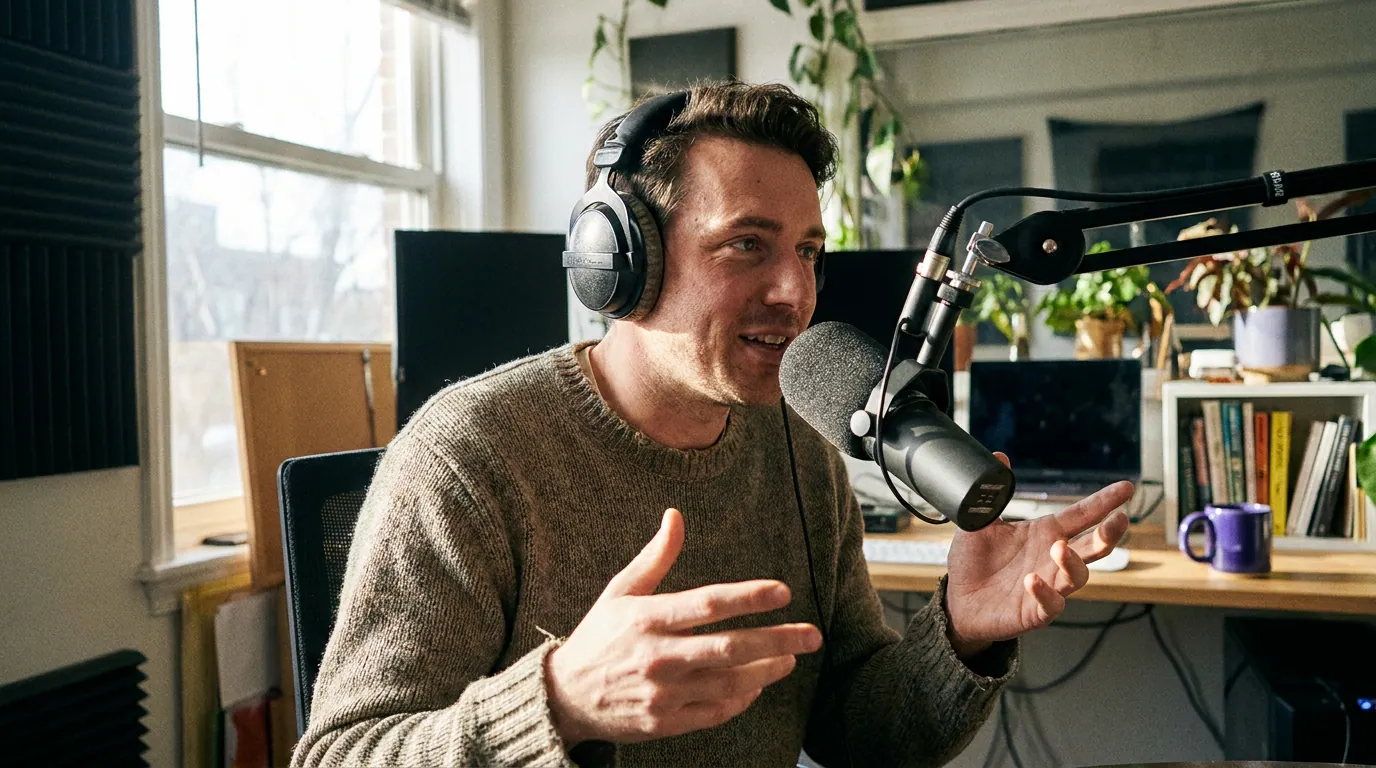
The best video podcasts are not audio shows with a webcam bolted on. They are built for the eye: two or more camera angles, a set that reads as a brand in a thumbnail, hosts who hold a clear eye-line, and conversation staged so any single moment survives as a standalone clip. Budget is not the dividing line. Staging is.
Scan any "best podcasts to watch on YouTube" list and the top looks chaotic. The 2025 YouTube year-end rankings put The Joe Rogan Experience, Kill Tony, Good Mythical Morning, The Diary of a CEO, and The Shawn Ryan Show in the same top 10 (Deadline, Dec 2025), and their production styles share almost nothing on the surface. One is two mics in a room. One opens like a Netflix documentary. So this is not a ranked list. It is a teardown of the four staging decisions those shows quietly have in common, written so you can copy the decisions without copying the budget.
What makes a video podcast actually work?
A video podcast works when the picture carries information the audio cannot, and when any 30-90 second stretch can stand alone as a clip. In practice that means multi-camera coverage, a recognizable set, disciplined eye-lines, and framing that leaves room for captions and a vertical crop. Get those four right and a cheap rig outperforms an expensive one.
Staging matters more every year because of where the audience now lives. YouTube is the most-used US podcast platform, Backlinko put it at 42% of monthly listeners as of October 2025, ahead of Spotify and Apple (Backlinko), and it reaches more than a billion monthly podcast viewers globally (Variety, Feb 2025). Platform-share numbers move around by survey, so treat the exact percentage as a range; the direction does not. More people choose to watch a podcast every quarter, and roughly 50.6% of shows now post full video to YouTube, up about 130% from 2022 levels (PodRewind, Jan 2026). When the default place people find a show is a video feed, the staging is the product.
The shows worth studying (and why, not just who)
There is no single winning format, and the rankings prove it. Episode lengths run from 15 minutes to over three hours, cadence from weekly to daily, subscriber counts from 2.5 million to 20.5 million (Deadline). What follows is a short curated set chosen for what a new host can steal, directory pages for each live on fanpage.wiki.
- The Joe Rogan Experience, the #1 show by watch time, 20.5M subscribers (Deadline). The setup is deliberately plain: a room, two mics, a few cameras with auto-switching between speakers, no B-roll, no transitions (Castos). The lesson is that minimalism done with intent beats clutter, but the framing and switching are still video decisions, not accidents.
- The Diary of a CEO (Steven Bartlett, 13.8M subscribers), the opposite pole. Cinematic cold opens, dramatic lighting, editing that reads as a documentary (Castos). Steal the set as credibility idea: the room tells you this conversation is serious before a word is spoken.
- Kill Tony (2.5M subscribers), a live stage show taped in Austin with audience reactions baked into the format (Deadline). The crowd is staging. Reactions give the editor a built-in supply of clip-ready beats.
- Good Mythical Morning (19.4M subscribers, weekday cadence), a full variety set with props and challenges (Deadline). It was designed for video from the first frame; nothing about it would survive as audio.
- This Past Weekend w/ Theo Von and The Shawn Ryan Show, long-form, unstructured, but with consistent framing and thumbnail discipline that make every episode recognizable at a glance (Castos).
The staging teardown: four decisions that separate them
Strip away the budgets and the four patterns below are what the top shows actually share. This is the information-gain part of the page, a production checklist drawn from the leaders, not a list of who they are.
1. Multi-camera coverage, scaled to the format
The baseline among serious video shows is at least two angles, even if both are phones (Castos). Coverage scales with how many people are talking. An interview show like Rogan runs two or three angles with auto-switching between speakers (Castos); a panel needs more cameras still so every reaction is on a face when it lands. Two angles do two jobs at once: they give the live edit a cut to make when energy spikes, and they hand the clipping team a second framing for the vertical crop. A single static shot gives you neither.
2. Set design as a brand asset
A set's first job is not to look expensive. It is to be recognizable in a thumbnail the size of a fingernail. The Diary of a CEO's dark, dramatic room signals seriousness; Good Mythical Morning's prop-filled variety set signals play; Kill Tony's live stage signals crowd and chaos (Castos). None of those reads as "a person at a desk." Pick two or three visual constants, a backdrop color, a light shape, one object always in frame, and never change them. Those constants are what let a returning viewer recognize your show before they read the title.
3. Eye-line discipline
Decide where each person looks and hold it. Rogan and his guests look at each other; the cameras observe (Castos). A direct-to-camera monologue looks at the lens. What kills a clip is the wander, eyes drifting to a second monitor, a phone, a producer off-screen, because the viewer instinctively reads a lost eye-line as a lost moment. The fix costs nothing: put the thing people glance at (notes, the run sheet, the other host's video on a remote) as close to the lens as possible, and mark the camera you address.
4. Clip-ready framing
This is where most shows that "added video" still lose. The leaders frame so a moment can be lifted out whole: faces kept off the dead-center where a vertical crop or captions will land, headroom that survives a 16:9-to-9:16 reframe, and a steady supply of reactions the editor can isolate. The clip economics make this non-negotiable. The top shows run heavy clip operations, Rogan's clips channel posts several times a day, and Diary of a CEO publishes multiple clips per full episode (Castos). Captions matter as much as the crop: a large share of social video is watched on mute, a figure commonly cited around 75% (Sharethrough, via Digiday), so a clip with no on-screen text loses the room before it speaks.
What they have in common (and what they don't)
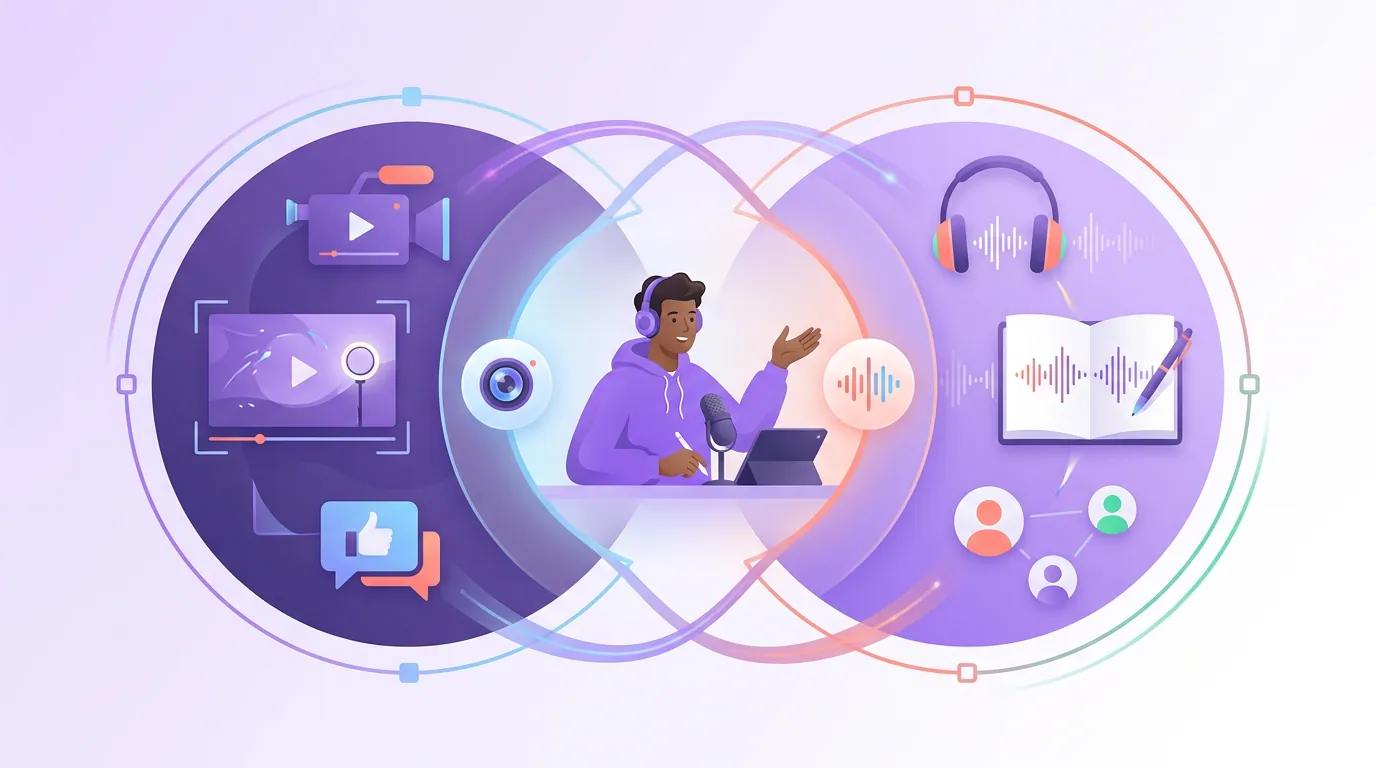
The shared thread is not a look, it is intent. Every show in the top 10 was either built for video from the ground up or had its video staging treated as a real production decision, never a camera bolted onto an audio workflow (Castos). The differences are real and worth respecting: Rogan proves restraint can win, Bartlett proves polish can win, Kill Tony proves a live crowd can win. The constant underneath is that someone decided, on purpose, what the picture would do.
| Staging decision | Minimalist (Joe Rogan) | Cinematic (Diary of a CEO) |
|---|---|---|
| Cameras | A few, auto-switching | Multi-cam plus B-roll |
| Set | Bare room, two mics | Dark, lit for drama |
| Editing | No transitions, no graphics | Documentary-style cold opens |
Source: Castos, 2026. Both shows chart in the YouTube top 10, the staging logic differs, the deliberateness does not.
For the country- and format-specific patterns behind the leaders, see the production habits the top US podcasts share, why the UK top 10 looks nothing like the US, and the business podcasts worth studying as a new host. For genre-specific staging, what the best true crime hosts do differently is a useful contrast. And if you are working in a smaller market, the small-market playbook from Australian podcasts and the cross-border problem Canadian shows face show how staging adapts to scale.
FAQ
Do you need an expensive studio to make a good video podcast?
No. The dividing line is staging, not spend. A two-camera setup, one consistent backdrop, a marked eye-line, and clip-ready framing will outperform a single static angle shot on costly gear. Joe Rogan's #1 show runs a deliberately plain room (Castos), the decisions are what cost effort, not money.
How many cameras does a video podcast need?
At least two, even if both are phones (Castos), scaled to your format. Solo and narrative shows manage on one to two angles plus a wide; interviews like Rogan's run two to three with auto-switching (Castos); panels want more so every reaction is covered. A second angle exists to give both your live edit and your vertical clips somewhere to cut.
Is YouTube the best platform for a video podcast?
For reach, yes, by a wide margin right now. YouTube is the most-used US podcast platform, Backlinko puts it around 42% of monthly listeners (Backlinko), and serves over a billion monthly podcast viewers globally (Variety). Platform-share figures vary by survey, but YouTube leads in every recent one.
What's the difference between a video podcast and an audio show with a camera?
A real video podcast uses the picture to carry information and stages conversation so any 30-90 second stretch survives as a standalone clip. An audio show with a camera bolted on records a fixed shot and ignores eye-line, set, and crop. The top 10 are the former, regardless of budget (Castos).