
The Best Podcasts for Creators Who Want to Get Better


The best podcasts for creators are the ones that teach a skill you can test this week, not the ones that just make you feel motivated for an hour. Six shows do that reliably: Creator Science and The Colin and Samir Show for growing an audience, My First Million for the business model, WTF with Marc Maron and Conan O'Brien Needs a Friend for interviewing, and Deep Dive with Ali Abdaal for sustainable output. Pick by the problem in front of you, not by the host's follower count.
Most "best creator podcasts" lists are a popularity ranking with a sentence of praise per show. That tells you what is famous, not what fixes the thing you are stuck on. This page is built differently. Every pick is grouped by the specific problem it solves, comes with the one episode to start with, and includes the honest reason it earns the slot. Listen to one, write down a single idea, and try it before the next episode. That is the whole method.
How to actually use a creator podcast (the fix-first rule)
Decide what you are trying to fix before you press play. A show about audience growth will not help a creator whose real problem is that recording the show drains them every week. A monetization show is wasted on someone who has no audience to sell to yet. Match the show to the bottleneck, take one tactic per episode, and test it. Listening more is not the same as improving.
That rule sounds obvious and almost nobody follows it. The default is to queue whatever is popular and absorb it as background audio while doing dishes. Background listening builds vocabulary; it does not build skill. The creators who get better treat a good episode like a single coaching session: one takeaway, written down, applied to the next thing they publish.
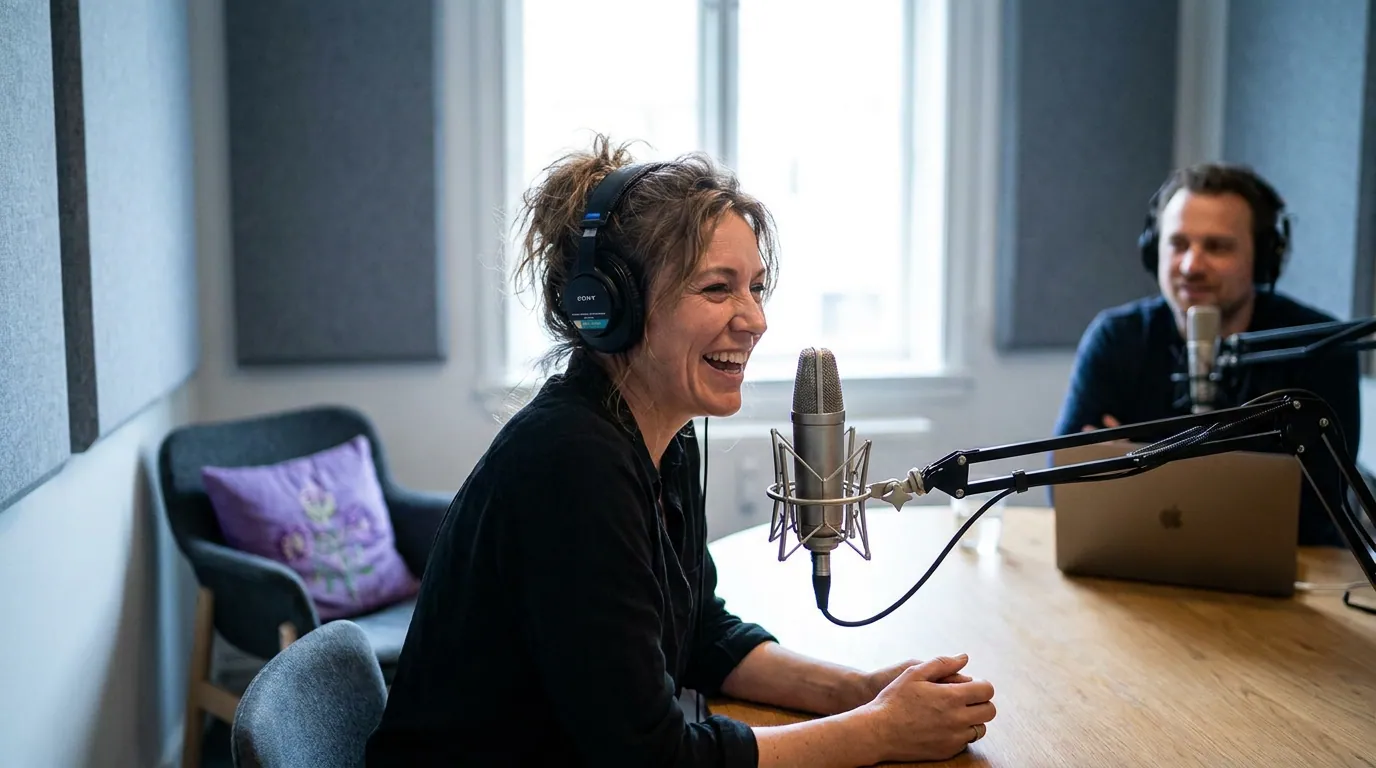
So group the field by problem. There are four problems worth solving with a podcast, your audience, your money, your interviewing, and your stamina, and a small number of shows that are genuinely good at each. The diagram below is the map.
What are the best podcasts for growing a creator audience?
For audience growth, start with The Colin and Samir Show and Creator Science. Colin and Samir break down the creator economy from inside it, they have made YouTube videos together for over a decade and interview the people at the top, from MKBHD to MrBeast (colinandsamir.com). Creator Science, hosted by Jay Clouse, runs evidence-backed conversations on what actually moves audience trust and reach (podcast.creatorscience.com).
These two pair well because they cover different altitudes. Colin and Samir are strong on the macro picture: how formats build a brand, how platform shifts change distribution, where brand-deal money is moving. They are candid about the hard math, too, they talk openly about how a booming creator economy (estimated around $250B in 2025) still leaves most individual creators earning little, and they break down where the money actually goes (NeoReach, 2025). That honesty is the tell of a show worth your time.
Creator Science goes narrower and more tactical. Episodes sit down with one creator and dissect a single mechanism, a launch, a YouTube thumbnail system, a newsletter engine, with the numbers attached. It is part of the HubSpot Podcast Network and has run for several hundred episodes, so the back catalog is a library, not a feed.
| Show | Best for | Start with |
|---|---|---|
| The Colin and Samir Show | Reading platform shifts and the creator-economy big picture | A recent "state of the creator economy" episode |
| Creator Science | Copying one creator's exact growth mechanism | The "How To Succeed on YouTube Today" episode with Colin & Samir (#263) |
The starting move with both: do not binge. Pick the episode whose guest is closest to your format, extract the one structural choice they made, and copy that, not their personality. A history-podcast host should steal Creator Science's system for testing thumbnails, not the guest's on-camera style.
For a deeper read on what the very top of the chart does that you can replicate without their budget, see our breakdown of the production habits behind the top US podcasts.
What are the best podcasts for the creator business and making money?
For the money question, My First Million is the most useful single show. Hosts Sam Parr and Shaan Puri reverse-engineer business models and revenue ideas, often with founders and operators in the room (mfmpod.com). Parr built and sold a newsletter business and now runs a paid community, so the show teaches from someone who has actually monetized an audience, not just theorized about it.
Start with one of the show's "business brainstorm" episodes, the recurring format where Parr and Puri spitball revenue ideas live. Search the back catalog for an episode whose topic touches your audience (newsletters, communities, info products) and listen for the mechanism, not the specific idea. That format, repeated, is the actual lesson.
The reason a money-focused show matters is unglamorous. Most creators do not earn a living. NeoReach's 2025 Creator Earnings Report, which surveyed over 3,000 creators, found that roughly half make less than $15,000 a year, and that the share at the bottom has grown, not shrunk (NeoReach, 2025). Audience size is not the constraint for that group; a missing business model is. My First Million is, in effect, a weekly seminar on the model.
One caveat to hold onto: creator-earnings surveys vary by sample and threshold. Some use a $10,000 line, some $15,000, and self-selected respondent pools skew differently year to year. Treat "about half earn very little" as the durable, well-supported finding, not any single decimal.
The companion data point worth knowing is where the reliable money has gone. Podcasters on Patreon earned $629 million in 2025, up 33% year over year, making podcasts Patreon's biggest content category (Variety, 2026). The lesson that shows like My First Million keep returning to: own the audience relationship and sell something directly, rather than living entirely on platform ad revenue you do not control.
If your real need is the business model specifically, our companion guide to business podcasts worth studying as a new host goes deeper on that shelf.
What are the best podcasts for learning to interview and host?
To get better on the mic, study the interviewers, not the advice-givers. WTF with Marc Maron is the textbook. Maron essentially defined the long-form interview podcast in 2009, and across 1,686 episodes he pulled disarmingly honest conversations out of guests from Barack Obama to Robin Williams (Wikipedia: WTF with Marc Maron). The show wrapped its original run in October 2025, which makes it a closed, studyable archive rather than a moving target.
What you are learning from Maron is restraint and follow-up. He lets silence sit. He asks the second and third question instead of moving to the next item on a list. New hosts over-prepare a script and then cling to it; Maron models the opposite, prepare the territory, then actually listen and chase what the guest just said. That single habit separates a real conversation from a press junket.
Pair it with Conan O'Brien Needs a Friend for a different muscle: warmth and play. Conan, despite decades of celebrity interviews, built his podcast around the admission that he had made almost no real friends from all those interviews, so the show's premise is connection, not promotion. Notably, when the two met on each other's shows, Conan openly treated Maron as a teacher and asked him for podcasting tips, which is itself the lesson: even a veteran broadcaster approached the medium as a new skill to learn.
Where to start: Maron's final episode (#1,686), with Barack Obama, dropped October 13, 2025 and is a clean entry point, a famously guarded guest opened up because the host kept following the thread (NBC News, Oct 2025). For Conan, pick any episode whose guest he clearly knows personally; the rapport you are studying shows up fastest there.
The contrast is the value. Maron shows you how to go deep; Conan shows you how to keep it human and funny so depth does not turn into an interrogation. A useful drill: take one Maron episode and one Conan episode with the same kind of guest, and mark every moment the host could have moved on but chose to dig in instead. Those choices are the craft.
| Show | The skill it teaches | Watch for |
|---|---|---|
| WTF with Marc Maron | Listening, silence, the follow-up question | How he ignores his "next question" to chase the live answer |
| Conan O'Brien Needs a Friend | Warmth, play, real rapport | How humor lowers a guest's guard before the honest part |
If interviewing is your main game, our guides to what the best true crime hosts do differently and the small-market playbook behind top Australian podcasts both pull apart hosting choices in narrower niches.
What are the best podcasts for avoiding creator burnout?
For stamina, Deep Dive with Ali Abdaal is the most grounded pick. Abdaal built his audience while explicitly studying sustainable, "feel-good" productivity, and the show interviews creators and entrepreneurs about how they keep producing without grinding themselves down (Deep Dive on Apple Podcasts). Episodes run long and conversational, releasing roughly every five days, which is itself a model of a manageable cadence rather than a daily treadmill. Where to start: pick an episode whose guest is a full-time creator at your stage, and listen specifically for how they structure a week, that pacing detail is the takeaway, not the motivation.
Burnout ends most shows before they find an audience. When Amplifi Media x-rayed the Podcast Index database of about 4 million titles, 47% had produced three episodes or fewer (Amplifi Media, 2022). That figure counts feeds, so it overstates abandonment a little, some are tests or trailers, but the shape is clear: most podcasts quit early. Few of them stop because the idea was bad. They stop because the workload was unsustainable. A show about pacing yourself is survival content, not a soft luxury.
The honest framing Abdaal's show keeps returning to is to design output you can actually maintain, then protect it, rather than chasing maximum volume and flaming out in a quarter. For a creator, that often means doing less per piece and more reliably: a tighter system, a smaller publishing promise you can keep, and ruthless reuse of what you already make. One recording, cut into many smaller pieces, beats five separate productions you cannot sustain.
That reuse point is where the workload math gets practical. A single 20–40 minute episode holds enough strong moments for a week or two of short posts (a directional rule of thumb, not a precise count), and clips are now how a large share of new listeners discover a show in the first place, 57% of listeners say they rely on social media for podcast recommendations, the first time that surpassed friends and family (InsideRadio). Repurposing is not just a growth tactic; it is the lower-effort path that keeps a tired creator publishing.
What they have in common (the part worth copying)
Strip away the genres and these six shows share four traits. Naming them is more useful than any single recommendation, because the traits are what make a creator-education show worth your hours.
- They teach mechanisms, not moods. The good episodes leave you with a specific thing to try, a thumbnail test, a launch sequence, a follow-up question technique, not a feeling.
- They are honest about the downside. Colin and Samir on creator pay, Ali Abdaal on burnout, My First Million on ideas that flopped. Shows that only celebrate are entertainment, not education.
- The hosts are practitioners. Every host on this list actively builds the thing they teach. Avoid creator advice from people whose only product is the advice.
- The back catalog is the asset. Five of the six have hundreds of episodes. You are not subscribing to a feed; you are getting access to a searchable curriculum. Use the archive.
When you evaluate a show that is not on this list, run it against those four. If it teaches a mechanism, tells the truth about the hard parts, comes from a practitioner, and has a deep archive, it belongs on your list regardless of who is trending.
One more shared trait is hiding in the cadence and length numbers: none of these shows ships daily, and most run long. That matters for your own planning. A sustainable creator-education show looks like a weekly-ish release of a meaty episode, not a daily firehose, the exact pattern the burnout section argues for.
How we chose these shows
This is an editorial pick, and the criteria are worth stating plainly. We required each show to (1) teach a transferable creator skill, not generic motivation; (2) be hosted by someone actively building in the space; (3) have enough archive to function as a curriculum; and (4) check out against its own publisher and platform pages for current status, host, and format. WTF, for example, earns its slot as a closed, studyable archive after ending its original run in October 2025, not as an active feed.
What we deliberately left off: pure celebrity-interview shows with no craft takeaway, motivation-only shows with nothing to test, and shows hosted by people who teach but do not build. Those can be fun. They will not make you better.
FAQ
What is the single best podcast for a brand-new creator? Creator Science. It is the most consistently tactical of the group, the episodes are self-contained, and most center on one creator's specific, copyable mechanism, which is exactly what a beginner needs over big-picture commentary. Start with an episode whose guest works in your format.
Should I listen to creator podcasts or just make stuff? Make stuff first; that is non-negotiable. Use podcasts to fix a specific, named problem in what you are already making, a flat hook, a weak interview, no business model. Listening without publishing is procrastination dressed as research.
How many of these should I follow at once? One, until you have applied something from it. Pick the show that matches your current bottleneck, work through five or six episodes, and add a second show only when the first stops giving you new things to test. Following all six at once guarantees you absorb nothing.
Are video versions worth watching over audio? For interviewing shows, yes, watching WTF or Conan lets you study facial cues, pacing, and how a host signals "keep going." For business and growth shows, audio is usually enough, since the value is in the ideas, not the visuals. Watch the craft shows; listen to the rest.
Where can I read more about the hosts and shows? Each show keeps a public archive and host bio on its own site, and entity pages on fanpage.wiki collect the show, host, and episode details in one place. Use those for the facts; come back here for what to actually do with them.