
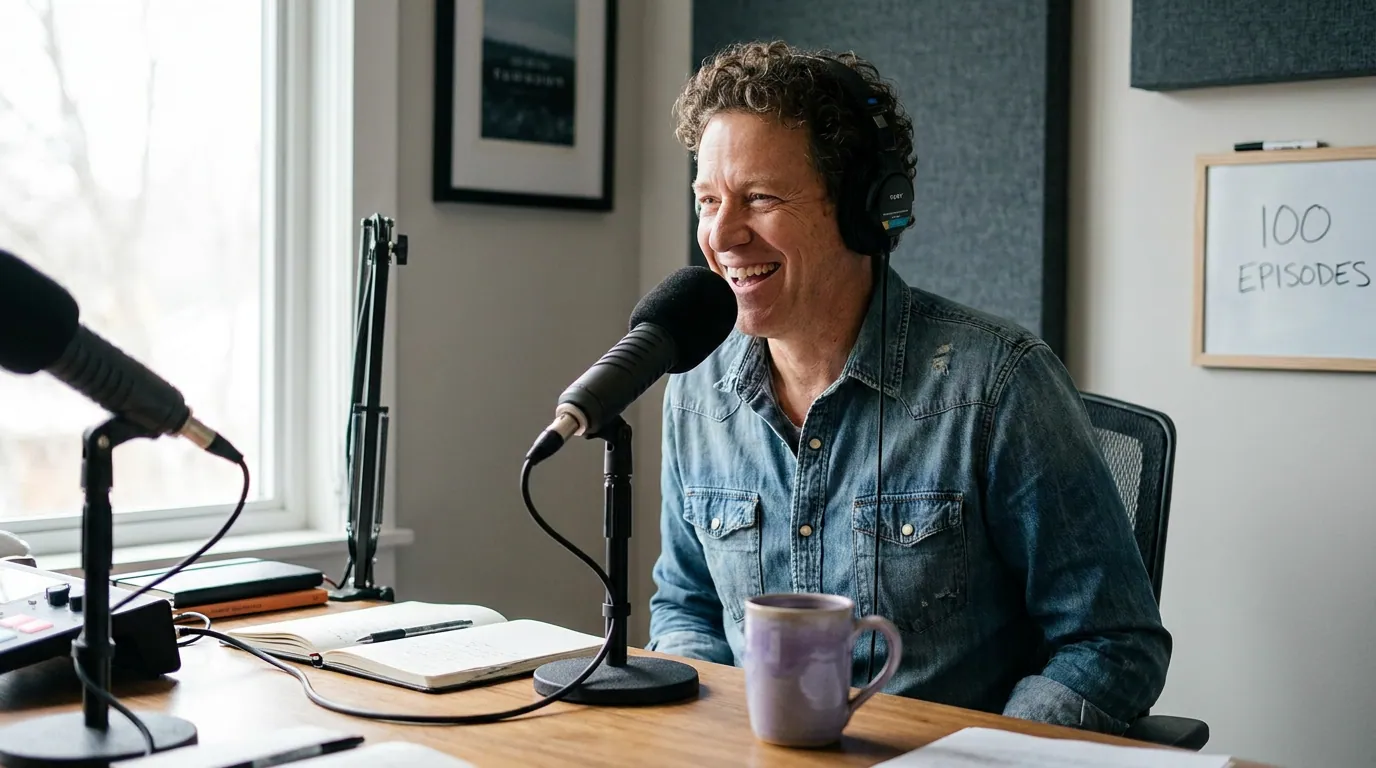
Celebrating (and Leveraging) Your 100th Episode

Reaching 100 episodes means you outlasted the vast majority of shows that ever start. About 47% of podcasts stop at three episodes or fewer (Amplifi Media analysis), and most that fade quit between episodes 7 and 25, long before triple digits. So mark it. Then make the round number earn its keep: record a special-format episode that's easy to share, and run a two-week press-and-outreach push that turns "we hit 100" into re-invited guests, a clip wave, and new subscribers.
Most hosts treat episode 100 as a private win, a quiet exhale, maybe a thank-you read at the top of the show. That's a waste of the only marketing hook you'll get for free this year. A round number is a reason to email people who'd otherwise ignore you: lapsed guests, press contacts, partner shows, your own list. The episode itself is the asset; the campaign around it is where the growth lives.
Is reaching 100 podcast episodes a big deal?
Yes, it puts you in rare company. About 47% of podcasts stop at three episodes or fewer (Amplifi Media analysis), and most that fade quit between episodes 7 and 25. By 100 you have cleared the danger zone that ends most shows. Consistency, not talent, got you here.
The honest caveat: these survival figures come from industry trackers and hosting samples that skew toward indie shows, since the largest platforms publish little public data. Read 100 episodes as a genuine signal of staying power against the visible field, not a precise global percentile. Either way, you're on the right side of a brutal drop-off curve.
The special-episode format menu
Don't record episode 100 the way you record episode 99. The whole point is shareability: pick a format that's naturally clip-friendly and gives lapsed listeners a reason to come back. Here are five formats that earn the occasion, scored by how much effort they cost and what they pay back.
| Format | Effort | Best when you want |
|---|---|---|
| Listener AMA | Low | Engagement and email replies, collect questions a week ahead, answer the best ones |
| Best-of supercut | Low–medium | A front door for new arrivals, stitch your strongest moments from 99 episodes |
| Behind-the-scenes | Low | Loyalty and parasocial pull, how the show is made, what changed, near-misses |
| Listener-voiced episode | Medium | Community proof, record fans' voice notes, stories, or thank-yous into the episode |
| Guest reunion / panel | High | A reach spike, bring back two or three past guests with their own audiences |
Pick by what you need right now, not by what looks most impressive. If your list has gone cold, the AMA pulls people back into a conversation. If you've grown a lot in a year, the best-of supercut doubles as a new-listener on-ramp, the self-contained episode you can point clips and swap partners at for months. If your goal is a one-week reach spike, the guest reunion is worth the scheduling pain because each returning guest brings a built-in audience to re-share to.
One rule across all five: build the episode so it stands alone. A first-time listener arriving from a clip or a guest's repost should understand it without your back catalog. That's the difference between a milestone that's a nice in-joke for regulars and one that converts strangers.
The press-and-outreach checklist
A round number is a permission slip to contact people. "We just hit 100 episodes" is a real, time-bound reason to land in someone's inbox without feeling like a cold pitch. Run it as a two-week campaign, not a single post.
Work the list in order:
- Tease it the week before. Tell your audience episode 100 is coming and what's in it. If you're doing an AMA or listener-voiced episode, this is where you collect questions and voice notes, give people a reason to participate, not just listen.
- Re-invite your best past guests. Email the guests whose episodes performed well: "We're at 100, your episode was one of the highlights, and I'd love to feature a clip of it / have you back for the reunion." Most will re-share to their own audience, which is reach a cold post never reaches.
- Send a short press note. Not a press release, a two-line email to any niche newsletter, local outlet, or trade blog that covers your space: "Independent [topic] podcast just hit 100 episodes; happy to share what we learned about [specific, interesting thing]." The round number is the hook; the specific lesson is what makes it printable.
- Run a clip wave for three days. Pull four or five clips from the milestone episode and your best-of moments, and post them across platforms. This is the part that reaches strangers, social clips now drive podcast discovery more than personal referrals, with 57% of listeners relying on social media for recommendations versus 54% on friends and family (InsideRadio).
- Convert the spike to owned audience. A milestone bump fades in days unless you catch the people it brought in. Point new arrivals at your email list so the next episode reaches them directly, start with a podcast email list from zero and warm them with a five-email welcome sequence. A follower can vanish when an algorithm shifts; an address can't.
The whole campaign hinges on having clips ready when the attention is there. A best-of supercut and an AMA are the two formats that generate the most clip-able moments per minute, which is another reason to pick one of them for the milestone itself.

What 100 episodes should change about how you work
It should make you ruthless about what to keep. A hundred episodes is enough data to see which formats, topics, and guests actually moved your numbers and which you kept doing out of habit. Before you start the next stretch, spend an hour looking back: which episodes drew the most listens, which clips traveled, which guests brought audience. Do more of that and quietly retire the rest.
It should also shift your growth lever. Early on you grew by hand, the grind that got you to your first 100 listeners and then your first 500. With 100 episodes of proof behind you, swaps and guesting get easier, because a show that has survived 100 episodes is a credible, low-risk partner. Comparable shows trade audiences with you; bigger guests take you seriously. The next targets are less about a single big number and more about a sustained one, pushing toward 1,000 listeners an episode and a reliable 500 weekly listeners rather than a one-week milestone spike.
Mark the moment properly. You earned it, and the data says almost no one gets here. Then treat 100 as a base camp, not a summit, the same weekly consistency that carried you this far is exactly what carries you to the next hundred.
FAQ
Is reaching 100 podcast episodes a big deal? Yes. About 47% of podcasts stop at three episodes or fewer (Amplifi Media analysis), and most that fade quit between episodes 7 and 25. By 100 you have cleared the danger zone where most shows fade. The honest caveat is that these figures skew toward indie shows, since the largest platforms share little public data.
What should I do for my 100th podcast episode? Pick a shareable format rather than a normal episode: a listener AMA, a best-of supercut, a behind-the-scenes, a listener-voiced episode, or a guest reunion. Choose by your goal, AMA for engagement, best-of for new-listener on-ramps, reunion for a reach spike. Build it to stand alone so a first-time listener can follow it without your back catalog.
How do I use a 100-episode milestone to grow? Treat the round number as a press hook. Re-invite your best past guests to re-share, send a two-line note to niche newsletters or trade blogs, run a three-day clip wave across platforms, and funnel new arrivals onto an email list. The number gets you in the inbox; the clips reach strangers; the list keeps them.
How long does it take to reach 100 episodes? At weekly publishing, just under two years; at biweekly, closer to four. There's no fixed pace, what matters is not missing publish days, because gaps reset the listening habit and a regular weekly or biweekly cadence is what separates surviving shows from the ones that fade. Most shows that reach 100 simply never stopped.
Should I rebrand or change my show at 100 episodes? Only if the data says so. A hundred episodes is enough to see which topics and formats actually drew listens and which clips traveled. Lean harder into what worked and retire what didn't, but resist a full reinvention that confuses the audience you spent two years earning. Evolution beats rebrand at this stage.