
Framing Two People for a Video Podcast


Seat the two of you at a 90–120° angle to each other, not side by side, not square to the wall, and frame so both faces are roughly the same size with matched eye lines. That single decision, the seating angle, fixes more two-person framing problems than any camera or lens does. Get the geometry right first; the camera just records it.
A two-person shot is harder than a solo one for a reason that has nothing to do with gear: you now have two faces, two eye lines, and the space between them to manage, and they all have to read as a conversation rather than two people who happen to share a table. More than half of new US weekly podcast listeners now prefer to watch a show, 53%, up from 30% in April 2022 (Backlinko, podcast stats), and YouTube alone passed a billion monthly podcast viewers as of early 2025 (Variety). When the picture is the show, two badly arranged chairs cost you viewers before anyone speaks.
How do you frame two people for a video podcast?
Angle the two chairs toward each other at 90–120° so the pair stays open to the camera but turned in to talk. Put the lens on the open side at seated eye level. Then frame both faces the same size, on one horizontal eye line, with a little space between them, never one head looming up front.
That is the whole job, and it breaks into three decisions: the seating angle, the camera approach (one wide or two singles), and matching the eye lines so they appear to face each other. The next sections take each in turn, because each one fixes a specific, recognizable kind of bad shot.
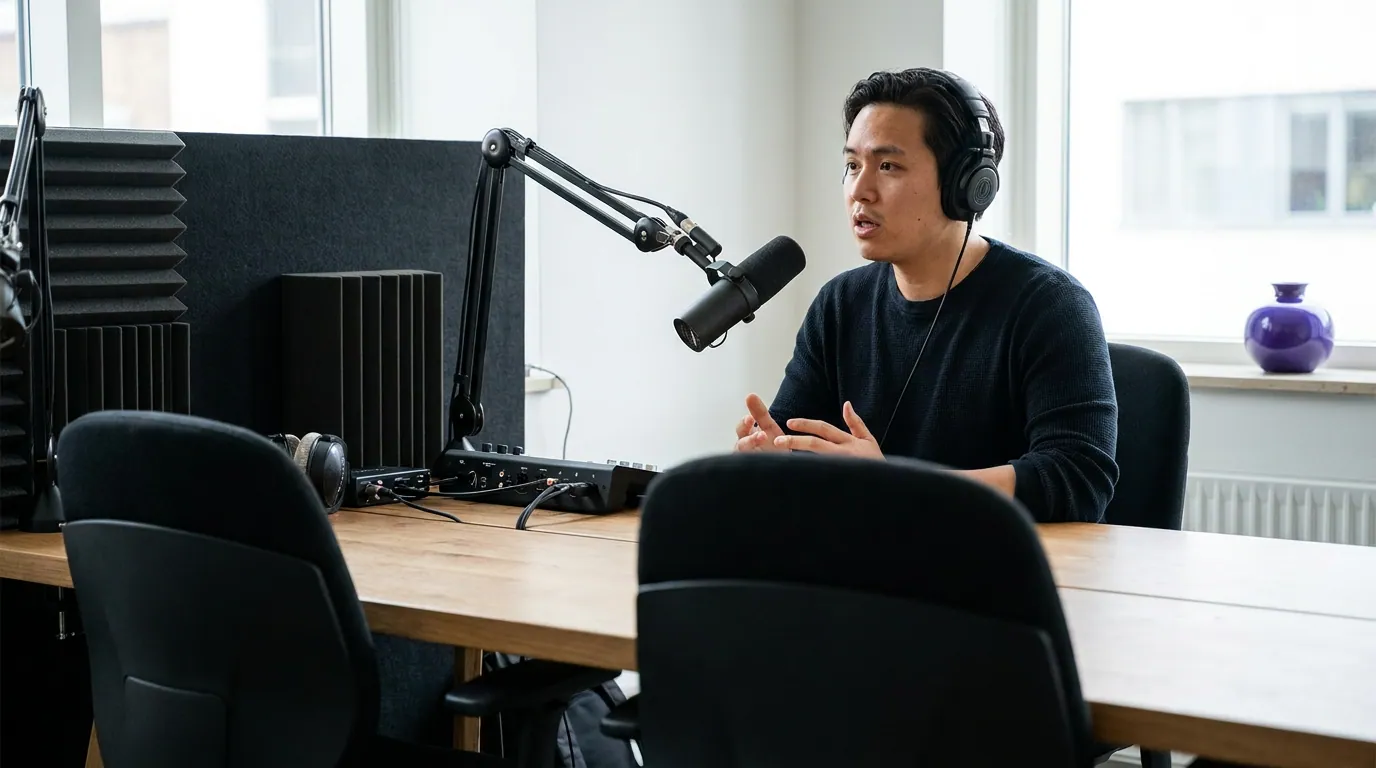
Start with the seating angle, not the camera
The most common two-person mistake is seating people first and worrying about the camera after. Reverse it. The angle between the two chairs determines everything downstream, whether both faces open toward the lens, whether the conversation looks natural, and whether a vertical clip can ever isolate one speaker cleanly.
Three seating layouts, and only one is reliably good:
- Side by side, both facing the camera (~0° between them). Reads like a news desk. The two never look at each other, so on screen they feel like two separate monologues. Avoid it unless you both address the audience and never converse.
- Square across the table, facing each other (180°). Now they talk naturally, but a single front camera sees one person's back or a hard profile. This forces two cameras and over-shoulder angles, which is where the wedge problem (below) lives.
- Angled toward each other at 90–120°. The sweet spot. Both bodies are open enough that the camera reads two faces, yet turned in enough that eye contact between them looks real. This is the seating you want for almost every two-person show.
Think of it as an open V with the camera in the gap. The chairs point at each other's far shoulder, not nose to nose. That slight openness is what lets one front camera hold both people without anyone showing the back of their head.
Single wide or two singles? The decision rule
Pick a single wide camera if you want the simplest edit and you clip the episode for social. Pick two singles, one camera framed on each person, only if you'll spend the extra editing time cutting to whoever's talking, every episode. The deciding factor isn't budget; it's edit hours, the same as the broader single vs multi-camera decision.
A single wide holds both faces in one frame. It's honest, stable, and impossible to cut wrong because there's nothing to cut. The trade is energy: a 45-minute locked two-shot can feel static on the long-form video. For most new shows that's a fine trade, especially because clips don't use the wide anyway.
Two singles give you a clean head-and-shoulders frame of each person, so you can cut to the talker and the long video feels alive. The cost is real: you sync two files, match exposure and white balance so the cut doesn't jump, and make an angle decision every few seconds. If you won't reliably do that edit, the second camera produces worse video than one good wide.
Here's the input most people miss: clipping pushes you toward fewer cameras. Vertical clips crop to roughly the center third of the frame and hold one face at a time, so your second angle rarely appears in the clip. For video podcasts, clips drive an estimated 20–40% of new audience (Podcast Studio Glasgow). If short-form is your growth plan, buy clean single-camera quality and a clipping workflow before a second body.
| Approach | Best for | The real cost |
|---|---|---|
| Single wide | New shows, heavy clippers, fast edits | Long video can feel static |
| Two singles | Two on camera + you'll cut every episode | +30–90 min edit per episode, sync + color match |
| Wide + occasional single | Want cuts only for key moments | Discipline to not over-cut |
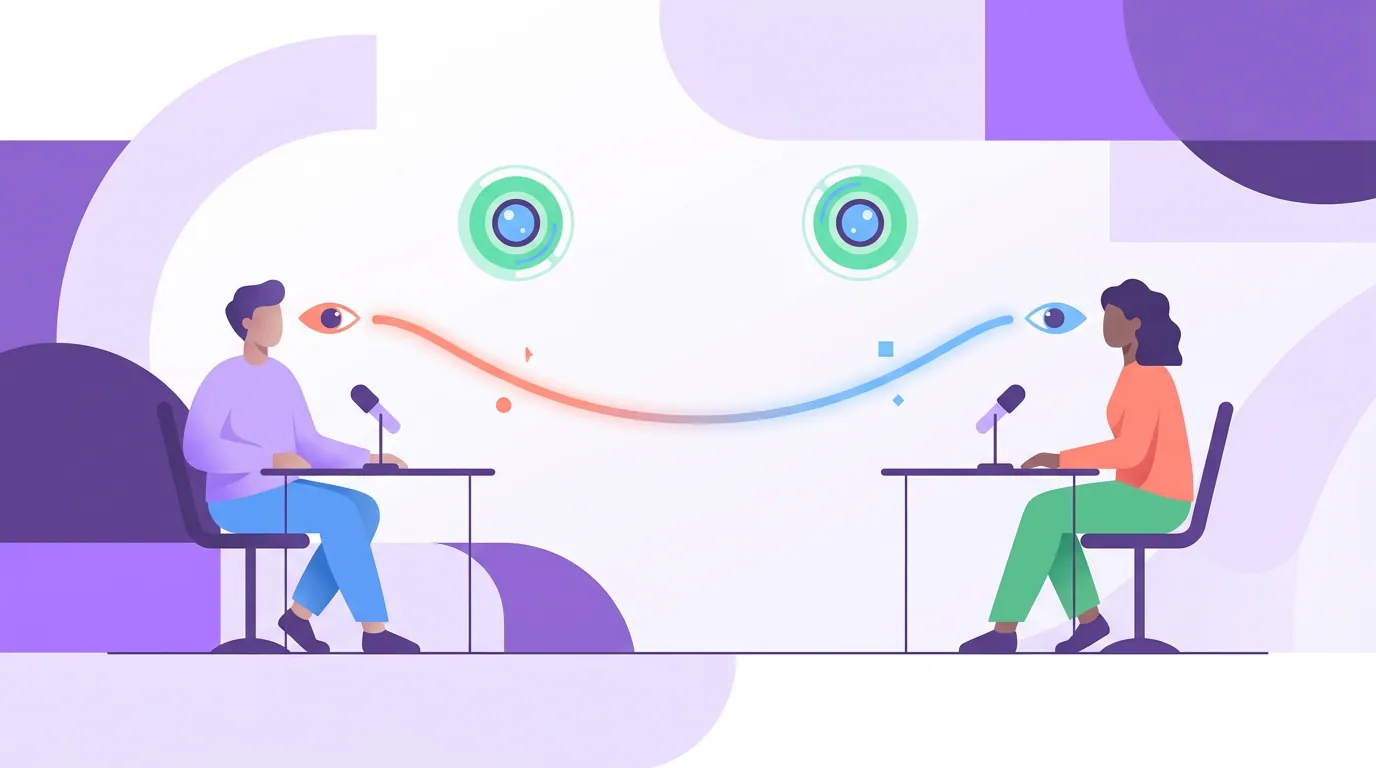
Match the eye lines so they appear to face each other
Two people can be in the same frame and still look like they're ignoring each other. The fix is eye-line geometry. When A looks at B, A's gaze should travel across the frame toward where B actually is, left-to-right or right-to-left, so the two eye lines meet in the middle. If both people drift their eyes to the camera or down at their notes, the conversation dies on screen even though the audio is fine.
Two specifics make this work:
- Keep both faces on the same horizontal eye line. If one chair is higher, one person looms and the other shrinks, and the shot tilts. Adjust seat heights until both pairs of eyes sit at the same level, ideally on the upper-third line, the same target as a solo talking-head frame.
- Respect the line between them (the 180° rule). If you use two single cameras, both must stay on the same side of an imaginary line drawn through the two chairs. Cross that line with one camera and a cut flips who's on the left and right, which disorients the viewer instantly. Keep both cameras on the open side of the V and you can't break it.
When the eye lines match and both cameras stay on one side, a cut from A to B feels like the viewer's own head turning. When they don't, every cut feels like a glitch.
Avoid the over-shoulder wedge
The over-shoulder shot, camera behind one person, looking past their shoulder at the other, is borrowed from scripted film, and it's where two-person podcasts go wrong most often. Done loosely, the foreground person becomes a giant dark wedge eating a third of the frame, blocking your guest and dominating a vertical crop with a blurry ear.
If you want over-shoulder energy, treat it as a flavor, not the main angle. Keep the foreground shoulder low and soft in the frame's corner, never a head-sized block, and always cut back to a clean single or the wide so the viewer gets full faces. For a vertical clip, skip the over-shoulder entirely, a clip needs the speaker's whole face, and a wedge of someone else's head is exactly the clutter the crop can't remove.
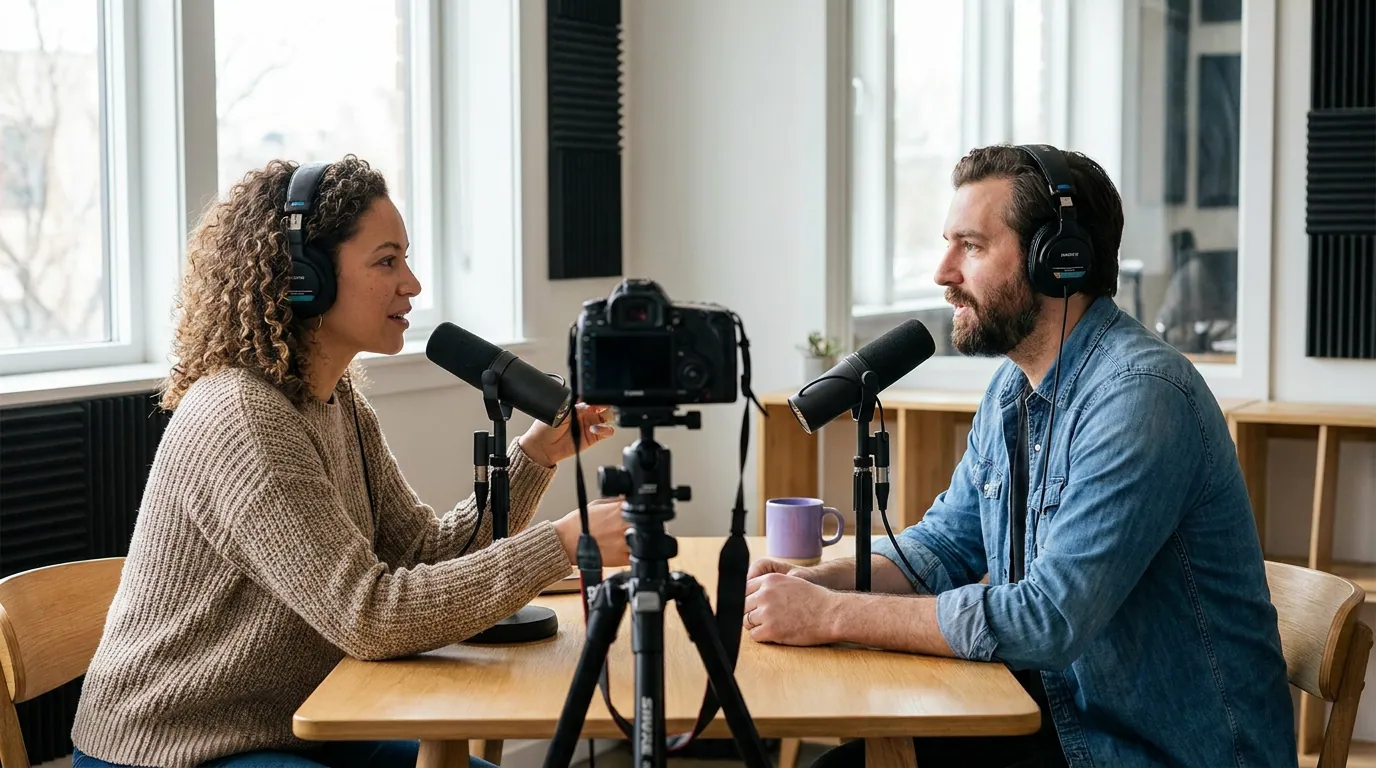
Common two-person framing mistakes (and the fix)
Most bad two-person shots are one of these five errors. Each has a one-line fix.
- Chairs square to the wall, side by side. Reads as a news desk; nobody looks at anyone. Fix: angle the chairs toward each other at 90–120° with the camera in the gap.
- Mismatched face sizes. One person dominates because they sat closer or higher. Fix: equalize chair distance from the lens and seat heights until both heads fill the frame the same.
- Different eye-line heights. One looms, one shrinks, the frame feels tilted. Fix: raise the lower seat until both pairs of eyes sit on the same horizontal line.
- Crossing the 180° line with a second camera. A cut flips left and right and disorients the viewer. Fix: keep both cameras on the same side of the line through the two chairs.
- A looming over-shoulder head. A dark wedge blocks the guest and ruins the vertical crop. Fix: keep the foreground shoulder low and soft, or skip over-shoulder for a clean wide.
What gear do you actually need?
Less than you'd think, the geometry is free. A single wide needs one camera at seated eye level on a tripod or arm; a stack of books works. Two singles need two identical bodies on identical settings, because a webcam cut against a mirrorless produces a visible color jump on every switch. Lighting matters more than a second camera: both faces want even, matched light, the job of three-point lighting for a video podcast. Two people also means two microphones, sort the audio with the best mics by budget tier or, on a tight budget, a solid mic under $100, and the rest of the rig with the first-time video podcast setup guide.
Frequently asked questions
What angle should two podcast chairs be at? About 90–120° toward each other, an open V with the camera in the gap. Side by side (0°) makes two people who never look at each other; square across the table (180°) forces over-shoulder angles. The 90–120° range keeps both faces open to the lens while their eye contact looks natural.
Should a two-person podcast use one camera or two? One wide camera if you want the simplest edit and you clip for social, since clips crop to one speaker and never use the second angle. Two single cameras only if you'll spend the extra 30–90 minutes per episode cutting to the talker. The decision is edit time, not budget.
How do I make two people look like they're facing each other on camera? Match their eye lines. Seat them at 90–120° so each looks across the frame toward the other, keep both pairs of eyes on the same horizontal line, and put the camera on the open side. If you use two cameras, keep both on the same side of the line through the chairs so cuts don't flip left and right.
Is an over-the-shoulder shot good for a two-person podcast? Use it sparingly. A loose over-shoulder turns the foreground person into a head-sized wedge that blocks the guest and ruins a vertical crop. Keep the foreground shoulder low and soft, cut back to a clean single or the wide for full faces, and skip it entirely for clips.
How should I frame a two-person podcast for vertical clips? Record a clean wide where both faces are well lit, the same size, and near the center, not at the edges. The vertical clip will reframe to one speaker at a time, so avoid over-shoulder wedges and don't let either person drift to the frame edge, where the 9:16 crop will slice them off.