
The One-Page Podcast Runsheet That Makes Recording Calm


A podcast runsheet is one page, four columns: a running time, the segment you're in, two or three talking-point beats for that segment, and a cue column for the things you forget under pressure, the ad read, the call to action, the question you swore you'd ask the guest. You build it in ten minutes before you record and keep it in your eyeline the whole time. That is the entire artifact, and it is the difference between a recording that drifts and one that stays calm.
Most planning advice tells you to "prepare a rundown" and then never shows you what one looks like. Below is the actual page, drawn out and annotated, plus a filled-in solo example and a filled-in interview example. The two are the same skeleton, the only column that meaningfully changes is the cue column, and exactly how it changes is the part nobody explains. Copy the table, adapt it to your show, and print it. It is meant to be held in your hand, not admired in a folder.
What goes in a podcast runsheet?
Four columns and nothing else: time, segment, beats, and cues. The time column tells you whether you're running long. The segment column tells you where you are. The beats column holds two or three bullet points, never sentences, so you can glance and keep talking. The cue column is for the non-negotiables: the sponsor read, the single CTA, the transition you keep fumbling. Anything that doesn't fit one of those four columns does not belong on the page.
A runsheet is not a script and it is not an episode structure. The six-block episode structure is the shape of your content, cold open, promise, body, turn, payoff, CTA. The scripting-vs-outlining decision is how much of it you write down. The runsheet is the physical page that holds both while you record. It is the operational layer: the thing your eyes land on the moment your mind goes blank.

Why a runsheet matters more than it looks
The runsheet is a survival tool, because the thing that kills shows is not bad audio, it's the recording getting hard enough that you stop. Nearly half of all podcasts never publish past their third episode, and most quitters fade out between episodes 7 and 25 (Command Linux, on podfade). The shows that survive are the ones where recording feels routine instead of effortful. A page you can glance at removes the low-grade panic, "where was I, did I do the ad, what was I going to ask", that makes recording exhausting.
It also protects the moments that grow your show. Discovery is increasingly social: 57% of listeners now rely on social media for podcast recommendations, the first time that has passed friends and family (InsideRadio, 2025). The clips that travel come from your payoff and your turn, and clips drive 20–40% of new audience for video shows (Podcast Studio Glasgow). Mark those rows on the runsheet and you record them deliberately, with a clean in and out, instead of hoping a good clip happens by accident.
How to build your runsheet in ten minutes
- Draw the four columns, Time, Segment, Beats, Cue, on one page. A sheet of paper, a sticky note grid, or a single doc table all work. One page is the rule. If it spills to a second page, it has become a script, and a script you read aloud sounds read aloud.
- List your segments down the left. Borrow them from your episode structure: cold open, promise, two or three body segments, the turn, payoff, close. These rarely change week to week, so this part is mostly copy-paste once you've done it once.
- Add target times, not durations. Write the clock time each segment should start, 0:00, 0:30, 2:00, and so on, plus "−3:00" and "−0:30" counting back from the end. Start times are easier to check mid-record than "this should take four minutes."
- Fill the beats column with bullets, never sentences. Two or three per segment. A beat is a trigger, not a transcript. "pricing mistake · the $9 test · what I do now" is a beat. A full paragraph is a trap.
- Place the cue markers last. Drop the ad read at your turn (mid-roll reads ride the attention you just re-earned) and the single CTA on the close row. Add any personal cue you keep forgetting, "slow down," "ask the follow-up," "name the sponsor correctly."
That's the whole build. Once the segment skeleton exists, a week's runsheet takes the time it takes to type six lines of bullets.
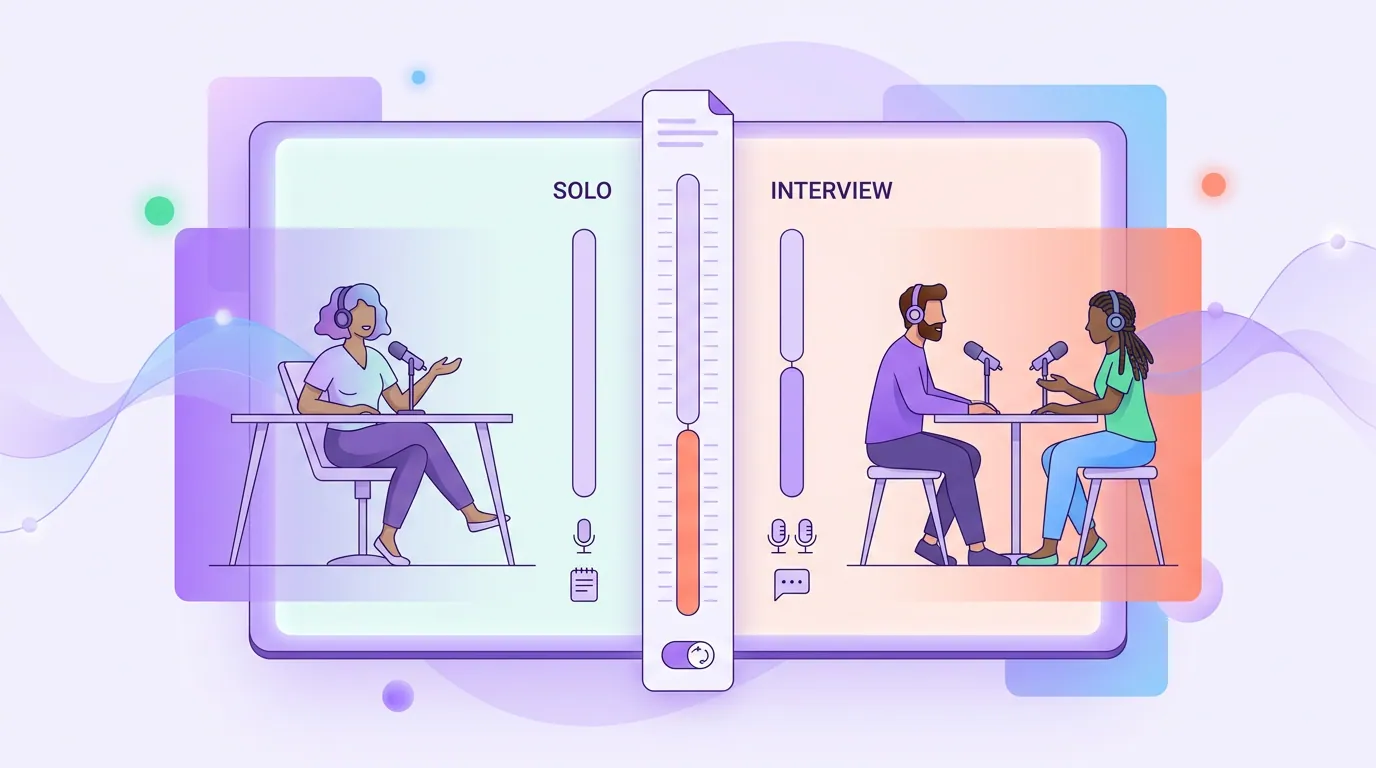
Solo vs. interview: the one column that changes
The skeleton is identical for both formats. What changes is the cue column. On a solo runsheet, the beats column does the heavy lifting, it's the only thing keeping you on track, so it holds more detail and your cues are mostly self-directed ("breathe," "don't bury the payoff"). On an interview runsheet, you talk less and steer more, so the beats column thins out and the cue column fills with guest-handling prompts: the question you must ask, the topic to avoid, the moment to let silence sit, the name pronunciation you checked beforehand.
Which format you're running shapes the whole page, so settle that first, solo, co-host, or interview is the upstream decision the runsheet inherits.
A worked solo runsheet (~22-min episode)
| Time | Segment + beats | Cue |
|---|---|---|
| 0:00 | Cold open, "the $9 test that fixed my pricing" | no music yet |
| 0:30 | Promise, three pricing mistakes · the fix I use | |
| 2:00 | Segment 1, mistake one · my example · the cost | |
| ~11:00 | Turn, "here's where it gets uncomfortable" | ad read |
| −5:00 | Segment 2, the script I use now · why it works | |
| −2:30 | Payoff, "price the outcome, not the hour" | clean in/out for clip |
| −0:30 | Close, join the email list | one CTA only |
A worked interview runsheet (~38-min episode)
| Time | Segment + beats | Cue (guest handling) |
|---|---|---|
| 0:00 | Cold open, guest's best line, pulled forward | record this last |
| 0:45 | Promise, who they are · why worth 38 min | name check: "Reyes" |
| 3:00 | Q1, origin story, kept short | don't interrupt |
| ~14:00 | Q3, the contrarian question | ad read after answer |
| −9:00 | Q4, the must-ask | let silence sit |
| −3:00 | Payoff, their most quotable answer | clean in/out for clip |
| −0:30 | Close, follow the show | one CTA only |
Common mistakes (and the fix)
- Sentences in the beats column. You end up reading instead of talking, and it sounds like it. Fix: bullets and fragments only. If a beat needs a full sentence, it belongs in a script, not a runsheet.
- Durations instead of start times. "This takes 4 minutes" is useless mid-record; you can't add 4 to a clock in your head while talking. Fix: write the start time of each segment and count the last two back from the end.
- No cue column, or cues buried in the beats. The ad read and the CTA are exactly what you forget under pressure, so they need their own column on the right edge where your eye lands. Fix: give cues a dedicated lane.
- A two-page runsheet. Two pages means you're scripting in disguise, and you'll lose your place flipping. Fix: cut until it fits one page. If it won't, your episode has too many segments, see how long an episode should really be.
- Re-drawing it every week. Rebuilding the skeleton from scratch wastes the ten minutes the runsheet is supposed to save. Fix: keep the segment column and cue markers fixed; only the beats change week to week.
FAQ
Is a runsheet the same as show notes? No. Show notes are written after the episode for listeners and search, the summary, timestamps, and links that go in the description. A runsheet is written before the episode for you, the host, and never gets published. They share material (your segments and timestamps), so a good runsheet makes writing show notes faster, but they are two different documents with two different audiences.
Do I need a runsheet for a casual chat show? Even a loose two-friends-chatting show benefits from the cue column alone, the ad read and the single CTA are the things every format forgets. You can drop most of the beats column and keep four lines: open, a couple of topic prompts, the ad marker, and the close. The looser the show, the more the cues matter, because nothing else is holding the structure.
Where should the ad read go on the runsheet? On the turn row, roughly mid-episode. A mid-roll placed at your turn rides the attention you've just re-earned, and it keeps the cold open clean for the hook rather than spending a listener's patience on a read before you've given them a reason to stay. Mark it in the cue column in capitals so it's impossible to miss on the day.
How is a runsheet different from an episode structure? The episode structure is the repeatable shape of your content, the same six blocks every week. The runsheet is the single page that holds this week's version of that shape with real times, real beats, and real cues. Structure is the blueprint; the runsheet is the working drawing you keep on the desk.
Paper or screen? Whatever you won't be tempted to scroll. A printed page or a second monitor you can't touch beats a doc on the same screen as your recording software, because the moment you scroll, you've left the recording. The whole point is one glance, no clicks. If you record video, keep it just below the camera so your eyes stay near the lens.