
A Podcast Launch Plan Built for Maximum Reach


A launch built for reach is a sequence, not a to-do list. You spend roughly four weeks before launch day stacking a trailer, an episode bank of three to five recorded shows, and a calendar of coordinated guest shares, then you fire all of it into a single 7-to-10-day window so subscriber velocity spikes hard enough to clear the chart-eligibility bar. The mistake almost everyone makes is dribbling one episode out per week and wondering why nothing moves. Velocity is the whole point.
The reason the timing matters more than the content quality: Apple and Spotify reward concentration, not just volume. A hundred new subscribers in one week reads to their ranking systems as momentum; the same hundred spread over ten weeks reads as background noise. Below is the plan that compresses your launch into the window where that momentum is visible, plus the week-by-week Gantt to run it.
Why launch with an episode bank instead of one episode?
Because a single first episode gives a new listener nothing to binge, and the data on early-stage quitting is brutal. Nearly half of all podcasts never make it past their first three episodes Amplifi Mediasummarizing industry failure data). Launching with three to five episodes already recorded does two things: it gives a curious new listener a reason to stay past the first play, and it removes the per-week production pressure that causes most shows to fade before they find their footing.
An episode bank also feeds the only metric a launch is really chasing, velocity. When someone discovers your show on launch day, you want them to subscribe and play two more episodes that afternoon. One episode caps their session at a single play. Three to five turns a discovery into a binge, and a binge into a subscribe that the algorithm actually notices.
The four-phase velocity-compression model
Every reach-first launch I have run breaks into four phases that overlap on purpose. The phases are not "record, then edit, then promote." They run in parallel so that on launch day you are firing fuel you loaded weeks earlier, not scrambling.
- Build the bank (weeks 1–3). Record three to five episodes plus a 60-to-90-second trailer. The trailer ships first, two to three weeks ahead, so the feed exists and Apple/Spotify can index it before any episode drops.
- Stage the reach assets (weeks 2–4). While episodes are still in the can, cut clips from them, line up guest co-promotion dates, and pre-write the launch-day posts. Nothing about this phase waits for "done" episodes, clips come from rough cuts.
- Coordinate the human network (weeks 3–4). Lock the exact days your guests will share. Three guests posting on three random days is noise; three guests posting in the same 48 hours is a spike. You are buying coordination, not just shares.
- Fire the burst (launch week + 1). Drop the bank, light the clip seeding, trigger the guest shares, and run a small paid burst on top, all inside one 7-to-10-day window. This is where you spend money, because paid amplification stacked on organic velocity costs less per subscriber than paid running alone.
The discipline is in the overlap. Phase 3 happens while phase 1 is still finishing. The payoff is that launch week has zero production work in it, only distribution.
The launch-week burst, hour by hour
Launch day is not a single drop. It is a coordinated fire across the channels where your future audience already is. Run it in this order so each move amplifies the last instead of competing with it.
- Drop the full bank at once, not one episode. Three to five episodes live on day one gives a new subscriber an instant binge and tells the directories you are a real, active show, not a trailer that never delivered.
- Trigger the email list first. The people who opted in before launch are your warmest velocity. Send them on day one, before any paid spend, so the early numbers are organic and the algorithm sees genuine demand. If you have not built this list, start with a podcast email list from zero and have a welcome sequence ready to catch the new arrivals.
- Fire the guest shares inside a 48-hour window. Coordination is the lever. Each guest posts their clip and tags the show on the same two days, so their separate audiences hit your feed as one concentrated wave.
- Seed clips everywhere a stranger might scroll. Short clips are how most new listeners now find shows: 57% of listeners rely on social media for podcast recommendations, the first time it passed friends and family (InsideRadio, "The State of Video Podcasting 2025"). Clips are also your most efficient organic reach asset, one studio estimates clips drive 20–40% of new audience for video shows, a directional range from a single source (Podcast Studio Glasgow).
- Layer the paid burst on last, not first. Run paid only after the organic wave is already moving, so your spend amplifies real velocity instead of buying cold numbers. Whether to spend at all depends on your math, see when paid podcast promotion is actually worth it and what it costs to buy a podcast listener before you commit a budget.
What does "enough" velocity look like? Use first-week downloads as your gauge. Buzzsprout's global benchmarks put the median episode at 28 downloads in the first seven days, the top 10% at 413+, and the top 1% at 4,611+ (Buzzsprout). A launch burst that clears the top-10% line in week one is a strong signal you concentrated enough.
The caveat that matters before you anchor on any of those numbers: these benchmarks come from a single host's catalog, not the whole industry. Buzzsprout is one of the larger paid hosts but still represents a minority slice of all podcasts, and it skews toward independent shows; the big free and enterprise hosts, and Spotify, which publishes no comparable benchmark at all, sit outside this sample entirely. Use the percentiles as a directional target, not a verdict on the whole market.
Common launch mistakes that kill reach
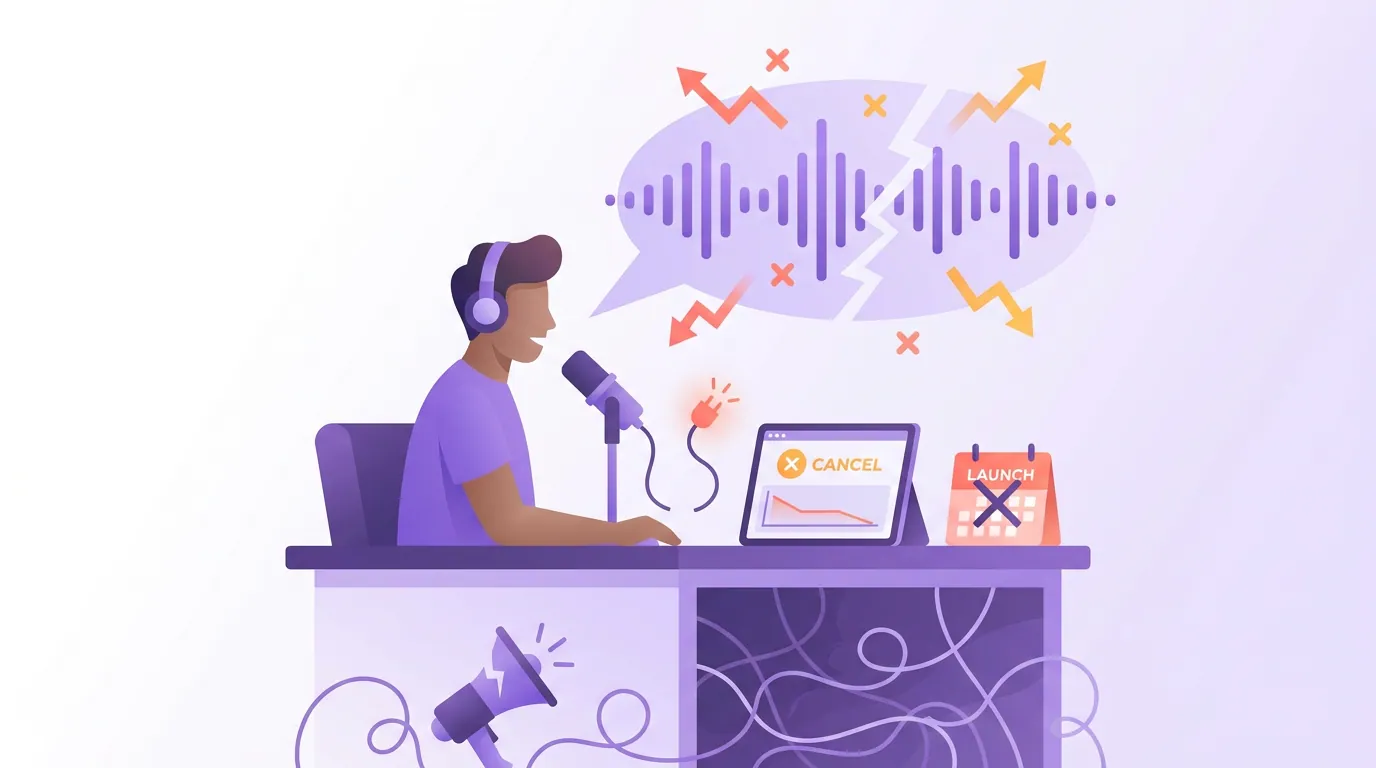
The plan above only works if you avoid the failures that quietly sink most launches. Each of these is a sequencing error, not an effort error.
- Dripping one episode a week from day one. This spreads your scarce early velocity across months so no single week registers as momentum. Bank the episodes and drop them together.
- Shipping the trailer the same day as episode one. The trailer's job is to exist early so directories index the feed and your warm audience can pre-subscribe. Ship it two to three weeks ahead.
- Leaving guest shares uncoordinated. "Share whenever you can" produces a scatter of posts on random days. Lock exact dates so the shares land as one wave inside a 48-hour window.
- Spending on ads before organic velocity moves. Paid running cold buys expensive, low-intent numbers. Layer it on after the email send and guest shares are already lifting the line.
- Treating launch as a day instead of a window. A single launch day with nothing behind it deflates by Tuesday. Plan a 7-to-10-day burst with staggered fuel, clips, guest posts, a feed swap, paid, so the spike has shape and duration.
How to keep the reach after the burst
A launch is a spike; a show is a slope. Once the burst settles, the work shifts from concentration to consistency, because the single strongest predictor of a podcast's survival is publishing on a steady cadence, and consistency is exactly what burns hosts out fastest. This is where your launch-week clip habit becomes a permanent system: every new episode becomes a handful of clips, which keeps reach flowing to strangers without adding a full second production job each week.
The launch also leaves you with assets to keep working. Your guest relationships become an ongoing feed cross-promotion loop, your email list becomes the warm velocity for every future episode, and your clip workflow becomes the discovery channel that does not depend on a directory's chart. The burst gets you noticed. The systems decide whether you stay noticed.
FAQ
How many episodes should I have ready before launching a podcast? Three to five recorded episodes plus a short trailer. Launching with a bank gives a new listener something to binge the day they find you and removes the weekly production pressure that causes most shows to fade, nearly half never make it past their first three episodes Amplifi Media. A bank also concentrates your early downloads into one visible window.
When should I release my podcast trailer? Two to three weeks before launch day. The trailer's real job is to make the feed exist early so Apple and Spotify can index it, and so your warm audience can pre-subscribe before episode one. Releasing the trailer and the first episode on the same day wastes that head start.
Is a podcast launch window real, or a myth? It is real in the sense that Apple and Spotify ranking systems reward concentrated activity, a burst of subscribes and plays in a short window reads as momentum. The "new and noteworthy" framing is dated, but velocity still matters: the same total downloads landing in one week move you further than spread across ten.
Should I run paid ads for my podcast launch? Only after your organic velocity is already moving, and only if the per-listener math works for you. Paid amplification stacked on an organic spike is far cheaper per subscriber than paid running cold. Check when paid promotion is worth it and the cost-per-listener benchmarks before committing a budget.
What's the single most important thing in a podcast launch? Coordination. Reach comes from concentrating your trailer, episode bank, email send, guest shares, clips, and any paid spend into one 7-to-10-day window, not from any one of those assets being excellent on its own. A good launch is a sequencing problem solved before episode one.