
How to Speak in Clips: Soundbites Hosts Will Cut


To speak in soundbites, build answers that make sense with nothing before them: open with a one-line setup that replaces the question, make a single standalone claim, back it with one concrete proof, and land on a clean close, all inside 20 to 40 seconds. An answer that survives being lifted out of context is the one that ends up as the show's clip.
That matters more than most guests realize, because the clip is where new people meet you. Clips drive an estimated 20-40% of new audience for video shows and can raise reach two to five times (Podcast Studio Glasgow). When a host or their editor goes hunting for the 30 seconds worth posting, you want your answer to be the obvious pick, and you want it to work for someone who never heard the question.
What does it mean to speak in soundbites as a guest?
Speaking in soundbites means delivering answers that are self-contained: each one carries its own setup, makes one clear point, and resolves without depending on the question or the sentence before it. A soundbite isn't a slogan or a rehearsed line. It's an answer engineered so the best 20-40 seconds can be cut out and still land.
The test is simple. If someone watched only that slice, with no question on screen and no host voice, would they understand it and feel something? Most guest answers fail that test. They start with "yeah, so, to your point about earlier...", which is a dead opening the moment it's clipped, because there is no earlier. The fix isn't talking in headlines. It's front-loading just enough context that the answer stands alone.
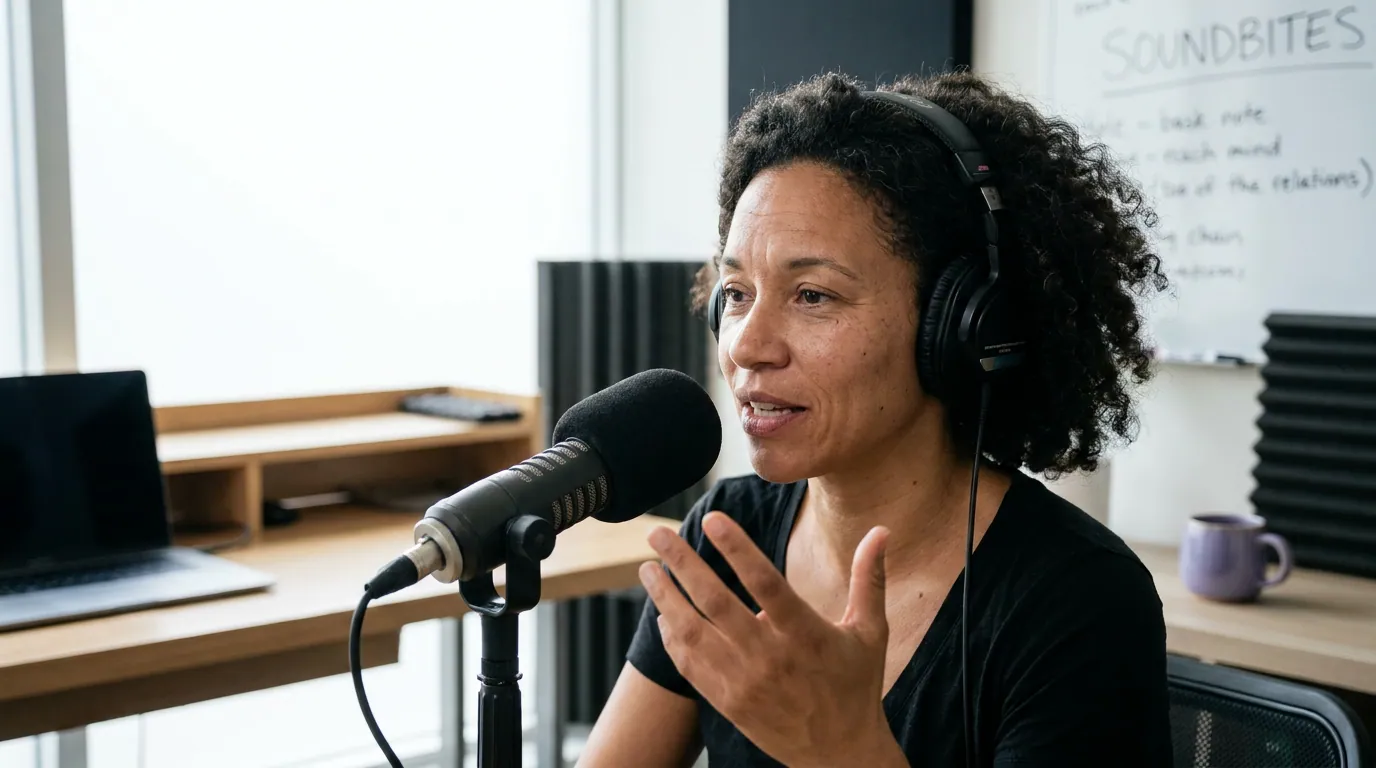
Why clippable answers are worth engineering
Discovery has moved to the feed. 57% of listeners now rely on social media for podcast recommendations, the first time it surpassed friends and family (InsideRadio). The clip is the storefront. If the clips a show posts feature you saying something sharp, you borrow that show's audience and point it back at your own work.
There's a second reason, and it's the honest one: most shows don't have time to clip well. Editors skim a transcript or a waveform for moments that already work. A self-contained answer is less work to cut, so it gets cut. You're not gaming anyone, you're making the editor's easiest choice also the one that flatters you.
The clip-proof answer: a four-part structure
Here's the structure I coach guests through. Four moves, in order, inside 20 to 40 seconds. Hit them and the answer holds up on its own; skip the first or the last and it dies the moment it's cut.
1. The self-sufficient setup (about 5 seconds). Open with one line that carries the context the question would have. Instead of "yeah, like I said," start with "The biggest mistake first-time founders make with pricing is..." Now a viewer who never heard the question still knows exactly what you're answering. This single move fixes 80% of un-clippable answers.
2. The standalone statement (5-10 seconds). Make one claim. Not three. The clip can only carry one idea, so pick the sharpest and say it plainly. Contrarian or counterintuitive travels best, "you don't need a bigger audience, you need a smaller, angrier one" beats a balanced list every time.
3. One concrete proof (10-15 seconds). Back the claim with a single example, number, or short story. One. The instinct to pile on three examples is what turns a 30-second answer into a two-minute ramble that no editor will touch. Specifics are what make people screenshot and share, name the client, the figure, the moment.
4. The clean close (about 5 seconds). End on a hard stop. "That's the whole game." Not "...but, you know, it depends, obviously." Trailing qualifiers are where clips go to die, because the editor has to cut you off mid-thought and it shows. Decide your last sentence and let it be the last sentence.
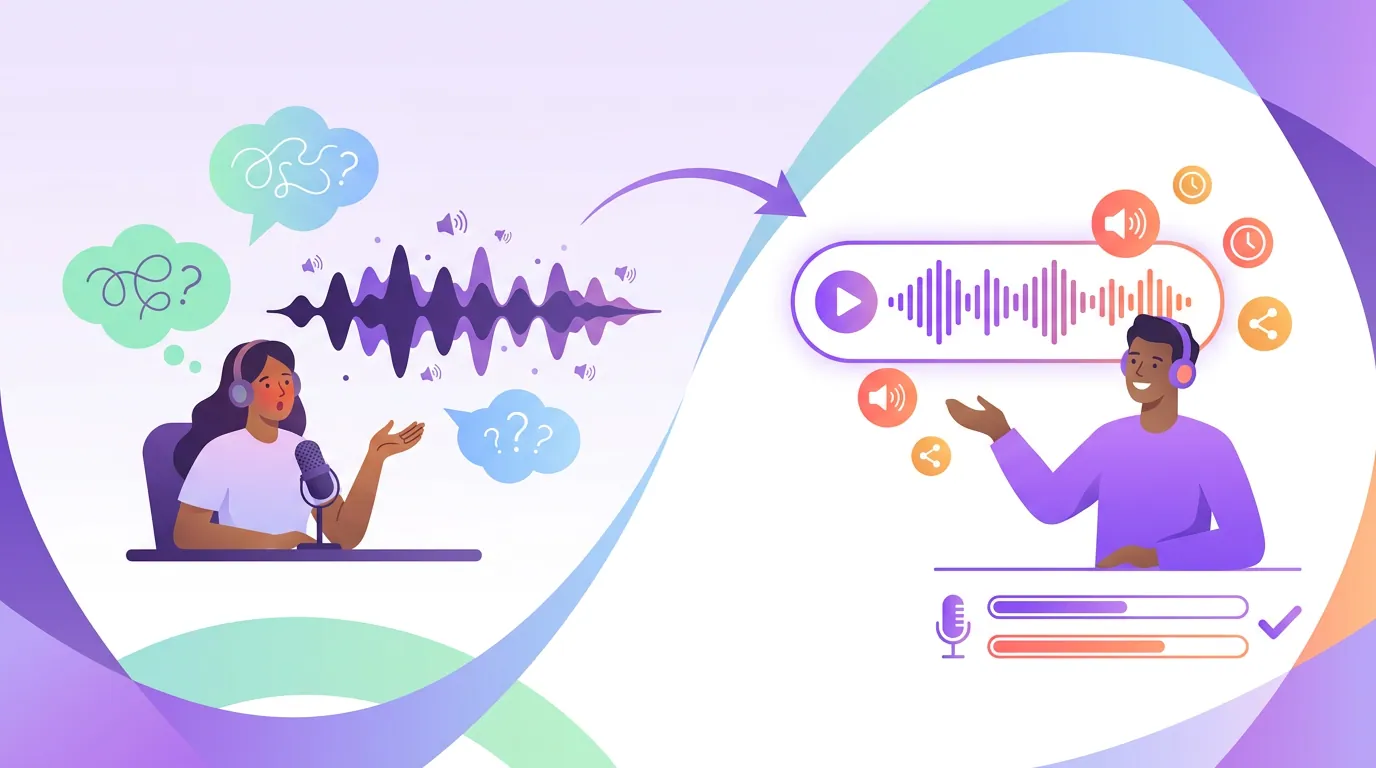
A worked before-and-after
Take a real-shaped answer to "how do you find your first clients?" Here's the version most guests give, and the clip-proof rewrite.
The left version has no setup, three half-claims, no proof, and a trailing question mark. Nobody can clip it. The right version opens with its own context ("my first ten clients"), commits to one claim, gives one concrete mechanism, and ends on a line you'd put on screen. Same honesty, same person, one is just built to survive being lifted.
The clip-survival test (use this on every answer you prep)
Before a recording, write your three most-likely questions and draft an answer for each. Then run each draft through this test. If it fails any line, it isn't clip-proof yet.
- Mute the question. Read the answer with no question in front of it. Does it still make sense? If it leans on "as you said," rewrite the setup.
- Find the one idea. Underline the single claim. If you underline more than one sentence, you have two answers wearing one coat, split them.
- Check for proof. Is there exactly one concrete thing a stranger could repeat? No proof, no save; three proofs, no clip.
- Read the last line alone. Would you put it on screen as a caption? If it trails into a qualifier, cut the qualifier.
- Time it. Read it out loud. Under 20 seconds is usually too thin; over 45 and an editor has to trim it, which means the cut might not be where you'd choose.
This is the same discipline behind good storytelling on a podcast and a strong guest self-introduction, every standalone unit earns its place. Note one caption point: most social video is watched on mute (Sharethrough reported 75% of people often watch videos on mute; Digiday reported 85% of Facebook video watched without sound back in 2016, both publisher-reported and directional), so the words have to land as text, not just audio. Speak in full sentences a caption can hold.
Common mistakes that make you un-clippable
Answering the host instead of the audience. The temptation is to talk to the host, referencing the last ten minutes. Talk past the host to the stranger who'll see the clip. Reset the context every answer.
Burying the line. Many guests warm up for 40 seconds, then say the brilliant thing, then keep going. The editor won't dig for it. Lead with the claim; the warm-up is for you, not the tape.
Stacking proofs. Three examples feels generous and reads as padding. One sharp, specific proof outperforms three vague ones, and keeps you inside clip length. The standard editors work in is 30 to 90 seconds (castmagic).
The hedge ending. "...but everyone's different, so, you know." A clip needs a period, not a fade-out. Land it and stop.
Being quotable but empty. A slick line with nothing under it is the worst outcome, it travels, then disappoints. Keep the proof real. The same instinct sits at the center of podcast guest etiquette: be easy to host and easy to trust.
Frequently asked questions
How long should a clippable podcast answer be? Aim for 20 to 40 seconds spoken, roughly four to six sentences. That fits the 30 to 90 second window most editors cut for (castmagic). Under 20 seconds usually lacks proof; over 45 forces an editor to trim, which means the cut may not land where you'd want it.
Won't planning my answers make me sound rehearsed? Plan the structure, not the script. Know your setup, your one claim, your one proof, and your close, then say them fresh. A memorized paragraph sounds robotic; a familiar shape sounds confident. Prep your three most-likely questions and improvise the rest on that frame.
What if the host asks something I didn't prepare for? Use the same four moves live: a one-line setup, one claim, one proof, a clean close. The structure works on the fly because it's how clear thinking sounds anyway. The prep just makes the pattern automatic so you reach for it under pressure.
Can I clip my own appearance afterward? Yes, and you should, most hosts welcome it, though confirm first. If your strongest answer wasn't the one the show posted, cutting a captioned version for your own feed brings that audience back to you. If you're still landing the bookings, start with how to get on podcasts as a guest and how to find shows that will book you, and tighten your outreach with a pitch email that gets replies.