
Writing a Podcast Description That Gets Discovered


Write two descriptions, not one. Your show description is a brand and entity signal that tells platforms what your podcast is, who it's for, and who's behind it. Each episode description is a separate, per-page ranking asset targeting that episode's specific topic. Treat them as one job and both do their jobs badly.
That split is the whole game, and almost nobody runs it deliberately. Most hosts write a warm paragraph about the show once, then either paste it under every episode or dash off two lines of "in this episode we chat about life and stuff." One field is doing double duty it was never built for; the other is left empty. This guide gives you a rule for each, the first-150-characters discipline that both share, and annotated before/after examples you can copy today.
Does the podcast description even matter for SEO?
Yes, but not everywhere, and that is the part people get wrong. Your description does real ranking work on Spotify, Amazon Music, and YouTube Music, which index it for search. It does almost nothing for Apple Podcasts search, which leans on the show name, episode titles, and the author field instead. So "description SEO" is platform-specific, not universal.
Spotify is the clearest case. Spotify's engineering team built natural-language episode search that matches a query against your episode's text metadata, show title, show description, episode title, and episode description, not against the spoken audio (Spotify Engineering). Spotify's own creator guidance tells you to include relevant keywords naturally in titles and descriptions for exactly this reason (Spotify for Creators). On Spotify, a sharp episode description is a direct ranking lever.
Apple is the inverse. Apple documents its search metadata as the show name, channel name, and episode title, descriptions aren't named as a ranking field at all (Apple Podcasts for Creators). Independent testing by Ausha adds a wrinkle Apple doesn't spell out: the author field also moves Apple visibility, while descriptions, show or episode, had "little to no impact on ranking" there (Ausha). The honest takeaway is below.
The cross-platform rule: write descriptions strong enough to rank where they're indexed, and persuasive enough to win the tap everywhere else. There is no version of "skip the description" that survives contact with the data. For the field-by-field mechanics of each store, see our breakdowns of Spotify podcast SEO and how Apple Podcasts search ranking actually works.
How to write the show-level description (the brand and entity signal)
The show description has one job: make a stranger and a search engine understand, in seconds, what your podcast is, who it's for, and who hosts it. It changes rarely. So spend an hour on it and get it right. This is the field that establishes your show as an entity, a known thing with a clear topic and a named host, which is what helps you surface for category searches and show up correctly in AI-generated answers.
Use this structure:
- Sentence one, the positioning line. Say what the show is and who it serves, with your category keyword in plain language. Not "a podcast about ideas." Try "Weekly conversations with B2B SaaS founders about pricing, retention, and the unglamorous parts of growth."
- Sentence two, the proof or the format. Who hosts it, what listeners get, how often. "Hosted by [Name], a 12-year product marketer, with a new 40-minute interview every Tuesday."
- Then the texture. Two or three sentences of voice, recurring segments, the kind of guest, what makes you different from the ten similar shows in your category.
- A consistent host name and links. Name yourself the same way everywhere (this consistency is what builds the entity). Add your website and one social handle.
Keep your category keyword in the first sentence, written for humans. Spotify and Google read this field; both reward natural relevance and punish stuffing. The author/host field is a separate, high-value lever on Apple specifically, don't bury your niche there.
How to write each episode description (the per-page ranking asset)
Each episode description is its own page in the eyes of search, so it should target that episode's specific topic, not repeat your show blurb. This is where most of the per-episode ranking opportunity lives, especially on Spotify, and it's the field most hosts leave half-empty.
The four-part episode template that works:
- A one-line hook that names the topic and the keyword a listener would actually type. "How [Guest] cut churn 40% by killing their free trial" beats "Episode 47 with a great guest."
- Three to five sentences of substance, the questions answered, the specific takeaways, names and numbers mentioned. This is the keyword-rich body Spotify matches against and the snippet Google may show.
- Timestamps / chapters for the key moments. They help listeners and give search more anchored text to read.
- A short, consistent footer, links, guest handles, your call to action. Keep it below the substance, never above it.
Write episode titles to match the description's topic; the two reinforce each other in the ranker. Our guide to writing podcast episode titles that get found pairs directly with this. And the same source material that fills a good episode description fills a Google-ranking show notes page, write once, place twice.
The first-150-characters rule
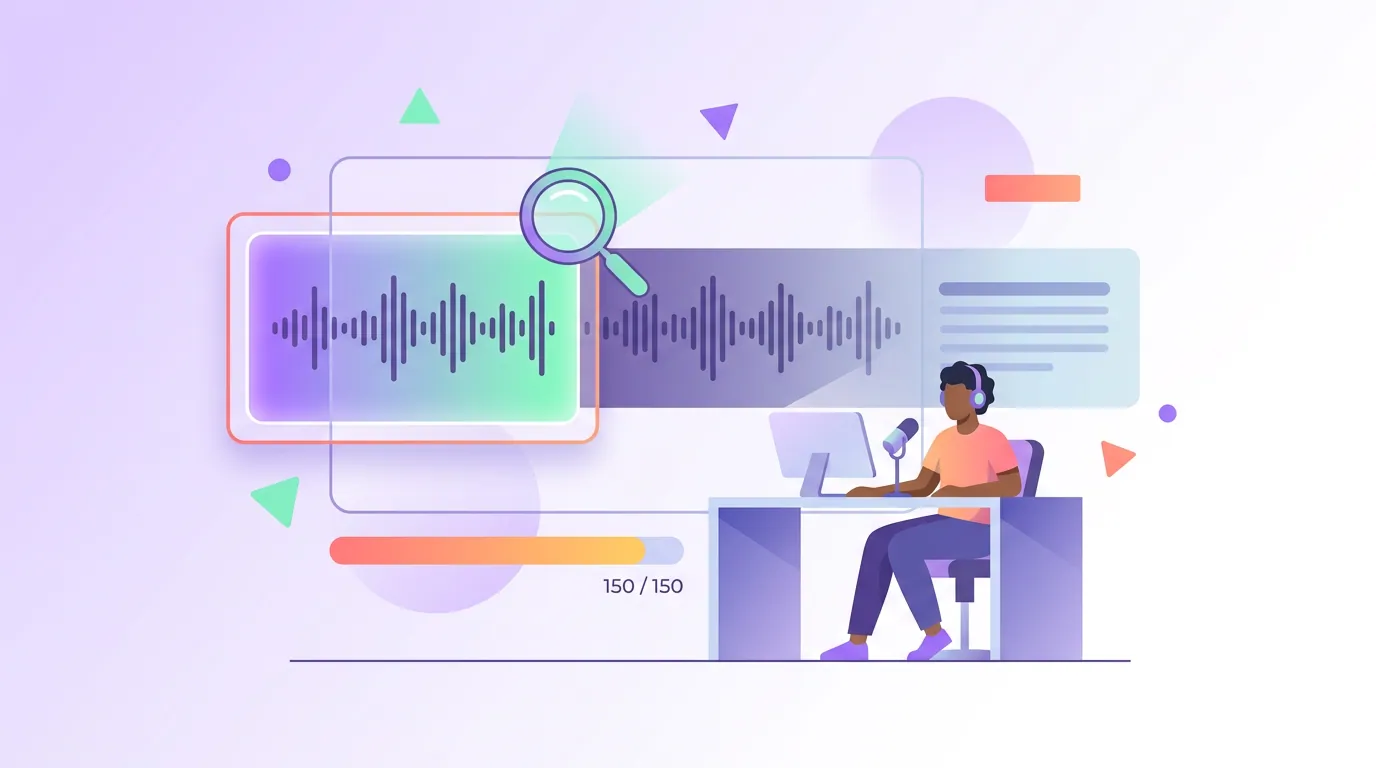
Front-load both descriptions so the most important words and the clearest promise land in the first ~150 characters, because that is roughly where most apps and search snippets cut off the preview. Whatever sits after the fold is read by fewer humans and carries less weight in the truncated previews search surfaces.
The rule in practice: the first 150 characters of your show description must contain your category keyword and your one-line positioning. The first 150 characters of each episode description must contain that episode's topic keyword and its sharpest promise. Save links, timestamps, sponsor reads, and your standing call to action for after that line.
Annotated examples: before and after
Here is the same fictional show, fixed.
Show description, before
Welcome to our podcast! We're two friends who love talking about business and life. Grab a coffee and join us every week for some great conversations. New episodes drop whenever we get a chance.
It names no topic, no audience, no host, no cadence, and front-loads "Welcome to our podcast", 150 characters spent before a single keyword appears.
Show description, after
Pricing and retention tactics for B2B SaaS founders, weekly. Hosted by Dana Cole, a 12-year product marketer, with a new 40-minute founder interview every Tuesday. Real numbers, no fluff, recurring "Teardown" segment where we rebuild one listener's pricing page.
The category keyword ("B2B SaaS," "pricing," "retention") and the host's name land in the first sentence. A search engine knows what this is; a stranger knows if it's for them.
Episode description, before
In this episode we sit down with a really smart guest and cover a ton of ground. You don't want to miss this one! Links below.
Zero topic words. It ranks for nothing and tells a browser nothing.
Episode description, after
How Maya Restrepo cut churn 40% by killing her free trial, the exact rollout, the pricing-page rewrite, and what she'd do differently. We cover usage-based vs seat-based pricing, the two metrics she watched, and the awkward customer emails. (02:10) The decision to kill the trial · (14:30) The new pricing page · (31:00) Results after 90 days. Guest: @mayar · Newsletter + full notes below.
Topic keyword and the 40% promise are in the first line. The body is keyword-rich and specific. Timestamps add anchored text. Housekeeping sits at the end.
Common mistakes that quietly kill description SEO
Most description problems are the same five errors, repeated across a whole feed.
- Pasting the show blurb under every episode. You're throwing away a fresh, topic-targeted page each time. Write a real episode description, every time.
- Burying the keyword below the fold. "On today's show, we're thrilled to be joined by..." spends the indexed, previewed first line on throat-clearing. Lead with the topic.
- Keyword-stuffing. Spotify and Google reward natural relevance and demote spammy repetition. Write it for a human; the keywords come out naturally when you describe the episode accurately.
- Treating Apple's description as your SEO field. It does little for Apple search (Ausha). Write it for humans and for Spotify, where it ranks.
- An inconsistent host name. "Dana," "Dana Cole," and "D. Cole" across fields fragment your entity. Pick one form and use it everywhere.
A note on scope: description optimization moves you up the results once people are searching your topic, it does little to create demand. The thing that sends new people to search you by name in the first place is distribution. 57% of listeners now rely on social media for podcast recommendations, the first time that surpassed friends and family (Inside Radio). Strong metadata makes you findable; clips and social make you found. You need both.
One more honest caveat on the benchmarks you'll see quoted elsewhere: listening is split across apps that don't share comparable data, Apple Podcasts accounts for roughly half of U.S. podcast listening and Spotify trails as the second app, so any single-platform "average" describes one slice, not the whole market (The Podcast Host). Read any cross-platform "average" as directional, not gospel.
FAQ
How long should a podcast description be? There's no fixed limit that matters for ranking, but front-load the value. Show descriptions: 2–4 tight sentences with your keyword and host in the first ~150 characters. Episode descriptions: a one-line hook plus 3–5 sentences of substance, then timestamps and links. Length without substance does nothing.
Should the show and episode descriptions be different? Yes. The show description is a one-time brand and entity signal targeting your category; each episode description is a separate, indexable page targeting that episode's specific topic. Pasting the show blurb under every episode wastes the per-episode ranking opportunity, especially on Spotify.
Does the description help on Apple Podcasts? Barely, for search. Apple documents its search metadata as the show name, channel name, and episode title, not the description (Apple Podcasts for Creators). Independent testing found the author field also helps while descriptions have little to no impact (Ausha). Treat Apple's description as a conversion field, and optimize it for Spotify and YouTube Music, which do index it.
Where should keywords go in a podcast description? In the first sentence, written naturally for a human. Spotify matches queries against your description text and rewards natural relevance (Spotify Engineering). Stuffing the same phrase repeatedly reads as spam and can hurt you.
Will a better description make my podcast grow on its own? No. A sharp description helps you rank and convert for people already searching your topic. It doesn't create new demand. Pair it with distribution, clips, social, and a list you own from day one, to bring people to the search box in the first place.