
Episode Hooks That Stop Listeners From Skipping


Open with the single most interesting thing in the whole episode, a question, a claim, or a raw moment, inside the first eight seconds, before any music, name, or "welcome back." Make a promise the listener wants kept, then prove you can keep it. Your intro, your sponsor, and your theme song all wait until after the hook has done its job.
Most episodes lose people not because the content is bad but because the first 30 seconds are spent on throat-clearing: a long jingle, a "hey guys, hope you're having a great week," a two-minute catch-up on the host's weekend. The skipper's thumb is already moving. A cold open is the fix, the part of the episode that earns the rest of it. Below are seven structures you can reuse on every episode, the second-by-second timing budget that makes them land, and a fill-in-the-blank script so you never stare at a blank page again.
What is a podcast cold open, and why does it matter?
A cold open is the content that plays before your standard intro, no theme music, no name-drop, no housekeeping. You drop the listener straight into the episode's most compelling moment or claim, hook them, and only then run the branding. It matters because attention is decided in seconds, not minutes: front-loaded payoff beats front-loaded admin every time.
The stakes are concrete. Nearly half of all podcasts stop at three episodes or fewer Amplifi Media, and most of those shows never lost a content fight, they lost the patience contest in their own openings. Discovery has shifted toward video and watch behavior too: 53% of new US weekly listeners now prefer to watch a podcast, up from 30% in April 2022 (Backlinko, "Podcast Statistics"), which means your open is increasingly judged like a video, visually, and within the first few seconds. The first seconds of social-first content are "absolutely critical," in castmagic's framing, and the same logic governs the top of your full episode: if the open doesn't pull, nothing after it gets heard.

The seven cold-open structures (and when to use each)
Treat these as templates you rotate, not a single trick you wear out. Each one is built around a different reason a listener keeps listening: curiosity, disagreement, emotion, or stakes. Pick the one your best moment naturally fits.
- The open loop. Pose a question or tease an outcome you deliberately don't resolve yet. "By the end of this, you'll know the one pricing mistake that nearly killed her business, but first, how she got there." Use it when the episode has a clear payoff worth waiting for. The risk: open a loop you never close and you train people to distrust your hooks.
- The contrarian claim. Lead with a statement that cuts against what your audience assumes. "Everyone tells you to niche down. For the first year, that's the worst advice you can take." Use it when you genuinely hold a minority view and can defend it. Never manufacture a hot take you don't believe, listeners smell it.
- The mid-conversation cut. Start the listener inside the most heated or funny exchange of the episode, then rewind. ", and that's when I realized I'd been lying to myself for ten years." (Beat.) "Okay, let me back up." Use it for interview and conversational shows where the gold is a reaction, not a thesis.
- The cliffhanger stakes. Name what's on the line before you name anything else. "Forty-eight hours before launch, the entire app went down. Here's the call we made." Use it for narrative and case-study episodes built around a decision or a turning point.
- The bold number. Lead with one specific, surprising figure and let it do the work. "We spent $4,000 on ads and got exactly two customers. This episode is why." Use it when you have a real, defensible stat from the episode, never round a number up to sound bigger.
- The relatable confession. Open with a small, honest admission your listener has felt too. "I almost didn't record this one because I was embarrassed about how badly it went." Use it for solo and personal shows where intimacy is the draw.
- The direct address. Speak straight to one specific listener and their exact problem. "If you've ever stared at a recording you're too scared to publish, this episode is for you and nobody else." Use it when the episode solves one sharp, common pain, it makes a broadcast feel like a DM.
The thread through all seven: you are buying the next 30 seconds, not the whole episode. A hook gets the listener to stay through the intro. The episode itself still has to deliver, or the hook becomes a bait-and-switch you pay for in your retention graph.
The 30-second timing rules
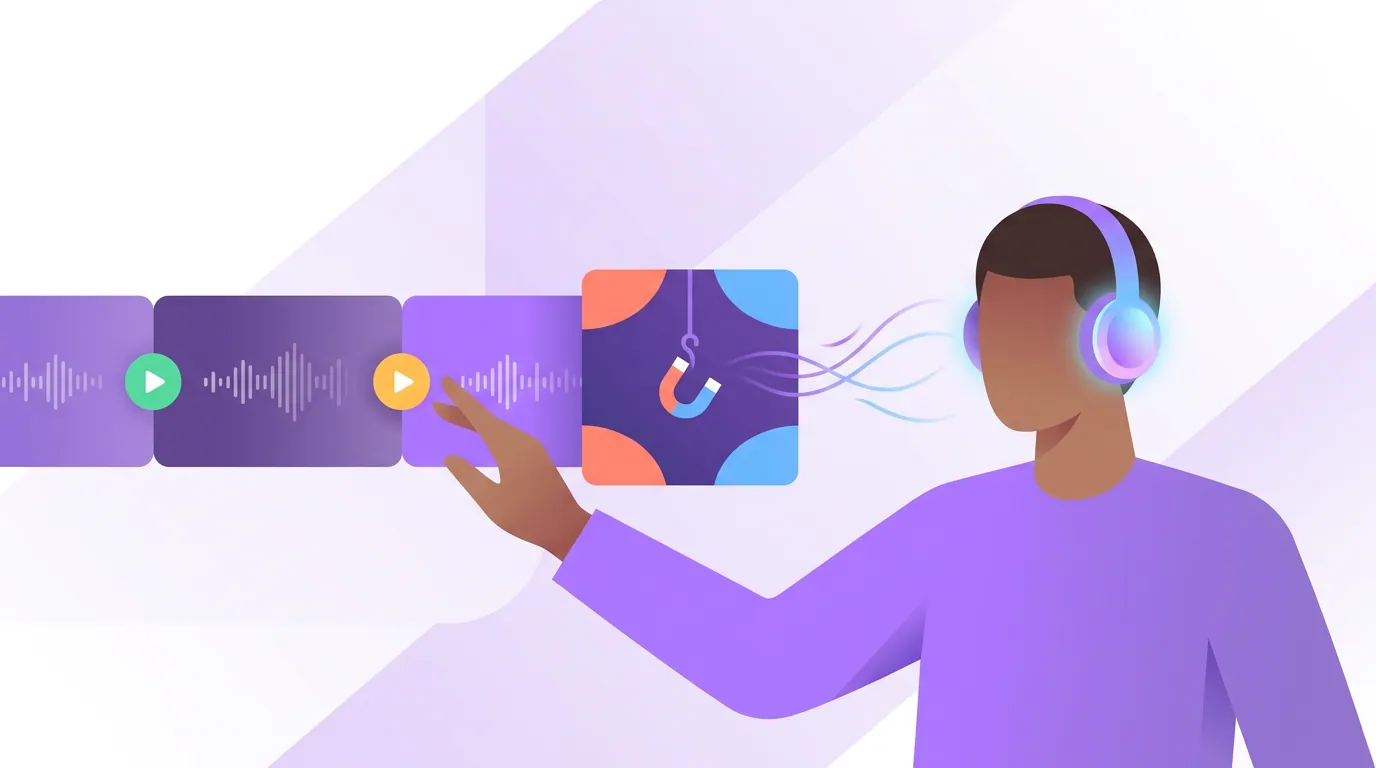
Structure decides what you say; timing decides whether it works. These are the rules I hold every cold open to, and they map directly to the budget in the diagram above.
- Seconds 0–8: the hook, and nothing else. No music, no name, no "welcome." The first words out are the most interesting thing in the episode. If your strongest line lives at minute 22, lift it to second one.
- Seconds 8–20: the promise. Tell the listener what they get for staying, the specific payoff, not "a great conversation." "By the end you'll have a three-line cold-email template that booked us four guests." Specific promises survive; vague ones don't.
- Seconds 20–30: the first proof. Give one concrete taste that the promise is real, a number, a one-sentence example, a surprising line from the guest. This is the deposit that makes the rest credible.
- Second 30 onward: now you may do admin. Theme music, your name, the show name, the sponsor. By now you've earned the seconds. Keep this block under 30 seconds too; nobody returned for your jingle.
One discipline most hosts skip: trim the dead air. Cut the breath, the "um," and the 1.5 seconds of silence before your first word in the edit. A cold open that starts a beat late reads as hesitation, and hesitation is the opposite of a hook.
The swipeable intro-hook script
Fill in the blanks before you hit record. It maps the seven structures onto the 30-second budget so you can build any episode's open in two minutes.
``` [0-8s · HOOK, pick one structure] Open loop: "By the end of this, you'll know ______, but first, ______." Contrarian: "Everyone says ______. For ______, that's the worst advice." Mid-conversation: "______ [the heated/funny line]." (beat) "Let me back up." Cliffhanger: "______ [the moment everything was on the line]. Here's what we did." Bold number: "We ______ and the result was ______. This is why."
[8-20s · PROMISE] "If you stay, you'll walk away with ______ [the specific, usable payoff]."
[20-30s · FIRST PROOF] "Here's a taste: ______ [one number, example, or surprising line]."
[30s+ · ADMIN, keep under 30s] "[Theme] · I'm [name], this is [show]. Today, [guest/topic]." ```
Three mistakes this script is built to prevent. First, leading with "welcome back" before the hook, that's the most common opening in podcasting and the easiest one to beat. Second, making a promise the episode never keeps; the open-loop structure is the worst offender, so only open loops you actually close. Third, a sponsor read inside the first 30 seconds, move it to a natural break after the hook, where a paying listener is far more likely to still be there.
Common mistakes that kill a good hook
- The two-minute housekeeping ramp. Catch-ups, ad reads, and theme music up front are the single biggest killer. Move all of it past second 30. Your most loyal listeners will forgive a fast intro; your newest ones won't forgive a slow one.
- A hook with no follow-through. A great open loop followed by a flat episode is a trust withdrawal. The hook sets a bar; the body has to clear it.
- Over-producing the open. A whoosh, three sound effects, and a dramatic voiceover can feel like a parody. The raw, well-chosen line usually beats the polished one. Production is seasoning, not the meal.
- The same hook every week. Listeners pattern-match fast. Rotate the seven structures so the open stays a surprise instead of a formula they learn to skip.
- Forgetting the visual. If you publish to YouTube or post clips, the first frame is part of the hook. A static logo card for eight seconds undoes everything your audio just did. Open on a face mid-sentence, not a splash screen.
How to find your hook inside an episode you already recorded
You rarely need to script the perfect line in advance, you usually need to find it in the recording. Listen back and mark every moment you'd quote to a friend: the surprising number, the unguarded confession, the line that made you both laugh. One of those is your cold open. Lift it to the top, write the promise and proof around it, and re-record only the 30-second intro.
This is also the exact muscle that makes your clips work. The moment that earns a cold open is, almost always, the moment that earns a social clip, the line strong enough to stop a scroll is strong enough to stop a skip. Hosts who run a clip workflow get a second benefit: every episode you mine for clips surfaces three to five candidate hooks for free. For the discovery side of that loop, a podcast lead magnet that converts turns the listeners a strong hook earns into subscribers you own.
FAQ
How long should a podcast cold open be? Keep the cold open itself to 30 seconds or less: roughly 8 seconds of hook, 12 seconds of promise, 10 seconds of first proof, then your intro. Longer than 30 seconds and you're back to the slow-ramp problem you were trying to avoid. The goal is to buy the next stretch of attention, not to deliver the whole episode up front.
Should every episode have a cold open? Yes for almost every show, with one caveat: rotate the structure so it doesn't become a predictable formula. Listeners learn to skip a hook they hear in the same shape every week. Use the seven structures above as a rotation, and let the episode's strongest natural moment pick which one fits.
Where does the intro music go if the hook comes first? After the cold open, around the 30-second mark. Theme music, your name, the show name, and any sponsor read all belong in the admin block that runs once the hook has earned the listener's attention. Front-loaded music is the most common reason a good episode loses people before the content starts.
Do cold opens help my podcast grow, or just retain listeners? Both. A strong open improves completion, and completion is a signal most platforms reward. It also fuels discovery: the moment that earns a cold open usually earns a great social clip, and 57% of listeners now rely on social media for podcast recommendations, the first time that has surpassed friends and family (InsideRadio, "The State of Video Podcasting 2025").