
Why Food Podcasts Have to Win on Video First


A food podcast grows fastest when you stop treating it as audio with a feed and start treating it as video that happens to have a great conversation in it. Record the cook and the dish on camera, cut the most appetizing 20-to-45-second moments into captioned vertical clips, and use a free recipe to turn a viewer into a subscriber. Your subject is the most scroll-stopping thing on the internet. Audio-only throws that away.
That is the core argument, and it is specific to your niche. A finance show can survive on talking heads because the value is the information. Food cannot, because half the value is the thing on the plate, the sear, the pull of melted cheese, the knife through a crust. When you publish food as audio only, you ship the one category where the picture is the hook and then hide the picture. Strangers scrolling a feed decide in three seconds whether to stop; for a food show, the dish is your three seconds.
The audience has already moved to watching. Among new US weekly podcast listeners, 53% now prefer to watch a show rather than only listen, up from 30% in April 2022 (Backlinko). YouTube now reports more than one billion monthly podcast viewers worldwide (Variety, Feb 2025). For food, that shift is not a trend to watch, it is the whole opportunity, because your raw material was always visual.
Why audio-only is a handicap for food specifically
Food sells on appetite appeal, and appetite appeal is visual. Describe a perfectly roasted chicken on a microphone and you get words; show it and the viewer's mouth waters. That reaction is what makes a stranger stop scrolling, and it is the one growth lever a cooking show has that a chat show does not.
There is a second reason that is mechanical, not philosophical. Most social video is watched on mute, commonly cited at 75-to-85% (Sharethrough reported ~75% of people keep their phone muted with video playing; Digiday reported ~85% of Facebook video watched without sound, both publisher-reported and directional). A muted clip of two people talking about food is dead air with faces. A muted clip of hands deglazing a pan, with a caption naming the dish, still works completely. Visual food content survives the conditions short-form video is actually consumed in. Audio-only does not.
So the honest framing is this: you are not "starting a YouTube channel for your podcast." You are recognizing that for food, the clip is the product and the episode is the long version people binge after a clip hooks them. The same logic applies across niches, it is why comedy podcasts grow by getting clipped, but food has the strongest claim to it, because nothing on a phone screen converts attention like a good-looking plate. For the line-level editing mechanics, our food podcast clips strategy guide goes deeper than this growth piece does.
Move 1: Shoot for the dish, not just the conversation
The single change that does the most work is pointing a camera at the food. Most food podcasts that record video frame two people at microphones and never show the thing they are talking about. That gives you a talking-head clip in the one niche where talking heads are the weakest possible cut.
Set up a second angle on the cooking surface or the plated dish, an overhead phone on a cheap arm is enough to start. You do not need a film crew. You need the moment of the sear, the pour, the slice, the first bite reaction. Those are your hooks. When you sit down to cut, you want every appetizing few seconds available as a clip candidate, not lost off-frame.
Keep clips to 20-to-45 seconds, sitting near the short end of the workable 30-to-90-second podcast-clip window (castmagic). Lead with the most visually arresting frame in the first three seconds, the finished dish or the most dramatic step, not "hey everyone, welcome back." A 30-to-40-minute cooking episode usually holds enough of these visual moments for a week or two of posts; treat that as a rule of thumb, not a fixed count, because a single-recipe deep-dive yields fewer clips than an episode that covers five dishes.
Clips do real work here. For video shows they drive an estimated 20-to-40% of new audience and can lift reach two-to-five times (Podcast Studio Glasgow). And social media has, for the first time on record, overtaken friends and family as the top way people discover podcasts, 57% now cite social versus 54% personal recommendations, a shift researchers attribute to video and clips (Inside Radio). Both figures are directional, not guarantees, but for a category as shareable as food, the direction is favorable.
Move 2: Run the recipe-as-lead-magnet loop
A view is not a listener, and a follow is not an email. The recipe loop closes that gap, and it is a tactic food podcasts can run that almost no other niche can: every episode produces a deliverable people genuinely want, the recipe.
Here is the loop. A clip shows the dish and earns the stop. The caption and pinned comment say "full recipe card free, link in bio." The link goes to a one-field email capture, not a wall of text. The recipe lands in their inbox, and the welcome email points them to the full episode where you explain the why behind every step. You have converted a three-second mouth-water into an email address you own and a listen you can repeat.
The recipe is the best podcast lead magnet there is because the desire and the delivery are the same object. People do not download a "growth checklist" with urgency; they download the cookie recipe they just watched come out of the oven. Build the mechanics with our guide to turning a podcast into a lead magnet, then capture and nurture with a podcast email list from zero and a welcome sequence for new subscribers. Email matters more than usual here because a platform can throttle your page overnight, and a recipe-hungry list cannot be taken away from you.
Move 3: Partner with food creators whose video carries your audio
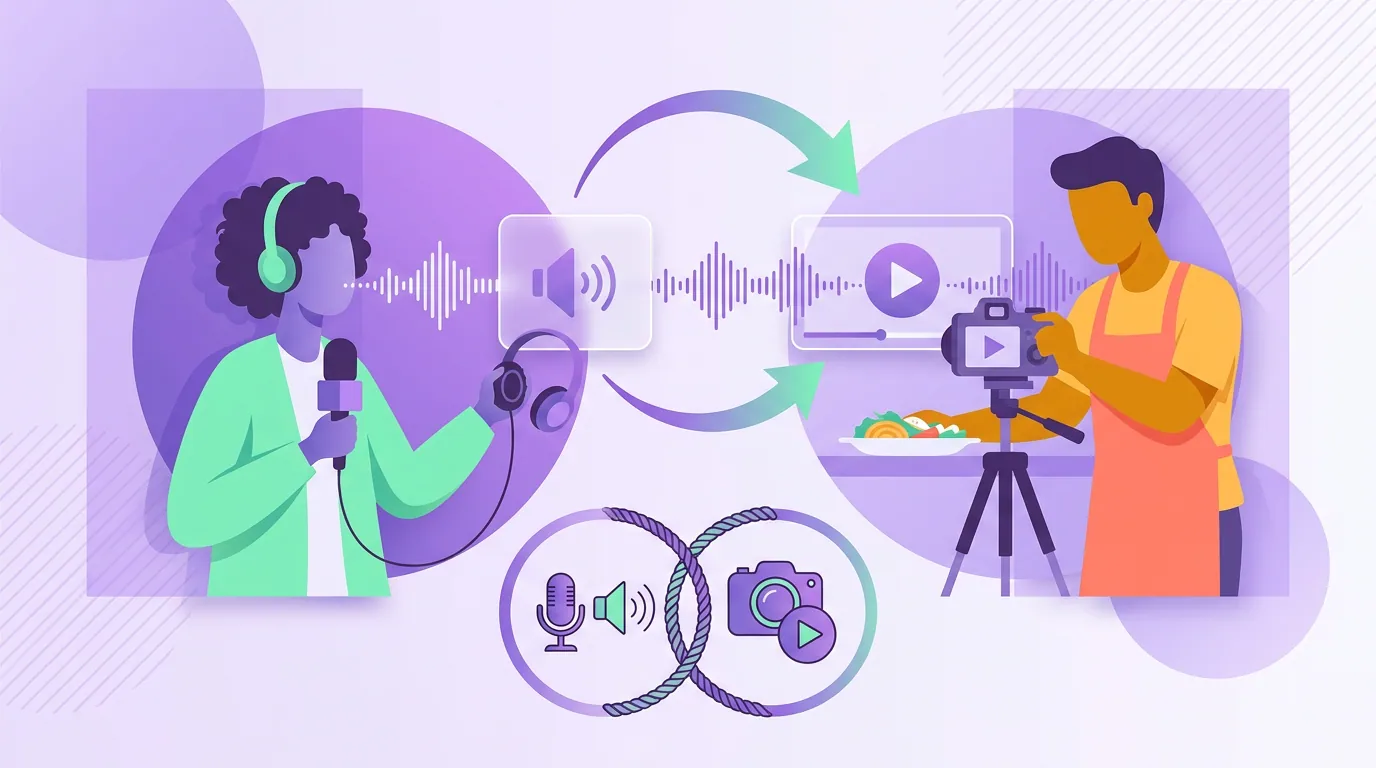
The third move borrows reach you have not built yet. There is an enormous population of food creators on TikTok, Reels, and YouTube whose entire skill is making food look irresistible on camera, and most of them do not host a podcast. You have the long-form conversation and the depth; they have the visual reach and the audience. That is a trade.
Concrete versions of the trade: invite a creator on as a guest, then let them cut and post the clips to their own audience under their handle. Co-cook a single recipe where they film their angle and you film yours. Or simply give a creator permission to clip your back catalog in exchange for a credit and a link. Their video carries your audio to people who would never have found a podcast feed. This is the food-niche version of a broader truth, that business podcasts grow by booking the right guests before chasing listeners, applied to a category where the partner's camera work is the asset you are borrowing.
Pick partners by audience overlap and visual quality, not raw follower count. A creator with 40,000 engaged home cooks who films beautifully is worth more to a food show than a 500,000-follower account whose audience would never sit through a 40-minute episode.
Common mistakes that stall food podcast growth
- Recording video but never showing the food. Two faces at mics is the default setup, and it is the wrong one for food. If a viewer cannot see what you are cooking, you have a chat clip in the one niche where the dish is the hook.
- Captioning poorly, or not at all. Muted viewing is the norm, so a clip that depends on tone of voice loses most of its punch. Name the dish on screen in the first second and keep the captions tight and readable on a phone.
- Treating the recipe as an afterthought. The recipe is your strongest lead magnet, not a nice-to-have in the show notes. Build the email capture around it deliberately, or you leave the easiest conversion a food show has on the table.
- Chasing one viral clip instead of a rate. A single breakout feels like growth and rarely converts. Post three to five clips a week so a stranger who likes one finds two more and a reason to follow. Virality without strategy is empty engagement, views are not subscribers.
- Posting the same horizontal cut everywhere. A wide kitchen shot crops badly to vertical and buries the dish. Reframe to 9:16 with the food centered, not the host's torso.
FAQ
Do I really need video to grow a food podcast? Practically, yes. Among new US weekly listeners, 53% prefer to watch (Backlinko), and food is the category where the visual is the hook. An audio-only food show can still grow with captioned audiograms, but it is competing with one hand tied, you are hiding the most shareable thing you produce.
What should I actually film if my budget is tiny? One overhead angle on the cooking surface, plus your existing host camera. An overhead phone on a cheap arm captures the sear, the pour, and the plating, the moments that make people stop. You do not need studio lighting to start; you need the dish in frame.
How many food clips should I post per week? Three to five short clips is the workable range for a growing show. Below three you rarely gather enough data to learn which dishes travel; above seven, quality usually slips unless you have help. Start at three, hold the cadence, and raise it only when your view-through rate stays steady.
Why is a recipe a better lead magnet than a checklist? Because the desire and the deliverable are the same object. Someone who just watched your cookie come out of the oven wants that exact recipe right now. The wanting is built into the clip, so the email capture converts far better than a generic download bolted onto an unrelated topic.
Should I edit food clips by hand or use AI clipping? AI clipping is the fastest way to surface candidates across a whole episode and add captions, but no clipper is hands-off, plan on a human review pass over every cut. For food, your job in that review is making sure the clip leads with the dish, not the dead air before it, let the tool find and caption, then you pick the cut that looks the most appetizing.