
Get Your Podcast Cited in Google AI Overviews


To get your podcast cited in a Google AI Overview, you need a page Google can quote: a public episode page with a clean transcript and show notes, where the answer to a specific question sits in one self-contained paragraph near the top. AI Overviews don't read your audio. They extract sentences from your text. Make the text liftable.
That is the whole game, and most shows lose it before they start, because their episode "page" is a player embed and a two-line description hosted on a platform that gives the AI nothing to chunk. The fix is not a trick or a schema. It is structure on a page you actually control.
How do Google AI Overviews choose what to cite?
AI Overviews are generated by Gemini, which breaks your search into several sub-queries (Google calls this query fan-out), pulls passages from indexed pages that answer each one, and stitches them into one answer with citation links. It scores passages, not whole pages. A clean, self-contained paragraph that directly answers a sub-query is what gets quoted.
Two findings from 2026 reshape how a podcaster should think about this. First, top rankings matter less than they did. Ahrefs analyzed 863,000 keyword SERPs and 4 million AI Overview URLs and found only 38% of cited pages also rank in the organic top 10, down from roughly 76% in mid-2025 (Ahrefs, March 2026). Ahrefs is candid that part of that drop is better citation parsing on their end, so treat it as directional, not gospel (Search Engine Journal, 2026). Still, the direction is clear: a page can be cited without being the number-one result, which is good news if you are not yet ranking.
Second, position inside the page is decisive. Research from Wix/Evertune on where LLMs lift their quotes found 44.2% of citations come from the first third of a document, 31.1% from the middle, and 24.7% from the final third. Your intro and the first paragraph under each heading are doing nearly half the citation work.
Look at that chart again with a podcaster's eyes. YouTube is the single most-cited domain in AI Overviews at 20.9% of citations, and Reddit is right behind at 19.6% (Ahrefs, June 2026). You can be on both. A video podcast on YouTube, with a real transcript and chapters, is sitting on the most-cited surface on the web. That is the under-discussed reason video matters here, separate from raw reach, and YouTube already passed a billion monthly podcast viewers (Variety, Jan 2025).
Why does this matter for a podcast specifically?
Because your episode is an hour of spoken answers to questions people type into Google, and right now almost none of it is text Google can read. Audio is opaque to the AI. The transcript and the page around it are the only parts that get chunked, scored, and quoted. Publishing them turns one episode into dozens of liftable passages.
This is the same shift that already changed regular search, just sharper. AI search now handles a meaningful slice of informational queries, and the pages that win are the ones that hand the model a clean answer. A guest of yours says something genuinely useful at minute 34, "the first thing a new landlord gets wrong is screening too late", and if that sentence lives on an indexed page near a clear heading, it can become the cited answer when someone searches "common new landlord mistakes." If it stays locked in the audio, it cannot.
One honest caveat before the steps: this is a slow, compounding lever, not a viral one. Citations follow indexing and ranking, so expect the same lag you would from any SEO change, weeks before the first ones show, months before a steady rate. Treat it like SEO, because it is SEO with a new front end.
The answer-first episode page: a pattern you can copy
Here is the part no one hands you. Build every episode page so its passages are individually quotable. This is the information-gain piece, an exact template, not a vibe. Each episode page gets seven blocks, in this order.
- The episode H1, written as a real query. Not "Episode 47 with Jane Doe." Use the question the episode answers: "How to screen tenants without a property manager." Your episode title is your biggest discovery lever; if titling is new to you, start with writing podcast episode titles that get found.
- A 40–60 word answer paragraph, immediately. Before the player, before "in this episode," answer the title question completely in one liftable paragraph. The model can quote this verbatim. Keep it self-contained, no "as we discuss below."
- Three to five question H2s, each with its own 40–60 word answer. Pull the real questions the episode covers and make each its own heading with its own clean answer beneath it. Every H2 is a separate citation candidate, and each gets its own self-contained paragraph the model can lift without the rest of the page.
- The full transcript, cleaned. Run the raw transcript through one pass: fix the obvious mis-hears, add speaker labels, break it into paragraphs. A wall-of-text auto-transcript is technically there but hard to chunk. For the deeper version of this, see show notes that rank on Google.
- A pulled-quote block of two or three of the best lines. Verbatim, attributed to the speaker. These are dense, quotable, and exactly the kind of statement AI Overviews favor, definitive sentences from a named source.
- A short, dated "key takeaways" list. Five bullets, each a complete claim. Add a visible "Updated: [date]." Freshness is a long-standing ranking input, and what ranks feeds what gets cited, so a genuine refresh when a guest's advice ages is worth doing.
- Internal links to two or three related episodes. AI Overviews lean toward deeply nested pages with topical support around them, not orphan posts.
Common mistakes that keep podcasts out of AI Overviews
The errors here are consistent, and each has a clean fix.
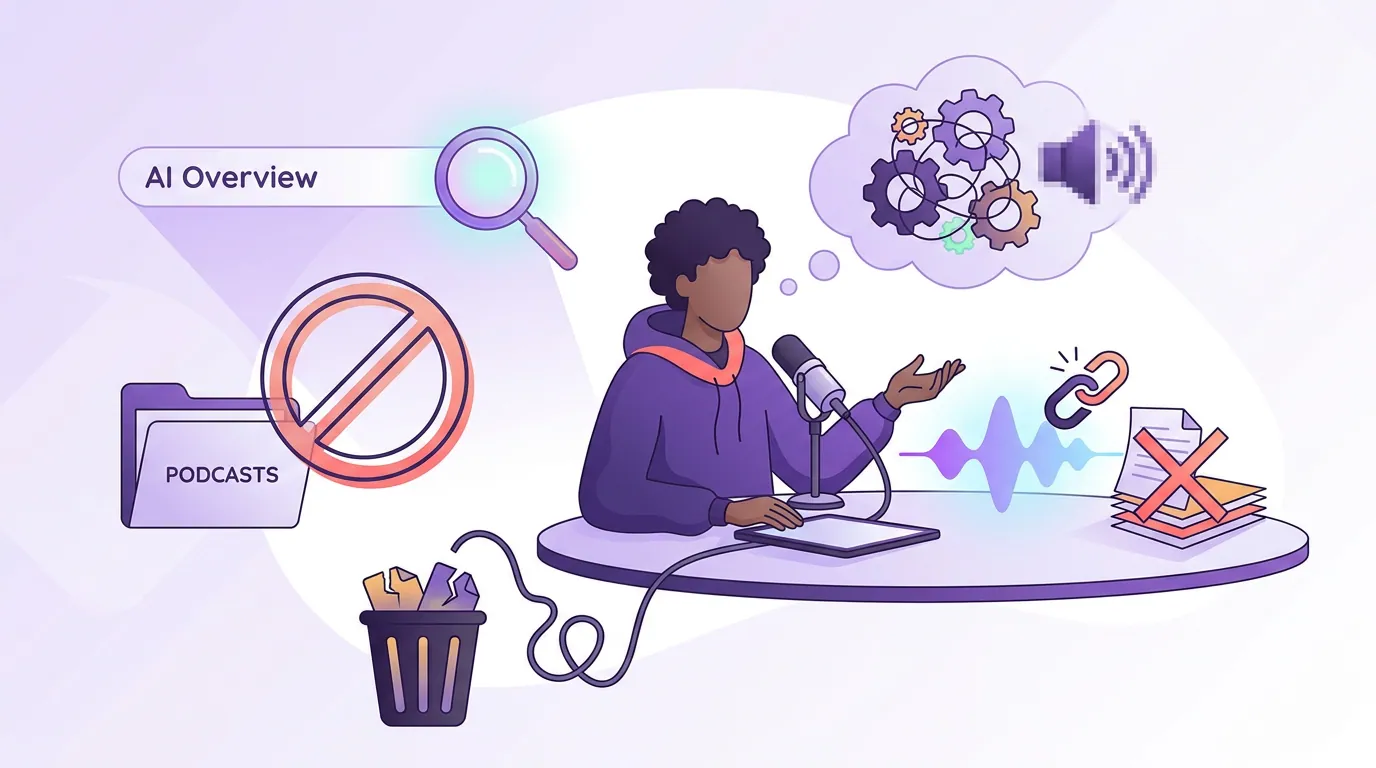
- Only a player embed and a two-line description. The AI has nothing to chunk. Fix: publish a real episode page with the transcript and the seven blocks above.
- The transcript lives only on Spotify or Apple, not a page you own. Those platforms rarely surface a quotable URL Google indexes. Fix: host the canonical transcript on your own site; let the platforms be the player. The platform-search side is its own discipline, see how Apple Podcasts search ranking works and Spotify podcast SEO.
- Burying the answer under "in this episode we sit down with." That throat-clearing is exactly what does not get quoted, and it pushes your real answer out of the high-citation top third. Fix: answer the title question in the first paragraph.
- Chasing FAQ schema for a SERP shortcut. Google ended FAQ rich results in May 2026 (Search Engine Land). Keep a visible FAQ for readers and AI, but don't expect the markup to win you anything. Honest structure beats stale schema.
- Publish-and-forget. Freshness is a real citation signal. Fix: when a guest's number or recommendation ages, update the page and the date, a genuine edit, not a date swap.
How do you know if it's working?
As of June 3, 2026, Google Search Console has a dedicated generative AI performance report that shows how often your pages appeared inside AI Overviews and AI Mode, broken down by page, country, and date (Google Search Central, June 2026). The catch: it shows impressions only, no clicks, CTR, or query data yet, and the rollout is staggered. Read it as a resonance signal: a page with rising AI impressions is content the model finds worth citing.
Until that report reaches you, do the manual check. Search your target questions in Google, expand the AI Overview, and look at the cited links at the bottom. Cross-reference with your standard Performance report: a query gaining impressions but losing clicks usually means an AI Overview has appeared and is absorbing the answer. Those are the queries to restructure first.
FAQ
Can an audio-only podcast get cited in AI Overviews? Yes, but only through its text. The AI cannot read your audio, so an audio-only show needs a published transcript and answer-first show notes on an indexed page. With those, an audio podcast competes on equal footing, the citation comes from the page, not the file.
Do I need to rank number one to get cited? No. Ahrefs found only 38% of AI Overview citations come from top-10 ranking pages, down from about 76% in mid-2025 (Ahrefs, March 2026). Query fan-out lets clear, well-structured passages get cited from lower positions. Strong ranking still helps; it is no longer the only path.
Is YouTube or my own website better for AI citations? Both, for different reasons. YouTube is the most-cited domain in AI Overviews at 20.9% (Ahrefs, June 2026), so a video episode with a transcript and chapters is valuable. Your own episode page gives you control over structure and internal links. Publish on both.
Does schema markup get my podcast into AI Overviews? Not on its own. Google says pages need to be indexed and eligible for standard snippets, there is no special AI markup. Keep your structured data accurate and aligned with the visible page, but spend your effort on answer-first writing, not schema tricks.
How long until I see citations? Plan on weeks, not days. Citations depend on Google re-indexing the page and on it ranking for the sub-query, so the lag mirrors any SEO change: expect weeks before the first citations appear and months before a steady rate, with already-ranking pages moving fastest. It compounds like SEO, because it is SEO.