
Getting Your First Podcast Review (and Why It Matters)


Your first review almost never arrives on its own, you get it by asking one real listener, by name, to do one specific thing on the platform where it is easiest for them. The fastest path is a Spotify star tap from someone who already listens; the most valuable is a written Apple review you can screenshot and show off. Pick a person who has told you they liked an episode, give them the exact action, and the first one shows up within a week.
The reason this milestone feels disproportionately good is that it is the first time a stranger, or a friend doing it publicly, vouches for your show where other people can see it. Downloads are private numbers only you watch. A review is a person putting their name next to yours and saying "this is worth your time." That is a different kind of proof, and it changes how the next browsing listener decides.
What does the first review actually mean?
The first review means your show now has social proof, not a ranking boost, and most shows never get even that. A review page that is blank tells a browsing stranger nothing; a single specific review tells them a real human finished an episode and chose to say so. That shift, from zero to one, does more for a cold visitor's decision than going from ten reviews to eleven ever will.
Be clear-eyed about the limit, because plenty of guides oversell it. Apple states plainly that ratings and reviews do not influence Charts or Search (Apple Podcasts for Creators). Your first review will not move you up a chart or surface you in more searches. It is a conversion asset, it helps turn a visitor who already found you into a listener, and a feedback channel. Treat it as the star rating on a product page, not as a growth engine.
Why most shows have zero reviews (and it is not the quality)
A near-empty review page is the default, not a failure signal. The path from "I'd happily review this" to a posted review is several taps long on a phone, in an app the listener opened to listen, not to type, and most people abandon it not because they dislike the show but because they were never asked to do the one specific thing. Reviews are rare across the whole medium, so a blank page does not mean you are behind.
It helps to remember the field you are in. Nearly half of all podcasts stop at three episodes or fewer Amplifi Media, so most shows never publish enough to accumulate a single review. If you are still releasing episodes and reading this, you are already in the minority that lasted long enough to earn one. The first review is less a quality verdict than a sign you reached the stage where asking finally pays off, roughly the same place you cross your first 100 listeners.
The first-review tactic kit
Getting the first one is not the same job as building an ongoing review machine. You do not need volume yet, you need one. Work this kit in order; each step is something you can do this week.
- Pick one named person, not "the audience." Think of a specific listener who has already told you they liked an episode, a reply, a DM, a friend who quoted it back to you. The first review comes from a person, so address a person. A broadcast "please review the show" to people who have not heard it goes nowhere.
- Ask for the easiest action on their platform. If they listen on Spotify, ask for a tap on the star rating, no typing, ten seconds. If they listen on Apple, ask for a short written review, because that is the one you can quote later. Match the ask to where they already are. (The exact taps for each platform live in how to get reviews on Apple and Spotify.)
- Hand them the destination, not directions. Don't read a long URL or describe a menu path. Send a single short link by DM or text. On Apple you can append
?action=write-reviewto your show URL to open the review box directly, test it on a real iPhone first, since it is a community convention rather than a documented Apple feature. - Give the reason out loud. Apple's own guidance is to tell listeners why a review helps, feedback, discovery, an engaged audience (Apple Podcasts for Creators). "It's the first thing a new listener sees, and it genuinely helps an independent show" converts far better than a bare "leave a review."
- Then add it to every episode. Once you know the ask works on one person, fold it into the show, a brief mention near the start, one woven into the middle, a fuller version at the end (The Podcast Host). New listeners weren't there for last week's ask, so the ask is permanent.
A note on Spotify worth knowing before you ask: it collects a 1-to-5 star rating only, no written review, and a listener must have played an episode before the app will let them rate (Castos). So a Spotify ask only lands on people who already listen, which is exactly who you want. If you tell a mixed audience to "review on Spotify," some will open the app, find no review box, and quit. Aim each ask at the right platform.
The screenshot-and-feature loop
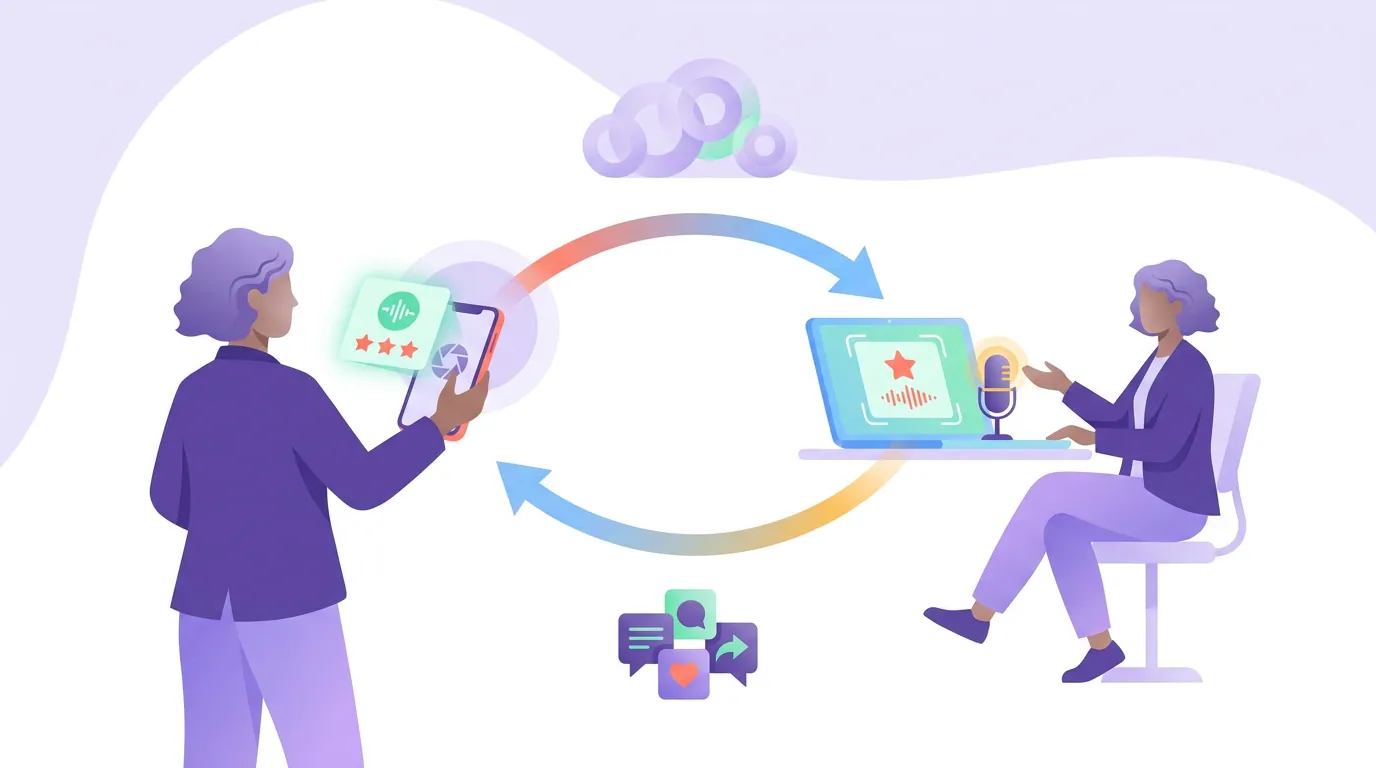
The single best thing you can do with review number one is make it recruit number two. When the first review lands, screenshot it, read it aloud on the next episode with a genuine thank-you, and post it as a clip or quote card where your show already lives. This does two jobs: it shows the rest of your audience that reviewing is a thing people here actually do, and it makes the reviewer feel seen, which is how you turn one quiet listener into a vocal advocate.
The loop is simple and it compounds. Each featured review lowers the barrier for the next person, because "leave a review" stops being an abstract request and becomes "do the thing that got read out last week." Treat your first review as a template you put on display, not a trophy you file away.
What the first review changes, and what it doesn't
It changes the conversion math, not the chart. A browsing stranger who lands on a blank review page has only your title and cover to judge; the same stranger reading one specific review has a reason to tap play. That is real, and it is why a single early review is worth chasing. But it will not surface you to people who have not already found you, that job belongs to distribution. Clips drive 20–40% of new audience for video shows and can raise reach 2–5x (Podcast Studio Glasgow), and 57% of listeners now rely on social media for podcast recommendations (InsideRadio, "The State of Video Podcasting 2025"). Reviews close the listeners that distribution brings in; they rarely create them.
So hold both truths at once. Chase the first review because it is the first public vote for your show and a feedback gift you cannot get from a download number. Do not over-rotate on review count as a growth metric, because it isn't one. The wider mechanics, every tap, every platform, the once-versus-ongoing math, are covered in our full guide to getting podcast reviews.
What the first review actually feels like: out of proportion to its size, and that is correct. You will reread it more than once. Someone you may never meet finished an episode and chose to say it mattered. Mark it, screenshot it, thank them by name, and cut a short clip of the moment they were reviewing so the next listener gets the same reason to start. Then keep asking, because the second review is always easier than the first. When the show is ready for the next stretch, the 100-to-500 playbook covers the channels that begin to compound.
FAQ
How do I get my first podcast review? Ask one specific listener who has already told you they liked an episode, and give them the single easiest action on their platform, a Spotify star tap, or a short Apple written review opened with a deep-link. Tell them why it helps. A named, specific ask lands the first review far faster than a broadcast plea to people who haven't listened.
Do podcast reviews matter for ranking? Not for the charts. Apple states ratings and reviews do not influence Charts or Search (Apple Podcasts for Creators). They matter as social proof that converts a browsing stranger into a listener, and as direct feedback. Listening velocity and completion move rankings; reviews close the new people distribution sends you.
Where is it easiest to leave a first review? Spotify, for speed, it is a single star tap with no typing, though it is stars only and mobile-app only, and the listener must have played an episode first (Castos). Apple takes more taps but lets people write words you can screenshot and quote, which is the more valuable first review to chase.
How long until I get my first review? Usually within a week once you ask a specific person directly, rather than waiting for reviews to arrive on their own. Most shows have zero reviews simply because nobody was asked the right way, not because listeners dislike them. The first one is an asking problem, not a quality problem.
Should I worry that my show has no reviews yet? No. A blank review page is the default across podcasting, partly because nearly half of shows stop at three episodes or fewer Amplifi Media and never reach the asking stage. If you are still publishing, you are positioned to earn reviews the moment you start asking listeners by name.