
How to Build a Podcast Community With Facebook Groups


A Facebook Group grows a podcast when you treat it as a place your listeners talk to each other, not a place you broadcast at them. Start one after you have a small base who finish episodes, roughly 50 to 100 engaged listeners. Run it on a fixed weekly prompt schedule and moderate it lightly but consistently.
Do that for a few months and the Group becomes the most reliable source of repeat plays, reviews, and shareable clips you have. Most hosts get this backwards. They create the Group on launch day, post "New episode is live" three times a week, and watch it go silent. A feed of release announcements is not a community. It is a second RSS feed nobody asked for. The Group earns its keep only when members are talking, and your job is to give them a reason to, on a schedule, with guardrails.
This is the framework: a readiness test, the engine that turns a Group into superfans, a five-prompt week you can run on autopilot, three moderation rules, and the path from member to reviewer.
When should you start a Facebook Group for your podcast?
Start a Group when you have enough engaged listeners to seed a conversation, about 50 to 100 people who finish your episodes, and when you can commit to showing up several times a week for at least three months. Below that base, a Group reads as an empty room, and an empty room repels the few people who do join.
The number that matters is not your download count. It is how many people would notice if you stopped publishing. Ten devoted listeners beat a thousand passive ones for seeding a Group, because devoted listeners reply, and replies are what new members see when they arrive. Social media now drives podcast discovery more than friends and family do: 57% of listeners rely on social media for podcast recommendations, narrowly ahead of the 54% who rely on friends and family, the first time social passed personal referrals (InsideRadio, "The State of Video Podcasting 2025"). A Group is where you turn that social attention into a relationship instead of a one-time view, and it converts TikTok and other social followers into actual listeners better than a passive feed does.
Run this five-question readiness test before you create anything:
- Do you have 50+ listeners who finish episodes? If not, grow the show first; a Group can't manufacture an audience you don't have.
- Can you post and reply four to five days a week? Honestly. A Group that goes quiet for two weeks is harder to restart than to start.
- Is Facebook where your listeners actually are? Skews older and broader. If your audience is under 25, a Discord or Reddit community will out-perform it, see where to build a podcast community across platforms before you commit.
- Do you have a clear theme people would gather around? "Fans of my show" is weak. "People navigating a career change" or "indie game devs" is a reason to stay.
- Will you let members talk to each other, not just to you? A Group is horizontal. If you want a broadcast channel, use a Facebook Page or a podcast email list instead.
If you answered no to two or more, you are early. That is fine. Note the date and revisit when the show is steadier.
What makes a Group a "superfan engine"?
A Group becomes a growth engine when it runs a loop: a casual follower joins, talks, becomes a repeat listener, then a reviewer and a clip-sharer, and their visible activity pulls the next casual follower in. Each member who posts makes the room look alive, which lowers the bar for the next member to post. That compounding is the whole point.
Think in three conversions, not one. Joining the Group is the first. Becoming someone who actually listens every week is the second, and far more valuable. Becoming someone who leaves a review or shares a clip is the third, and it is where your reach quietly grows without you posting more. Clips drive an estimated 20–40% of new audience for video shows (Podcast Studio Glasgow), and a warm Group is the easiest place to seed them, because members share to people who trust them. (For the discovery side of that loop, see the TikTok growth playbook.)
The honest caveat: this loop is slow. It runs on months, not weeks, and it dies the moment you stop showing up. A Group is not a growth hack. It is a relationship you maintain, and the payoff is the steadiest audience you will ever have.
How do you set up the Group so it grows itself?
Set it up to lower friction for talking and raise friction for spam. Three settings do most of the work: make it Private and Visible so people can find it but content stays members-only, turn on membership questions to filter joiners, and write a pinned welcome post that tells new members exactly what to do in their first minute.
The build, in order:
- Name it for the theme, not the show. "The [Topic] Circle" or "[Audience] Who [Do Thing]" pulls in people searching for the subject. "Fans of [My Podcast]" only pulls people who already know you. Put the show name in the description, not the title.
- Set three membership questions. Ask how they found you, what they want from the Group, and require agreement to one rule (no self-promo without permission). This single step blocks most spam accounts and gives you a built-in conversation starter for every new member.
- Write a pinned welcome post with one action. Not a wall of rules. "Welcome, drop a comment telling us the one thing you're working on this month." Getting that first comment is the single best thing you can do for retention: a member who has posted once is far likelier to come back than one who only lurked.
- Approve members in small daily batches. Approving a wave at once buries their intro comments. A handful a day, each greeted by name, sets the tone that this is a place where people get noticed.
- Link the Group everywhere the show appears, show notes, episode end, your welcome email sequence, and your social bios. The Group should be the consistent next step you point people to.
Do not gate the Group behind payment at the start. A free Group is your top-of-funnel community; a paid tier is a later decision once you know what people will pay for.
A five-prompt week that keeps the Group alive
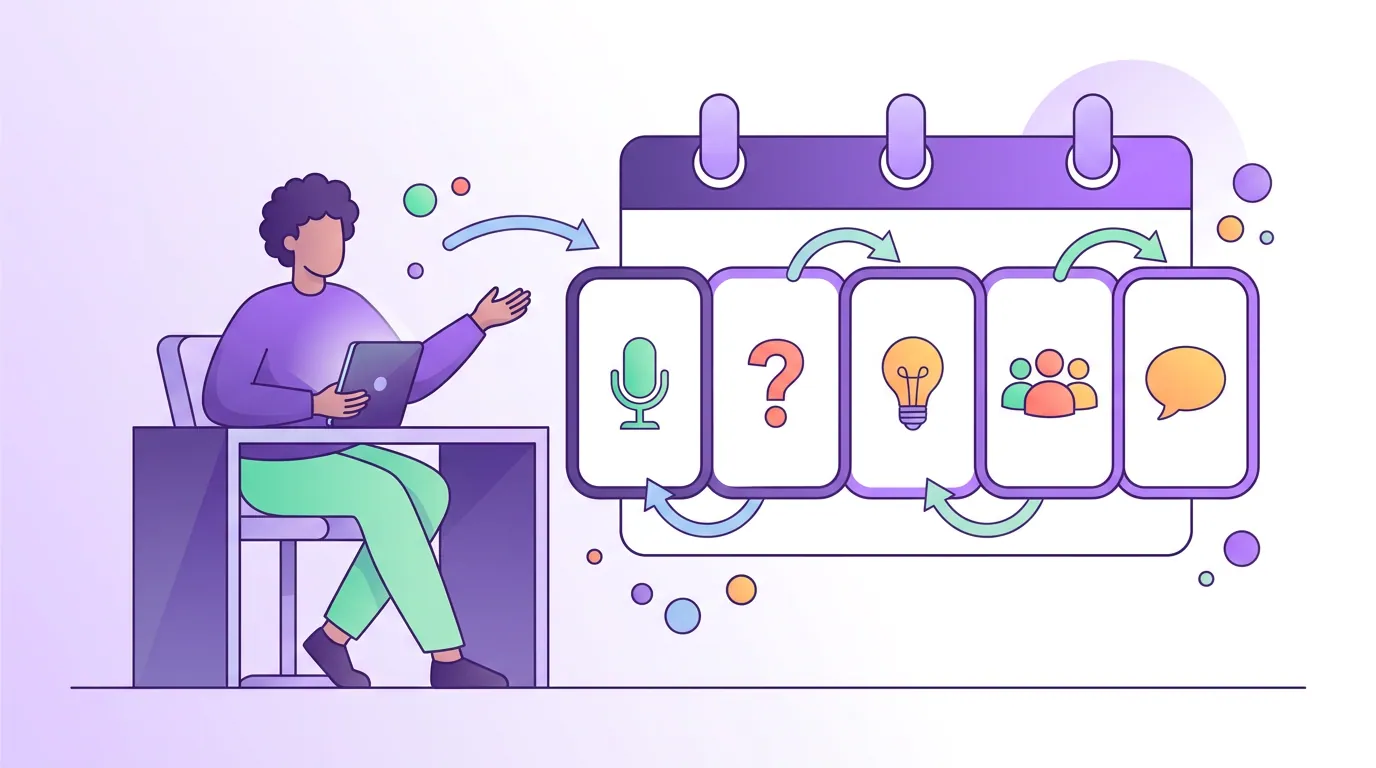
The hardest part of a Group is not starting it, it is the second month, when novelty wears off and you run out of things to post. Solve that with a fixed weekly rotation. Five recurring prompt formats, one theme per weekday, so you are never staring at a blank box. Members learn the rhythm and start showing up for it.
The mechanics that make it work:
- Monday, Question of the week. Open, theme-tied, no right answer. "What's the one habit that actually moved the needle for you this year?" The goal is replies, because a thread with twenty comments greets every visitor for the next six days.
- Tuesday, Episode discussion. Do not post "new episode is live." Post the single most interesting question the episode raised, then link it. You are selling the listen with curiosity, not announcing a release.
- Wednesday, Member spotlight. Feature one member's project, question, or win. This is the format that builds loyalty fastest, because being seen by the host is why people stay in a Group long after the novelty fades.
- Thursday, Quick poll. A one-tap poll re-activates members who lurk. Use the result in a future episode and tell them you did. Now the Group shapes the show, and they feel it.
- Friday, Clip and wins. Share that week's best clip and ask members to post their own wins from the topic. This is where sharing starts: members tag friends in a clip far more readily than in a text post.
Batch these. Write the week's five prompts in one 30-minute sitting and schedule them. Showing up to reply is non-negotiable and cannot be scheduled, but the prompts themselves should never be a daily decision.
Moderation guardrails that keep it from going toxic
Moderate with three standing rules and apply them the same way every time. A Group dies one of two deaths: silence, or a takeover by self-promoters and arguers. Consistent, light-touch moderation prevents the second without strangling the conversation that prevents the first.
The three guardrails:
- No self-promotion without a designated slot. Unchecked promo turns a community into a classifieds board and drives real members out. Give it one home, a weekly "share what you're working on" thread, and remove promo posted anywhere else, with a friendly DM pointing to the slot.
- Disagreement is fine; contempt is not. You are not policing opinions. You are policing how people treat each other. State the line in the pinned rules and enforce it on the first violation, publicly enough that members see the standard is real.
- Approve members, but trust them to talk. Pre-approving every post kills momentum, conversation needs to feel live. Approve people at the door (membership questions), then let posts flow and moderate after the fact. Recruit one or two trusted members as moderators once you pass a few hundred people, so the room is covered when you are recording.
The mistake to avoid: over-moderating into a ghost town. A few off-topic posts are the sound of a living room. Sterile is worse than messy.
How do Group members become reviewers and listeners?
You ask them directly, at the moment they are already engaged, and you make it specific and easy. A warm Group member will leave a review or share a clip when you give them a precise reason and a one-tap path, but only if you have spent months giving before you ask.
The ask, done well:
- Tie the ask to a moment, not a calendar. After an episode the Group clearly loved, post: "If this one landed for you, a one-line review on Apple or Spotify is the single biggest thing that helps new people find us." Ride the energy that already exists. For the mechanics of getting those reviews to actually post, see how to get podcast reviews on Apple and Spotify.
- Make it concrete. "Leave a review" is vague. "Tell one person what surprised you in this episode, in the review" gives them a sentence to write and a far higher completion rate.
- Convert listeners, not just members. A Group join is not a listen. Treat the Group as the top of your funnel and route members toward the deeper relationship, the show on repeat, then your email list. The same logic that turns TikTok followers into actual listeners applies here: a follow is attention; a subscribe is a habit.
- Thank publicly, every time. When a member shares a clip or leaves a review, name them in the Group. Recognition is the cheapest fuel you have, and it teaches the rest of the room what behavior earns a spotlight.
FAQ
How many members do you need before a Facebook Group is worth running? You need engagement, not headcount. About 50 to 100 listeners who finish episodes is enough to seed real conversation. Ten people who reply daily out-perform a thousand silent joiners, because the visible replies are what convince the next person to post.
Should a podcast use a Facebook Group or a Facebook Page? A Page is a broadcast channel, good for announcements and ads, one-directional. A Group is horizontal: members talk to each other, which is what builds loyalty. Use a Page for reach and a Group for retention. Most growing shows want both, but the Group is where superfans form.
Is Facebook the right platform for a podcast community in 2026? It depends on your audience age. Facebook Groups skew older and broader, which suits many shows. If your listeners are under 25, a Discord or Reddit community will likely out-engage a Facebook Group. Check where to build a podcast community before committing.
How often should you post in a podcast Facebook Group? Four to five days a week, on a fixed rotation of prompt formats so it never depends on inspiration. Posting once a week reads as neglect; posting only release announcements reads as spam. Replies matter more than posts, show up in the comments.
Should you charge for access to your podcast's Facebook Group? Not at the start. A free Group is your top-of-funnel community and your warmest source of reviews and shares. A paid tier is a later decision, made once you know what members value enough to pay for. Gating too early starves the loop that makes a Group worth anything.